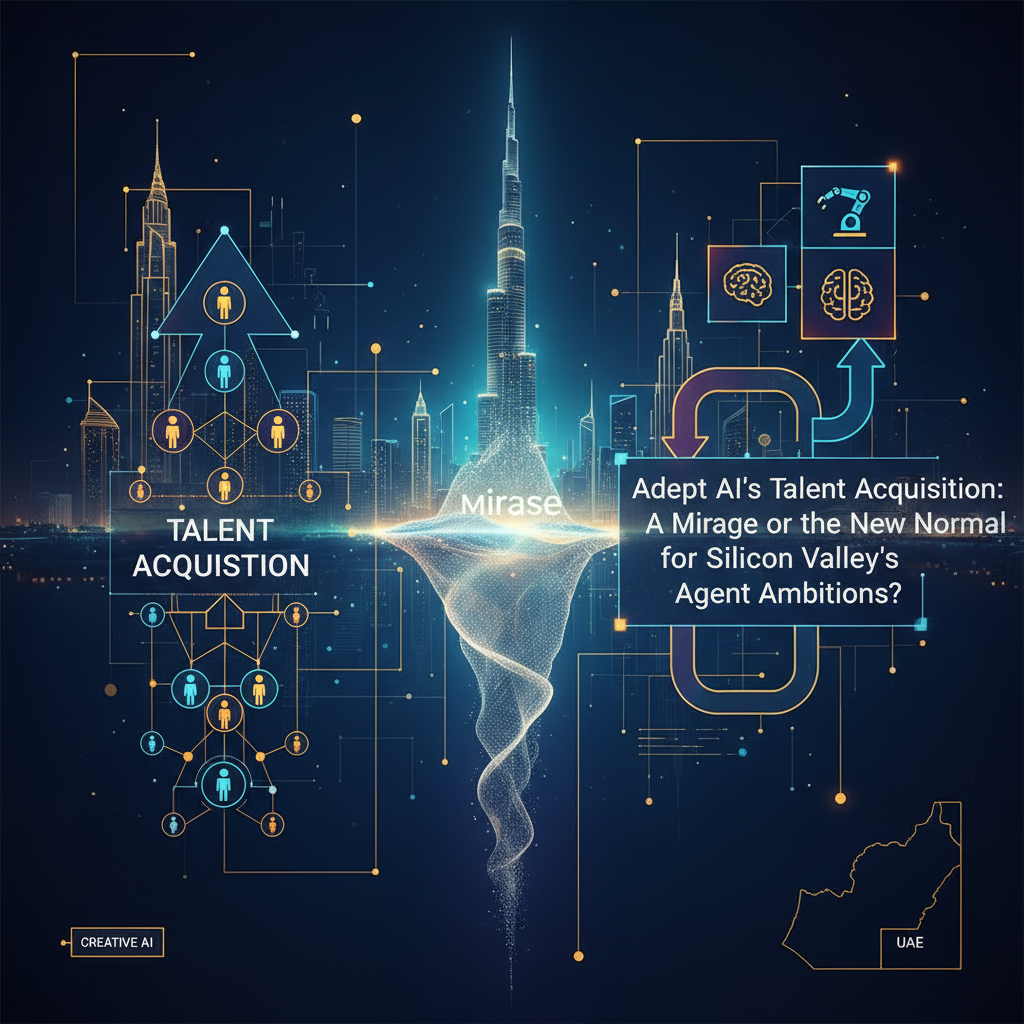

The digital sands of Silicon Valley are shifting once more, and their tremors are felt even in the meticulously planned metropolises of the Arabian Gulf. The recent news of Adept AI, a company once heralded as a pioneer in the development of universal AI agents, being acquired primarily for its talent rather than its foundational product, has sent ripples through the global AI ecosystem. This event compels us to ask a critical question: Is the era of ambitious, independent AI agent startups drawing to a close, or are we merely witnessing a strategic recalibration in the frantic race for artificial general intelligence?
For years, the narrative around AI agents was one of boundless potential. Imagine an AI capable of navigating complex software, executing multi-step tasks, and learning from human interaction across diverse applications. This was Adept AI's grand vision, attracting significant investment and some of the brightest minds from Google Brain and OpenAI. Their promise was to create an AI assistant that could truly understand and act upon human intent, seamlessly integrating into our digital lives. The initial excitement was palpable, fueling a venture capital frenzy around the agentic AI paradigm.
Yet, the reality of building truly robust, reliable, and scalable AI agents has proven far more challenging than anticipated. The path from impressive research demos to enterprise-grade deployment is fraught with technical hurdles, from ensuring task reliability and interpretability to managing computational costs and ethical considerations. While companies like Google with its Gemini models and OpenAI with its evolving API capabilities continue to push the boundaries of agentic behavior, the sheer complexity often necessitates the resources and long-term vision of established tech giants.
This brings us to the Adept AI situation. While specific terms of the acquisition remain undisclosed, industry whispers and informed analyses suggest the primary value lay in Adept's exceptional team of engineers and researchers. This is not an isolated incident. We have observed a trend where smaller, innovative AI startups, particularly those in highly specialized or foundational areas, are increasingly being absorbed by larger entities not just for their intellectual property, but for the human capital that drives it. In the first quarter of 2026 alone, data from TechCrunch indicates that over 60% of AI startup acquisitions globally were classified as 'acqui-hires,' a significant increase from 45% in the preceding year.
“The talent war in AI is more intense than any we’ve seen in decades,” states Dr. Ayesha Al-Farsi, Head of AI Strategy at the Dubai Future Foundation. “For the mega-corporations, acquiring a team with proven expertise in a niche like agentic AI is often more efficient than building that capability from scratch, especially when time to market is paramount. It’s a strategic move to consolidate intellectual firepower.” Her perspective underscores the pragmatic approach taken by industry leaders.
This trend has profound implications for the broader AI landscape, including for nations like the UAE that are heavily investing in AI as a cornerstone of their future economies. Dubai doesn't just adopt the future, it builds it. The UAE's AI strategy is decades ahead, focusing on developing indigenous talent and attracting global expertise. The question then becomes: how do we ensure our burgeoning AI ecosystem remains vibrant and competitive when the global giants are effectively vacuuming up the most promising startups and their teams?
Mr. Tariq Al-Hammadi, CEO of Abu Dhabi's AI Innovation Hub, offers a nuanced view. “While it may appear that independent agent development is faltering, this consolidation can also be seen as a maturation of the market. The foundational research and early-stage exploration often happen in nimble startups, but the industrialization and scaling require immense resources. For the UAE, this means our focus on creating an attractive environment for AI researchers and entrepreneurs, coupled with strategic partnerships with global players, becomes even more critical.” He emphasizes the importance of a robust national AI infrastructure, including advanced computing resources and a supportive regulatory framework, to nurture local talent and attract international collaboration.
Indeed, the UAE has been proactive in this regard. Initiatives like the Mohamed bin Zayed University of Artificial Intelligence (mbzuai) and the establishment of various AI-focused free zones are designed to cultivate a talent pool that can both innovate independently and integrate seamlessly into global collaborations. The goal is not merely to be a consumer of AI technology, but a significant contributor and developer. This is what ambition looks like, a vision extending far beyond quarterly reports.
However, concerns remain. Dr. Lena Khan, a prominent AI ethicist based in Sharjah, warns of potential monopolization. “When a few dominant players control the vast majority of AI talent and foundational models, it raises questions about diversity of thought, ethical oversight, and the potential for a narrow vision of AI’s future. We must ensure that the benefits of AI are broadly distributed, and that innovation isn't stifled by consolidation.” Her point highlights the delicate balance between progress and equitable access.
The pivot from product to talent acquisition, exemplified by Adept AI, is likely not a fleeting fad but rather a new normal in the fiercely competitive AI domain. The sheer complexity and strategic importance of advanced AI, particularly agentic systems, mean that the human ingenuity behind these systems is the most valuable commodity. For the UAE, this trend reinforces the imperative to double down on its investments in education, research, and talent attraction, ensuring it remains a magnet for the world’s best AI minds. The future of AI agents, whether built by independent startups or integrated within tech behemoths, will ultimately be shaped by the caliber of the individuals driving their development. The race for AI supremacy is, at its core, a race for human talent. The nations that understand and act upon this reality will be the ones that truly build the future. For more insights into the broader implications of AI advancements, one might consult analyses from MIT Technology Review.