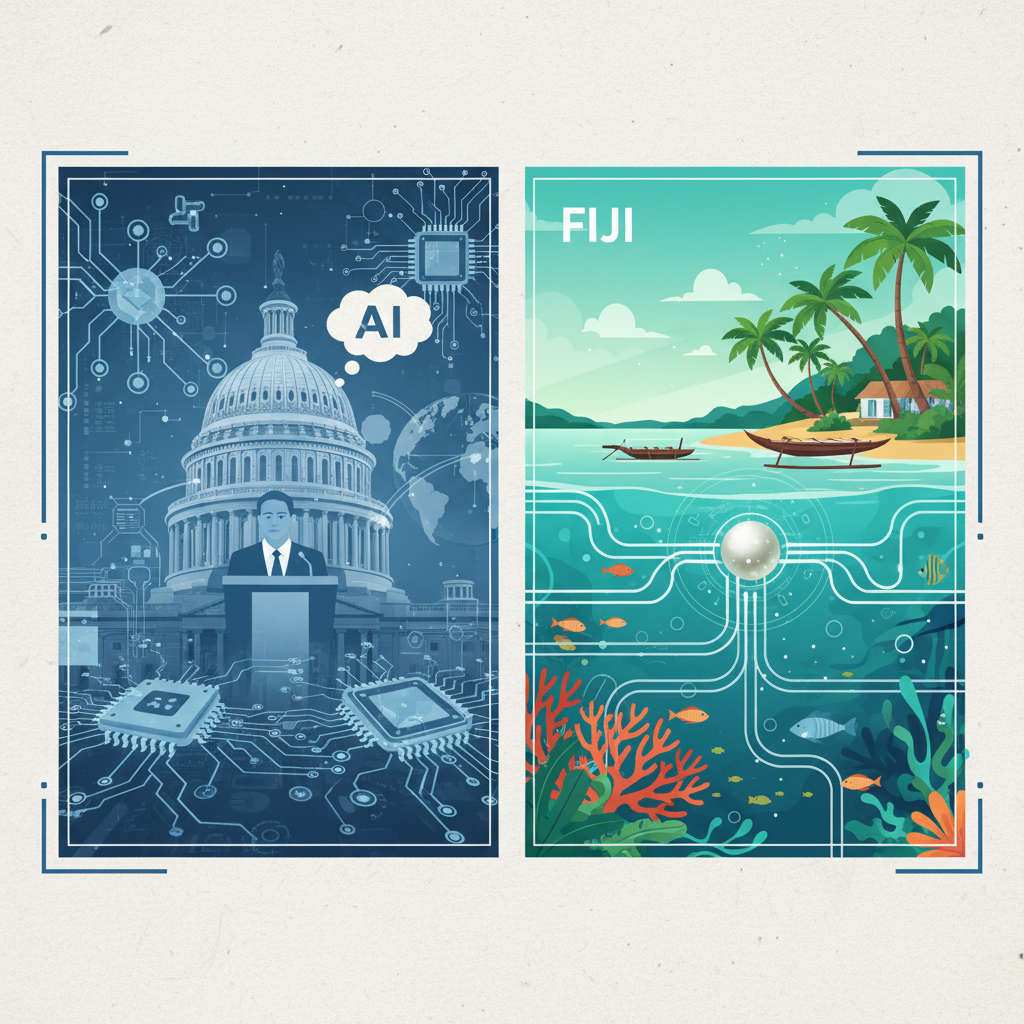

The halls of the US Congress are a long way from the warm shores of Fiji, both geographically and culturally. Yet, what happens in Washington, particularly when it comes to something as transformative as artificial intelligence, often sends ripples that eventually reach our islands. Right now, the American legislative body is deep in debate over comprehensive AI legislation, a process heavily influenced by the very tech giants it seeks to regulate. And for us, watching from the front lines of climate change and digital disparity, these discussions are not just academic, they are practical.
In Fiji, we face the future with clear eyes. We understand that AI is not a magic bullet, but it holds immense potential for everything from disaster prediction to sustainable resource management. The challenge, however, is access, equity, and ensuring that the global rules being shaped today do not inadvertently disadvantage nations like ours. The current US legislative push, driven by concerns over national security, economic competitiveness, and ethical safeguards, has significant implications for how AI models are developed, shared, and governed worldwide.
The Breakthrough in Plain Language: A Regulatory Framework for a Fast-Moving Target
What we are seeing unfold in Washington is less a single 'breakthrough' and more a complex, evolving attempt to construct a regulatory framework for AI. The core development is the sheer breadth of proposed legislation, moving beyond specific applications to encompass foundational models, data governance, and liability. This isn't just about self-driving cars anymore; it's about the very algorithms that power everything from our social media feeds to critical infrastructure. Lawmakers are grappling with how to define AI, how to assess its risks, and how to balance innovation with public safety, all while major players like OpenAI, Google, and Microsoft lobby intensely to shape the outcome.
For instance, proposals often include mandatory risk assessments for high-impact AI systems, requirements for transparency in model training data, and the establishment of new federal agencies or expanded powers for existing ones to oversee AI development. The goal is to move from a patchwork of state-level initiatives and voluntary industry guidelines to a unified national approach. This shift, if successful, would set a precedent that other nations, including those in the Pacific, will inevitably look to as they consider their own AI governance strategies.
Why It Matters: Global Standards and Local Impact
Why should Fiji care about US AI laws? Because the US, as a major driver of AI innovation and a significant economic power, often sets de facto global standards. If American legislation mandates certain safety features, data privacy protocols, or transparency requirements for AI models, those requirements will likely become embedded in the models themselves, regardless of where they are deployed. This can be a double-edged sword.
On one hand, robust US legislation could lead to safer, more transparent, and more accountable AI systems that benefit everyone, including users in Fiji. Imagine AI tools used for early warning systems for cyclones, or for optimizing agricultural yields in the face of changing weather patterns. We need these tools to be reliable and fair. As Professor Meredith Broussard of New York University, an expert on AI and society, often emphasizes, "Technology is not neutral, it reflects the values of its creators and regulators." If those values prioritize safety and equity, that is a positive.
On the other hand, overly restrictive or protectionist legislation could stifle the development of open-source AI, limit access to advanced models for smaller nations, or create compliance burdens that are impossible for developing countries to meet. The lobbying efforts by major tech companies often push for frameworks that favor their existing infrastructure and proprietary models, potentially creating barriers for smaller players or alternative approaches. This could further widen the digital divide, making it harder for countries like Fiji to leverage AI for their unique challenges.
The Technical Details: From Foundational Models to Risk Taxonomies
At the heart of the US legislative debate are foundational models, the large AI systems like OpenAI's GPT series or Google's Gemini that are trained on vast datasets and can be adapted for a wide range of tasks. Lawmakers are trying to figure out how to regulate these powerful, general-purpose models, which are often developed by a handful of well-resourced companies. This is where the technical complexity truly bites.
One key area of discussion involves risk taxonomies. Researchers at institutions like Stanford University's Institute for Human-Centered AI (HAI) have been instrumental in proposing frameworks to classify AI systems based on their potential for harm. Their work, often published in papers discussing responsible AI development, informs legislative proposals that seek to apply different levels of scrutiny to AI systems deemed 'high-risk' compared to those with lower risk profiles. For example, an AI system used in critical infrastructure or healthcare would face much stricter regulations than one recommending movies.
Another technical consideration is data provenance and bias. Legislation aims to mandate transparency around the data used to train AI models, requiring developers to disclose information about dataset sources and potential biases. This is crucial because biased training data can lead to discriminatory outcomes, a concern that resonates deeply in diverse communities globally. The US National Institute of Standards and Technology (nist) has also been developing an AI Risk Management Framework, which provides a voluntary guide for organizations to manage AI risks, and elements of this framework are now being considered for mandatory inclusion in legislation. This framework, detailed on their official website, offers a structured approach to identifying, assessing, and mitigating AI-related risks.
Who Did the Research: Academia, Think Tanks, and Industry Experts
The legislative efforts are not happening in a vacuum. They are informed by years of research from leading academic institutions, think tanks, and even the AI companies themselves. Researchers at universities like Stanford, MIT, and Carnegie Mellon have published extensively on AI safety, ethics, and governance. Organizations like the AI Now Institute have consistently advocated for stronger regulatory oversight and public interest protections.
Industry leaders, while often lobbying against overly stringent regulations, also contribute to the discourse. Companies like Anthropic, with its focus on constitutional AI and safety, have publicly shared their perspectives on responsible AI development. Their CEO, Dario Amodei, has often spoken about the need for robust safety mechanisms and guardrails for advanced AI systems. These contributions, both academic and industrial, form the intellectual bedrock upon which legislative proposals are built.
Implications and Next Steps: A Pacific Perspective
For Fiji and other Pacific Island nations, the implications are clear. The regulatory landscape emerging from the US will influence the availability, cost, and ethical standards of the AI technologies we might adopt. If US legislation promotes open and accessible AI, it could accelerate our ability to deploy smart solutions for climate adaptation, such as AI-powered models for predicting sea-level rise impacts on coastal communities or optimizing renewable energy grids. Conversely, if it creates a highly proprietary and regulated ecosystem, it could make these tools expensive and difficult to integrate.
Our focus must remain on ensuring that any global AI governance framework, whether driven by the US or international bodies, considers the unique needs and vulnerabilities of small island developing states. We need AI that is culturally appropriate, resilient to our specific environmental challenges, and developed with local input. The Pacific way of problem-solving requires solutions tailored to our context, not just off-the-shelf imports.
We also need to invest in local capacity building. Understanding these complex legislative debates, and the technical underpinnings of AI, is crucial for our policymakers and innovators. The University of the South Pacific, for example, is increasingly looking at how to integrate AI education into its curriculum, preparing a generation that can not only use AI but also critically engage with its governance. This is not just about technology; it is about sovereignty and self-determination in the digital age.
The ongoing US congressional debates are a critical juncture for global AI governance. They highlight the tension between rapid innovation and the imperative for responsible development. For us in Fiji, these distant discussions are a reminder that the future of technology, much like the future of our climate, is interconnected. We must remain engaged, advocating for a future where AI serves all humanity, not just a privileged few. The stakes are too high for us to be mere spectators. As the world grapples with these complex questions, our voice, though from a small island, must be heard in the global conversation about AI's future. We need to ensure that the AI tools of tomorrow are built to help us navigate the rising tides, both literal and metaphorical. For more insights into how AI is shaping policy, Reuters Technology often provides excellent coverage of these legislative developments.