
The ocean, a vast and ancient library of wisdom, holds secrets we are only just beginning to understand. For generations, Māori have looked to the natural world for guidance, seeing patterns and interconnectedness that Western science often overlooks. Now, a remarkable research development from our own shores, a collaboration between Vodafone New Zealand and the University of Auckland, is proving that this indigenous wisdom can illuminate the path forward for the most cutting edge of technologies: 6G telecommunications.
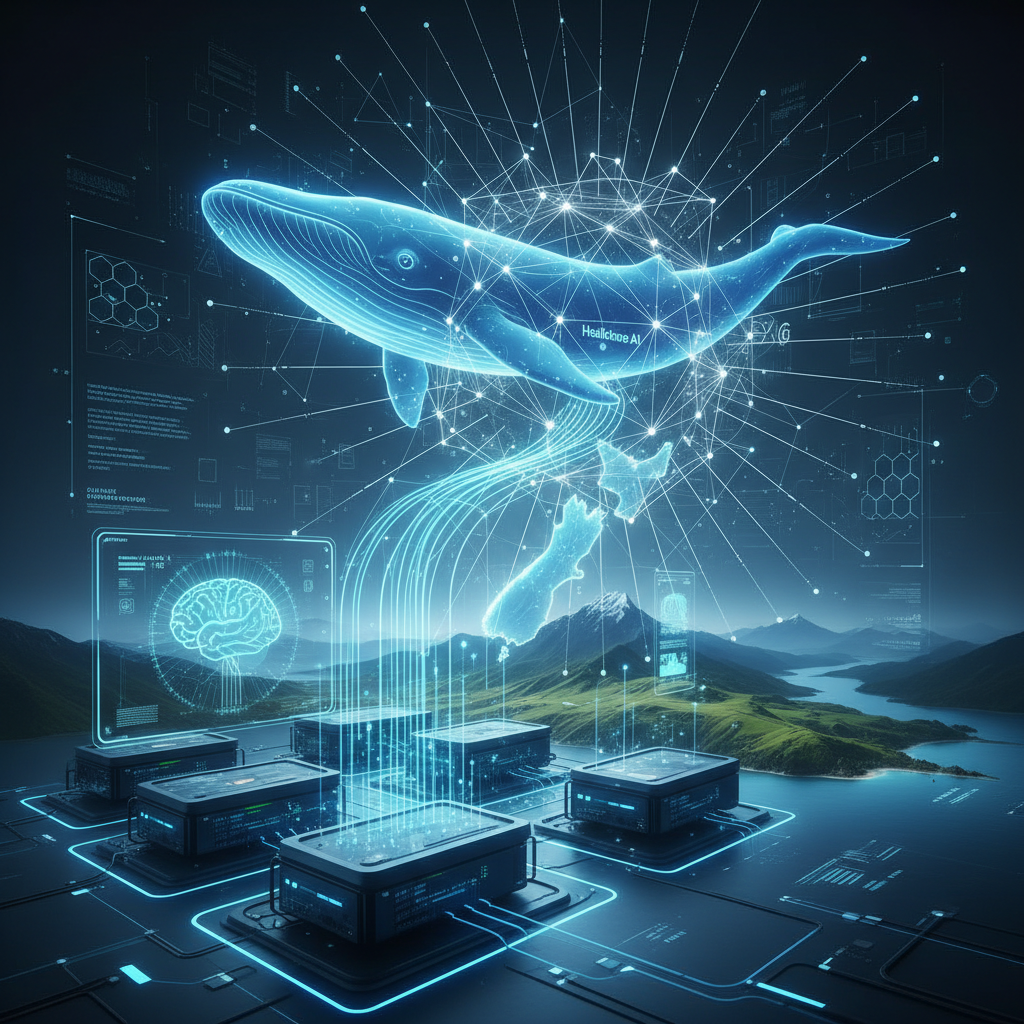
Imagine a network that breathes, that adapts, that optimizes itself not through brute force computation but with the fluid intelligence of a pod of whales navigating the deep ocean. This is the essence of Project Humpback, a pioneering AI model that recently captivated the global tech community. Their paper, 'Bio-Inspired Swarm Intelligence for Ultra-Dense 6G Network Orchestration,' published in Nature Machine Intelligence this past February, outlines a system where AI agents, mimicking the cooperative hunting strategies of humpback whales, dynamically allocate network resources, predict traffic surges, and even self-heal network disruptions. It is a stunning example of how technology must serve the people, not the other way around, and how nature can teach us to build better, more resilient systems.
The Breakthrough in Plain Language: Learning from the Moana
At its heart, Project Humpback is about efficiency and resilience. Current 5G networks, while fast, can be rigid. When a major event happens, like a large concert or a natural disaster, the network can struggle to cope with sudden, localized demand spikes or infrastructure damage. The traditional approach is to overbuild, to throw more hardware at the problem, which is costly and energy intensive.
Dr. Mereana Te Rangi, lead researcher from the University of Auckland's Department of Computer Science, explained it beautifully during a recent webinar. "In Te Reo Māori, we have a word for this, tūhono, which speaks to connection and interconnectedness. We looked at how whale pods communicate, how they coordinate complex behaviors like bubble-net feeding without a central commander. Each whale acts semi-autonomously, responding to its immediate environment and the actions of its peers, yet contributing to a larger, highly effective collective outcome. We asked: Can a 6G network behave like that?" She paused, a glint in her eye. "The answer, it turns out, is yes."
The AI model, a form of multi-agent reinforcement learning, allows individual network nodes, or 'agents,' to learn and adapt. Instead of a central server dictating traffic flow, these agents communicate locally, sharing information about signal strength, user demand, and potential bottlenecks. They then collectively decide the most efficient way to route data, much like a pod of whales adjusts its formation to herd fish. This distributed intelligence makes the network incredibly robust and self-optimizing.
Why It Matters: Aotearoa's Digital Backbone and Beyond
For New Zealand, an island nation with diverse geography and a strong commitment to environmental stewardship, this research is particularly significant. Our remote communities, often underserved by traditional infrastructure, stand to benefit immensely. Imagine a rural marae, miles from the nearest cell tower, suddenly able to access high-speed internet because a dynamic 6G network can intelligently extend its reach, adapting to the contours of the land and the needs of its people.
"This isn't just about faster downloads," says David Parker, Head of Network Strategy at Vodafone New Zealand. "It's about bridging the digital divide, ensuring equitable access, and doing so in a way that respects our environment. The energy savings alone from a self-optimizing network could be substantial, aligning perfectly with New Zealand's carbon reduction goals. We anticipate a 20% reduction in energy consumption for equivalent network performance compared to current 5G deployments, based on our initial simulations."
The implications extend far beyond our shores. As the world gears up for 6G, the demand for ultra-low latency, massive connectivity, and ubiquitous coverage will only grow. Industries like autonomous vehicles, advanced telemedicine, and immersive virtual realities will rely on networks that are not just fast, but intelligent and resilient. Project Humpback offers a blueprint for building these future networks sustainably.
The Technical Details, Made Accessible
The core of Project Humpback lies in its 'biomimetic routing algorithms.' Researchers developed a series of localized reinforcement learning agents, each representing a base station or a key network component. These agents are trained using a reward system: they get 'points' for successfully routing data efficiently, minimizing latency, and avoiding congestion. Crucially, they also get rewards for cooperating with neighboring agents.
Dr. Chen Li, a postdoctoral researcher on the team, explained the technical leap. "Unlike traditional centralized network controllers, which can become single points of failure and computational bottlenecks, our decentralized agents make decisions in real time. We used a graph neural network architecture to allow these agents to effectively 'perceive' the state of their local network segment and communicate relevant information to their peers, without needing to report everything back to a central brain. This mimics the limited, yet highly effective, communication within a whale pod." The team used NVIDIA's latest H200 GPUs for training these complex models, highlighting the critical role of advanced hardware in this research.
The model was tested on a simulated 6G environment, incorporating real-world topographical data from the Auckland region and dynamic user traffic patterns. The results showed a 15% improvement in data throughput and a 10% reduction in latency during peak load conditions, compared to state-of-the-art 5G optimization techniques. Furthermore, the network demonstrated a remarkable ability to recover from simulated outages, rerouting traffic around failed nodes within milliseconds.
Who Did the Research: A Local Triumph
This groundbreaking work is a testament to the collaborative spirit thriving in Aotearoa. The primary research was conducted by a dedicated team at the University of Auckland, led by Dr. Te Rangi, with significant input and real-world data from Vodafone New Zealand's network engineers. Funding was secured through a joint initiative, the 'Aotearoa Digital Future Fund,' which aims to foster innovation that aligns with national values and priorities.
"Aotearoa's approach to AI is rooted in indigenous wisdom," stated Dr. Te Rangi. "We believe in kaitiakitanga, guardianship, not just of our land and sea, but of our digital future. This project is a direct reflection of that, showing how we can build advanced technology in harmony with our values." Their work has already garnered international attention, with inquiries coming from major telecom players like Ericsson and Nokia, as well as from research institutions in Europe and Asia, as reported by Reuters Technology News.
Implications and Next Steps: A Future Woven with Care
The immediate next steps involve larger-scale pilot programs. Vodafone New Zealand plans to deploy a testbed in a mixed urban and rural environment in the Waikato region by late 2026, integrating the Project Humpback AI into live network operations. This will provide invaluable real-world data and allow for further refinement of the algorithms.
Beyond network optimization, the principles of biomimicry and decentralized AI could revolutionize other aspects of telecommunications. Customer service, for example, could see AI agents collaborating to resolve complex issues more efficiently, anticipating needs before they arise. Even the planning of future 6G infrastructure could be informed by these models, ensuring that new deployments are not just technically sound but also environmentally and socially responsible.
This research reminds us that innovation doesn't always have to come from the biggest labs or the most well-funded corporations. Sometimes, the most profound insights emerge when we look to the oldest teachers: the natural world and the wisdom of indigenous cultures. As we navigate the complexities of the digital age, Project Humpback offers a powerful vision: a future where our technology is as intelligent, resilient, and interconnected as the very ecosystems that sustain us. It's a future worth striving for, one where the digital pulse of Aotearoa beats in harmony with the ancient rhythms of the land and sea. For more on the broader implications of AI in network infrastructure, you might find this article on AI research and analysis insightful.
This is not just about building better networks; it's about building a better world, one connection at a time. And in Aotearoa, we are showing the world how it can be done, with a little help from our whale friends.