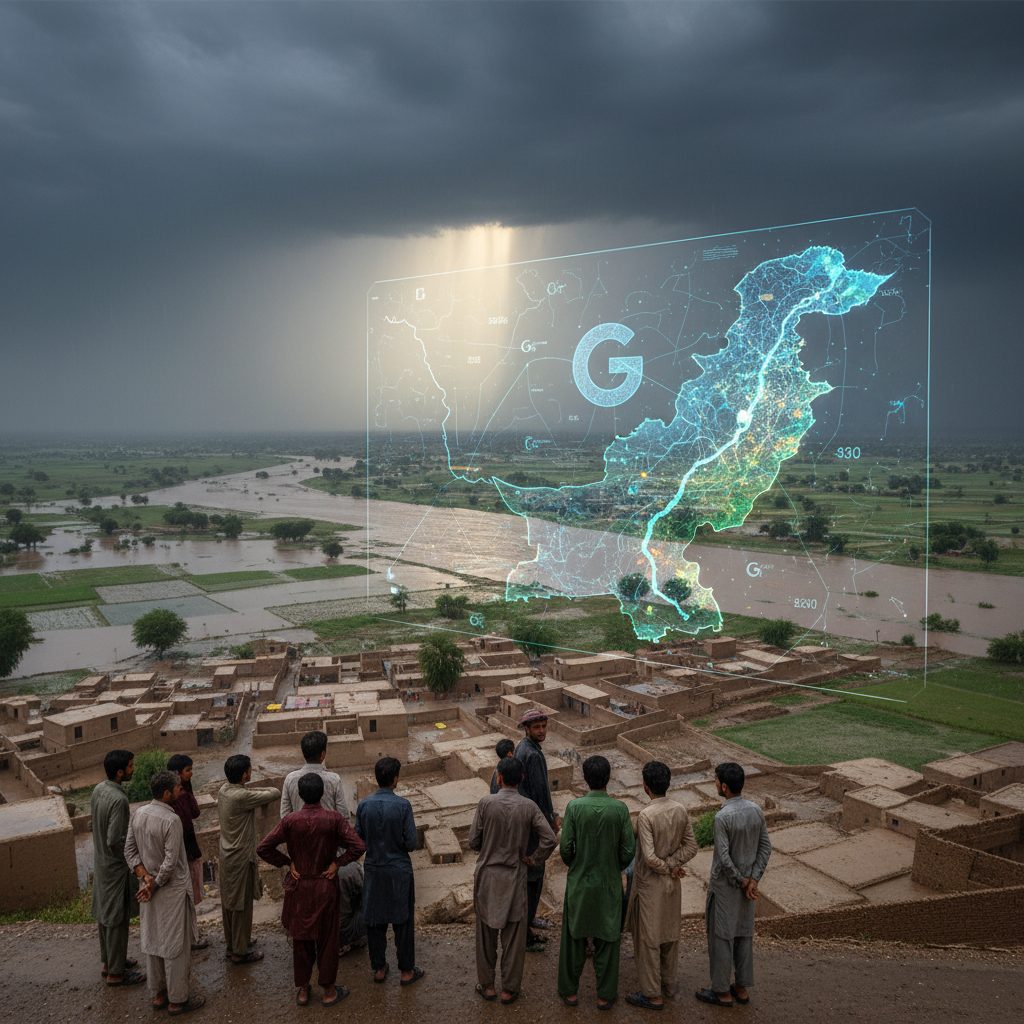

The air in Lahore still carries the memory of last summer's heat, a suffocating blanket that pressed down on us, followed by the relentless monsoon rains that turned our streets into rivers. Here in Pakistan, climate change is not a distant threat discussed in air-conditioned conference rooms; it is a lived, brutal reality that claims lives and livelihoods with terrifying regularity. We are on the front lines, bearing the brunt of a global crisis we did little to create. This is a human rights issue disguised as a tech story, and it demands our unwavering attention.
For years, our meteorologists have done their best with limited resources, issuing warnings that sometimes arrive too late, or lack the precision needed for effective evacuation and disaster preparedness. But now, the whispers from the global tech hubs speak of a new dawn: AI-powered climate modeling, capable of predicting extreme weather with an accuracy that was once unimaginable. Companies like Google DeepMind and NVIDIA are pouring immense resources into these models, promising to revolutionize our ability to foresee the fury of nature.
Take Google DeepMind's 'GraphCast' model, for instance. Unveiled last year, it uses machine learning to predict weather up to 10 days in advance, reportedly outperforming traditional forecasting systems in 90% of metrics. Researchers at DeepMind claimed it could generate a 10-day forecast in less than a minute on a single Google Tensor Processing Unit, a stark contrast to the hours or even days required by conventional supercomputer models. Imagine the difference that could make for a country like Pakistan, where every hour counts when a flood is bearing down on a village.
NVIDIA, with its powerful GPUs, is also a major player, enabling the computational horsepower needed for these complex AI models. Their Earth-2 platform aims to create a digital twin of Earth, allowing for high-resolution simulations of climate and weather patterns. These are not just academic exercises; they are tools that could literally save lives, protect infrastructure, and safeguard our agricultural backbone.
But here is where my journalist's heart, rooted in the realities of Pakistan, starts to ask the hard questions. The technology sounds miraculous, a beacon of hope against the rising tides. Yet, who truly benefits? Will these sophisticated models, developed by tech giants in Silicon Valley, genuinely translate into actionable insights for a farmer in rural Sindh, or a fishing community along the Makran coast? Will the warnings reach them in time, in a language they understand, through accessible channels?
"The promise of AI in climate prediction is undeniable," says Dr. Aisha Khan, CEO of the Civil Society Coalition for Climate Change in Pakistan, a voice I deeply respect. "We've seen the devastating impact of the 2022 floods, displacing millions. If AI can give us even a few extra days of accurate warning, it's invaluable. But the challenge isn't just about prediction; it's about early warning dissemination and community-level preparedness, especially for our most vulnerable populations. We need localized solutions, not just global models." Her words echo the sentiments of many who understand the chasm between technological advancement and on-the-ground impact.
The Pakistani Meteorological Department (PMD) has been working with international partners to enhance its forecasting capabilities, but the integration of cutting-edge AI models from the likes of Google and NVIDIA is a monumental task. It requires significant investment in infrastructure, data pipelines, and perhaps most crucially, human capital. We need more data scientists, more AI engineers, and more climate experts who can bridge the gap between complex algorithms and practical application. This is where I believe women in Pakistan are coding the future, if given the chance. Our universities are producing brilliant minds, eager to tackle these challenges, but they need the resources and opportunities to do so.
Consider the sheer volume and granularity of data required for these AI models. Satellite imagery, ground sensor data, historical weather patterns, and even social media feeds can feed these systems. For a country with vast, remote areas and varying levels of digital connectivity, collecting and processing this data consistently is a hurdle. While companies like Google have made strides in making their models more accessible, the operationalization of such tools in a developing nation context is far from straightforward.
Just last month, a report from the World Meteorological Organization highlighted that while global climate models are improving, the 'last mile' problem of delivering timely, accurate, and understandable warnings to vulnerable communities remains a significant barrier, particularly in South Asia and Africa. This isn't just about having the best algorithm; it's about building resilient communication networks, educating communities, and fostering trust in these new systems. It's about ensuring that the prediction of a flood doesn't just stay on a computer screen in a capital city, but translates into immediate, life-saving action in a remote village.
I spoke with a young climate activist from Karachi, Fatima Zahra, who is part of a local NGO focusing on climate resilience. "We hear about these amazing AI tools, and it gives us hope," she told me, her voice tinged with both optimism and frustration. "But then we look at our own reality. Our coastal communities are losing land to rising sea levels, and the warnings often come from local fishermen who know the sea, not from sophisticated models. How do we connect these two worlds? How do we ensure that the benefits of this advanced technology are not just for the privileged few, but for everyone?" Her question is a poignant one, and it is the question we must all grapple with.
The path forward is not simply about acquiring the technology. It is about fostering partnerships that prioritize local needs and capacities. It means tech giants like Google and NVIDIA must not just offer their models, but actively collaborate with local governments, universities, and civil society organizations in countries like Pakistan. It means investing in training programs that empower our own people to understand, adapt, and even build upon these technologies. It means ensuring that the data used to train these models is representative of our diverse climate conditions, not just those of the developed world.
There is a real danger that without this concerted effort, the gap between those who can leverage these advanced AI tools and those who cannot will only widen, exacerbating existing inequalities. The climate crisis is a global equalizer in its destructive power, but access to the tools that mitigate its impact must also be equally distributed. Don't look away from the human stories behind the data points and the algorithms. The future of millions in Pakistan, and indeed across the vulnerable regions of our planet, depends on how we answer this call.
We must demand that the promise of AI-powered climate modeling is not just a headline in a tech journal, but a tangible lifeline for communities facing the wrath of a changing climate. The potential is immense, but the responsibility to ensure equitable access and impact is even greater. This is our moment to ensure technology serves humanity, especially those who need it most. For more insights into how AI is shaping our world, you can always check out TechCrunch's AI section or explore the research at MIT Technology Review. The conversation is ongoing, and Pakistan's voice must be central to it.