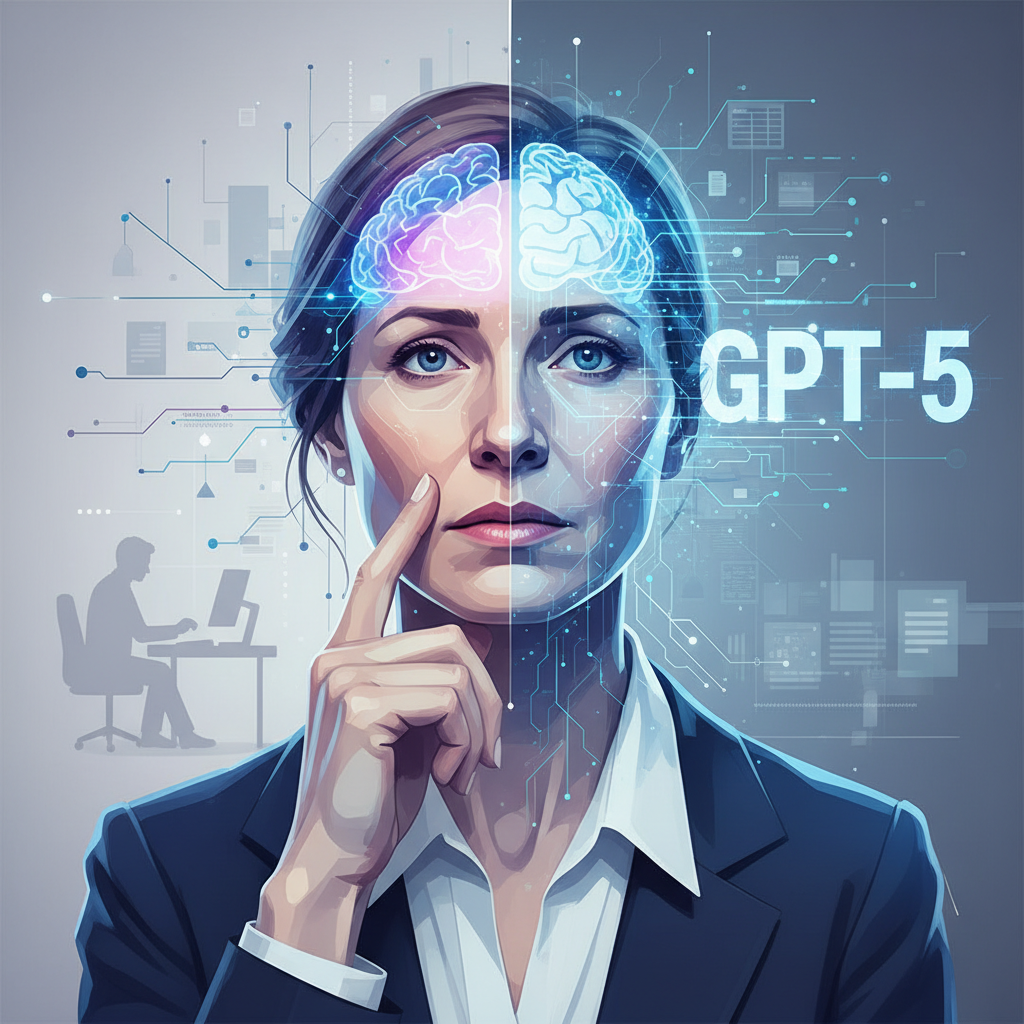

Let's be real. We've all seen the headlines. Another week, another round of layoffs at some big consulting firm, a venerable law office, or a once-proud newsroom, all whispered to be 'optimizing for efficiency' with AI. Yeah, right. They're optimizing for profits, and the human cost is mounting. But here's what the tech bros don't want to talk about: beyond the economic devastation, what happens to the human psyche when the very cognitive tasks we built careers on are outsourced to a machine, say, OpenAI's GPT-5 or Google's Gemini Ultra?
I'm talking about the lawyers who spent years honing their research skills, the consultants who prided themselves on synthesizing complex data, the journalists who saw their craft as an art of language and insight. Suddenly, an algorithm can draft a legal brief in minutes, analyze market trends with terrifying speed, or even churn out news articles that are, let's admit it, often indistinguishable from human work. This isn't just about job displacement. This is about an existential crisis brewing in cubicles and corner offices across America.
Take Sarah, a former senior associate at a prestigious New York law firm. She spent a decade climbing the ladder, her identity deeply intertwined with her ability to dissect intricate legal texts and craft persuasive arguments. Then, her firm integrated an advanced AI legal research tool, boasting it could do the work of five junior associates in a fraction of the time. "It wasn't just the job loss, Deshawné," she told me over coffee in Brooklyn, her voice still laced with disbelief. "It was like my brain, my expertise, became obsolete overnight. What was the point of all those late nights, all that studying, if a machine could do it better, faster, cheaper? I felt like a relic, a dinosaur in my own profession." Sarah's story isn't unique, it's a growing chorus.
Research is starting to catch up to this lived experience. Dr. Maya Jenkins, a cognitive psychologist at the University of Pennsylvania, has been studying the psychological impact of AI integration in white-collar environments. "We're observing a phenomenon I call 'cognitive erosion,'" Dr. Jenkins explained during a recent virtual conference. "When AI takes over tasks that require critical thinking, problem-solving, and creative synthesis, humans tend to disengage those neural pathways. It's not just about deskilling, it's about a fundamental shift in how we perceive and utilize our own intellectual capacities. People report feeling less mentally agile, less engaged, even a decline in their intrinsic motivation for complex tasks." Her team's preliminary findings, published in a recent paper, suggest a measurable decrease in certain executive functions among professionals whose roles have been heavily augmented or replaced by AI, particularly in areas like complex reasoning and novel problem generation. You can read more about similar research trends on MIT Technology Review.
This isn't some abstract academic debate. This is hitting people where they live, right here in the USA. Think about the pride a journalist takes in breaking a story, the nuanced understanding a consultant brings to a client's unique challenges. These aren't just tasks, they're sources of meaning, purpose, and social validation. When an algorithm can do it, or even appear to do it, what does that do to our sense of self-worth? What does it do to our relationships with our colleagues, who are either also being replaced or are now competing with an invisible, tireless entity?
"The psychological contract between employer and employee is fundamentally broken by this AI wave," argues Dr. Robert Chen, a labor sociologist at Ucla. "For decades, white-collar work offered a pathway to upward mobility, intellectual challenge, and a certain societal status. Now, that pathway is being paved over by algorithms. The uncertainty, the feeling of being perpetually evaluated against a machine, it's creating widespread anxiety and a sense of learned helplessness. We're seeing spikes in occupational burnout and even depression among those still employed in AI-augmented roles." He points out that this isn't just about a few individual cases; it's a systemic issue impacting millions.
Silicon Valley has a blind spot the size of Texas when it comes to the human impact of their innovations. They celebrate efficiency and disruption, but rarely grapple with the fallout. They talk about 'upskilling' and 'reskilling,' but for many, it feels like being told to learn a new language while your old one is being erased from existence. It’s a classic American story, really: innovation at any cost, with the human element often an afterthought.
Uncomfortable truth time: the tech industry, dominated by companies like Microsoft and Amazon, is selling us a dream of effortless productivity, but the nightmare for many is the erosion of meaningful work. We're not just losing jobs; we're losing the very activities that define our intellectual lives and contribute to our well-being. The gig economy already chipped away at job security, and now AI is coming for cognitive security. This is especially poignant in a country where work ethic and professional identity are so deeply intertwined with personal value.
So, what's the play? First, we need to acknowledge the psychological toll. Employers can't just implement AI tools and expect business as usual. They need to invest in robust psychological support, career counseling that goes beyond generic advice, and genuine opportunities for employees to transition into new, meaningful roles that leverage uniquely human skills. This isn't about fighting AI, it's about understanding its impact and designing a future where humans aren't just cogs in an algorithmic machine.
Second, we need to redefine what 'value' means in a professional context. If AI can handle the rote, analytical tasks, then human value shifts to creativity, emotional intelligence, complex ethical reasoning, and interpersonal communication. These are the domains where AI still falters, and where our cognitive resources need to be redirected and celebrated. This means a radical rethinking of education and training, moving away from purely technical skills towards fostering uniquely human capabilities. For more on how companies are navigating this, check out TechCrunch.
Finally, we, as individuals, need to cultivate a resilience that transcends our professional titles. Our worth isn't solely tied to our job function. This is a tough pill to swallow in a society that often equates success with career achievement, but it's a necessary shift for mental health in the age of AI. We need to find meaning and purpose outside of the tasks that an algorithm can now perform. It's about rediscovering our inherent human value, not just our market value. Perhaps a good place to start is by examining how other industries are adapting, like the creative sector discussed in Runway ML's Hollywood Dream: A Golden Age for Creatives, or Another Data Gold Rush for Africa, Mr. Altman? [blocked].
The AI revolution isn't just changing how we work; it's changing who we are. And if we don't pay attention to the psychological cost, we might find ourselves with a highly efficient, algorithm-driven economy, but a deeply disengaged and mentally fractured populace. That's a future no one should want, not even the tech titans. We've got to demand better, for our brains, our livelihoods, and our humanity.