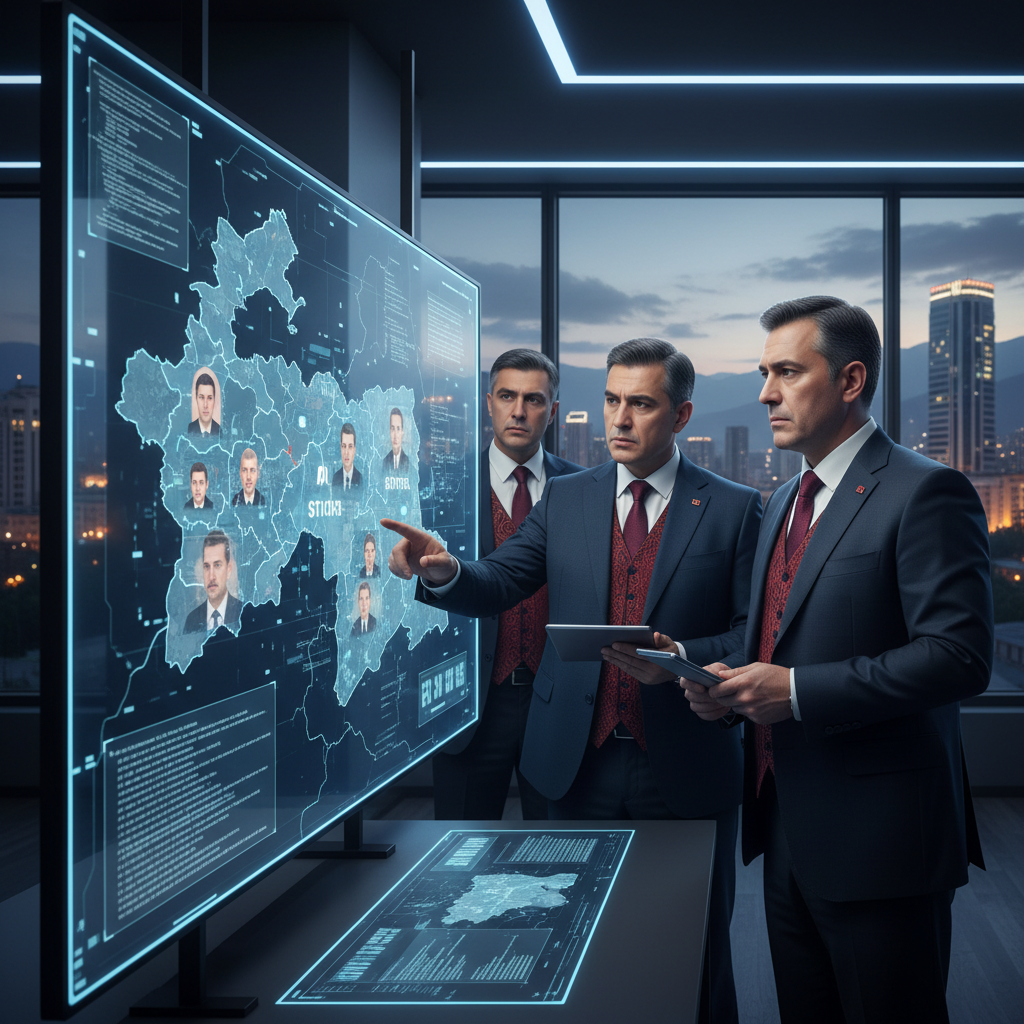

The promise of artificial intelligence has often been framed in terms of progress, efficiency, and innovation. However, as with any powerful tool, its capacity for disruption is equally profound. In the context of global elections, the emergence of AI-generated deepfakes presents a particularly insidious threat, one that can erode public trust and destabilize democratic institutions. For countries like Tajikistan, where information dissemination can be complex and digital literacy varies, this challenge is not theoretical; it is a tangible concern for upcoming electoral cycles.
The Technical Challenge: Crafting and Countering Digital Deception
At its core, the problem is one of authenticity. Deepfakes, synthetic media generated by AI, are designed to mimic real individuals with startling accuracy, often depicting them saying or doing things they never did. In an election, a deepfake of a candidate making a controversial statement or appearing in a compromising situation can spread like wildfire, influencing public opinion before truth can catch up. The technical challenge lies in two primary areas: the sophisticated generation of these fakes and the equally complex task of their timely and accurate detection.
Traditional digital forensics struggle against these AI-driven forgeries because they exploit the very statistical patterns that define natural human speech and appearance. The goal is to create media that is perceptually indistinguishable from reality, making human discernment unreliable. Therefore, automated, robust detection mechanisms are not merely desirable; they are essential.
Architecture Overview: A Multi-Layered Defense
Addressing the deepfake threat requires a comprehensive, multi-layered architectural approach. This system must integrate generation, detection, and dissemination monitoring capabilities. Conceptually, such a system would involve:
- Ingestion Layer: Real-time monitoring of social media platforms, news outlets, and messaging apps for suspicious content. This layer would leverage APIs from platforms like Meta and X, alongside custom web scrapers, to collect vast amounts of multimedia data.
- Pre-processing and Feature Extraction Layer: Raw multimedia data (video, audio, images) is normalized and key features are extracted. For videos, this includes facial landmarks, head pose, gaze direction, speech characteristics, and temporal inconsistencies. Audio would undergo spectral analysis and voiceprint extraction.
- Deepfake Detection Core: This is the heart of the system, employing multiple AI models to analyze extracted features for signs of manipulation. Redundancy and ensemble methods are critical here to improve accuracy and robustness.
- Verification and Contextual Analysis Layer: Detected deepfakes are cross-referenced with known legitimate sources, public statements, and behavioral patterns of the individuals depicted. This layer also assesses the potential impact and origin of the fake.
- Reporting and Dissemination Layer: Automated alerts are sent to relevant authorities, fact-checking organizations, and platform moderators. This layer also supports public awareness campaigns and educational initiatives.
Key Algorithms and Approaches
Deepfake generation primarily relies on Generative Adversarial Networks (GANs) and Variational Autoencoders (VAEs). GANs, pioneered by researchers at Google and NVIDIA, consist of a generator network that creates synthetic data and a discriminator network that tries to distinguish real from fake. They are locked in a continuous adversarial game, leading to increasingly realistic outputs. For detection, the inverse problem is tackled, often using similar deep learning architectures.
1. Detection Algorithms:
- Spatial Consistency Analysis: Deepfakes often exhibit subtle inconsistencies in facial textures, lighting, or shadows that are not physically plausible. Convolutional Neural Networks (CNNs) can be trained to identify these minute artifacts. For example, a model might look for discrepancies in eye reflections or unnatural skin pores.
- Temporal Coherence Analysis: In video deepfakes, inconsistencies can appear across frames. For instance, head movements might not align perfectly with speech, or blinking patterns might be irregular. Recurrent Neural Networks (RNNs) or Transformer networks, which excel at sequential data processing, can analyze temporal patterns to detect these anomalies. A common approach involves analyzing optical flow fields for unnatural transitions.
- Physiological Signal Analysis: Heart rate and breathing patterns, often imperceptible to the human eye, can be extracted from video using Eulerian Magnification techniques. Deepfakes frequently fail to replicate these subtle physiological signals accurately. Models can be trained to detect the absence or inconsistency of these micro-expressions and physiological rhythms.
- Voice Biometrics and Audio Forensics: For audio deepfakes, advanced speech processing techniques are employed. This includes analyzing spectral characteristics, pitch variations, and formant frequencies. Machine learning models, such as Gaussian Mixture Models (GMMs) or deep neural networks, are trained on authentic voice samples to identify synthetic speech characteristics. OpenAI's voice synthesis models, for example, often leave specific digital footprints that can be identified by trained classifiers.
Conceptual Example: Facial Landmark Inconsistency Detection
Let's consider a simplified pseudocode for a detection module focusing on facial landmark consistency:
function DetectFacialInconsistencies(video_frame):
 landmarks = DetectFacialLandmarks(video_frame) # e.g., using Dlib or MediaPipe
 head_pose = EstimateHeadPose(landmarks) # yaw, pitch, roll
 eye_gaze = EstimateEyeGaze(landmarks) # direction of eyes

# Load pre-trained model for consistency checking
 model = LoadPretrainedCNN('facial_consistency_detector.h5')

# Create feature vector from landmarks, pose, gaze
 feature_vector = Concatenate(landmarks, head_pose, eye_gaze)

# Predict probability of being fake
 is_fake_probability = model.predict(feature_vector)

return is_fake_probability
function DetectFacialInconsistencies(video_frame):
 landmarks = DetectFacialLandmarks(video_frame) # e.g., using Dlib or MediaPipe
 head_pose = EstimateHeadPose(landmarks) # yaw, pitch, roll
 eye_gaze = EstimateEyeGaze(landmarks) # direction of eyes

# Load pre-trained model for consistency checking
 model = LoadPretrainedCNN('facial_consistency_detector.h5')

# Create feature vector from landmarks, pose, gaze
 feature_vector = Concatenate(landmarks, head_pose, eye_gaze)

# Predict probability of being fake
 is_fake_probability = model.predict(feature_vector)

return is_fake_probability
Implementation Considerations
Deploying such a system involves significant practical considerations. First, computational resources are immense. Real-time processing of vast amounts of multimedia data requires powerful GPUs, such as those from NVIDIA, and distributed computing architectures. Second, data bias is a critical concern. Detection models must be trained on diverse datasets of both real and synthetic media, reflecting various demographics, lighting conditions, and languages. A model trained predominantly on Western faces might perform poorly on individuals from Central Asia, for example. Third, the adversarial nature of the problem means detection models must continuously evolve. As deepfake generation techniques improve, detection methods must adapt, necessitating continuous retraining and model updates.
Scalability is another key factor. Monitoring global information flows demands a cloud-native architecture, leveraging services from providers like Amazon Web Services or Microsoft Azure. Latency is also paramount; an effective deepfake detection system must identify and flag malicious content within minutes, not hours, to mitigate its impact during a rapidly unfolding election cycle.
Benchmarks and Comparisons
Comparing deepfake detection systems is challenging due to the rapidly evolving nature of deepfake generation. However, key metrics include accuracy (precision, recall, F1-score), inference speed, and robustness against unseen deepfake variants. Leading research often reports accuracy rates exceeding 90% on benchmark datasets like FaceForensics++ or Celeb-DF. However, these benchmarks may not fully capture the complexity of real-world, adversarial scenarios. For instance, a system might achieve 95% accuracy on known deepfake types but drop significantly when confronted with a novel generation technique.
Alternative approaches include digital watermarking for authentic content, but this requires widespread adoption and infrastructure, which is often lacking in many regions. The reality in Central Asia is different from the headlines; practical solutions must consider existing infrastructure and resource limitations.
Code-Level Insights
For developers, frameworks like TensorFlow and PyTorch are indispensable for building and training deep learning models. Libraries such as OpenCV are crucial for image and video processing, while Dlib or MediaPipe can be used for robust facial landmark detection. For audio analysis, Librosa and PyDub offer powerful functionalities. The use of pre-trained models from Hugging Face or custom models trained on specific regional data can accelerate development. For example, fine-tuning a pre-trained EfficientNet or ResNet for image-based artifact detection, or a Transformer-based audio model for voice spoofing, would be a common starting point.
Real-World Use Cases
- Election Monitoring in India: The Election Commission of India has reportedly explored AI-driven tools to combat misinformation, including deepfakes, during their complex electoral processes, given the country's vast digital landscape and linguistic diversity.
- European Union's Digital Services Act (DSA) Compliance: Major platforms like Meta and Google are investing heavily in deepfake detection to comply with stricter regulations under the DSA, which mandates swift removal of harmful content, including manipulated media that could influence elections.
- Academic Research and Fact-Checking Partnerships: Organizations like the Partnership on AI collaborate with academic institutions to develop open-source deepfake detection tools, making them available to journalists and fact-checkers globally. This collaborative model is crucial for democratizing access to these critical technologies.
- Tajikistan's Electoral Commission Initiatives: While specific details are often not public, institutions like the Central Commission for Elections and Referenda of Tajikistan are increasingly aware of these threats. Discussions with local tech experts and international observers indicate a growing interest in deploying localized, culturally sensitive solutions for monitoring digital media during campaign periods. Tajikistan's challenges require Tajik solutions, adapted to our unique media consumption patterns and linguistic nuances.
Gotchas and Pitfalls
One significant pitfall is the adversarial machine learning attack. Deepfake creators can intentionally design their fakes to bypass detection algorithms by adding imperceptible noise or manipulating features in ways that confuse the detector. This necessitates continuous research into adversarial robustness. Another issue is the false positive rate. Incorrectly flagging legitimate content as a deepfake can lead to censorship concerns and erode trust in the detection system itself. The ethical implications of such systems are profound, requiring careful consideration of privacy and freedom of speech.
The sheer volume of data is also a 'gotcha.' Without efficient data pipelines and scalable infrastructure, detection systems can quickly become overwhelmed. Furthermore, the legal and regulatory frameworks often lag behind technological advancements, creating a vacuum where malicious actors can operate with relative impunity. Let's talk about what actually works; it is not just about building better algorithms, but also about establishing clear guidelines and international cooperation.
Resources for Going Deeper
For those interested in delving further, several resources are invaluable. The MIT Technology Review frequently publishes analyses on AI's societal impact, including deepfakes. Academic papers on deepfake detection algorithms can be found on arXiv, particularly in the computer vision and machine learning sections. The work of organizations like the AI Foundation and the Partnership on AI provides insights into ethical considerations and policy recommendations. For practical implementations, GitHub repositories from researchers at institutions like the University of Southern California and the Technical University of Munich offer open-source codebases and datasets. The blogs of major AI companies, such as OpenAI and Google DeepMind, also provide updates on their latest research in generative models and detection techniques.
The fight against deepfakes in elections is a race against time and ingenuity. It demands not only advanced technical solutions but also a concerted effort from governments, technology companies, and civil society to educate the public and build resilient information ecosystems. The integrity of our democratic processes depends on it.