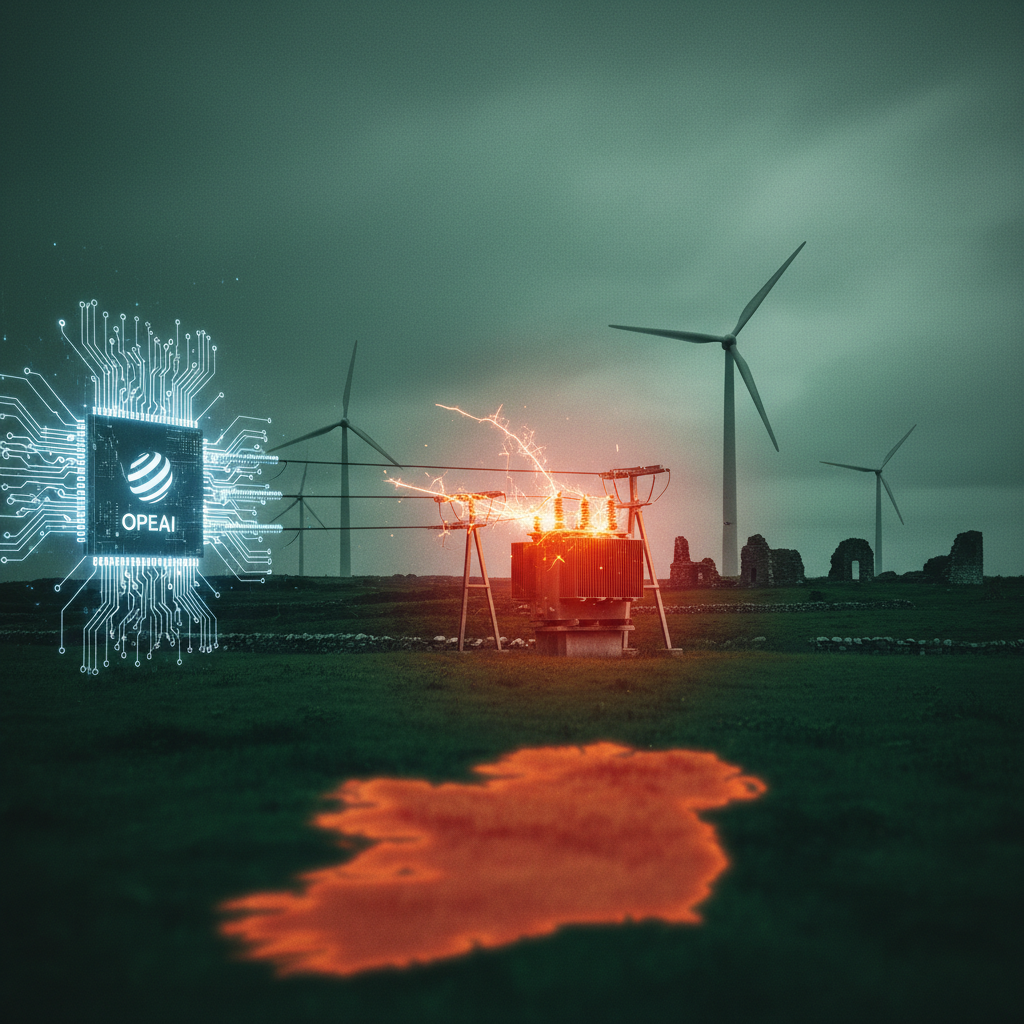

The hum emanating from Ireland's burgeoning data centers, home to the digital infrastructure of global tech giants like Microsoft, Google, and Amazon, has long been a source of economic pride. Yet, beneath the veneer of technological advancement and foreign direct investment, a far more unsettling reality is taking root. The relentless march of artificial intelligence, particularly the resource intensive demands of large language models from entities such as OpenAI and Anthropic, is creating an energy crisis that threatens to eclipse even our most pressing environmental concerns, and Ireland, with its disproportionate share of data infrastructure, stands at a precipice.
Behind the press release lies a very different story. While the public narrative often focuses on the transformative potential of AI, the sheer volume of electricity required to train and run these sophisticated models is staggering. We are not merely talking about servers running spreadsheets, but vast, interconnected supercomputers that consume power on a scale previously unimaginable for commercial operations. Industry estimates suggest that by 2030, AI data centers could demand as much electricity as entire countries, a figure that sends shivers down the spine of anyone familiar with Ireland's already strained energy infrastructure. Our small island nation, a magnet for data centers due to its cool climate, robust connectivity, and favorable tax regime, is now grappling with the very real prospect of energy rationing and increased carbon emissions, all in the name of algorithmic progress.
Why most people are ignoring it, one might ask. The answer is multifaceted, rooted in a blend of corporate opacity, political expediency, and a general lack of public understanding regarding the physical footprint of the digital world. The abstract nature of AI, often presented as ethereal code, obscures its very tangible impact. Furthermore, the economic benefits, real or perceived, of hosting these data behemoths often overshadow the environmental and infrastructural costs. Politicians, eager to trumpet job creation and investment, are slow to acknowledge the elephant in the room, or perhaps, the server farm in the field.
How does this affect you, the ordinary citizen, the small business owner, the family trying to keep their home warm in winter? The implications are profound and personal. Firstly, increased demand drives up electricity prices. As the national grid struggles to meet the voracious appetite of AI data centers, the cost of power for homes and businesses inevitably rises. This is not some distant economic theory, but a direct hit to household budgets and operational costs for local enterprises. Secondly, it jeopardizes Ireland's climate targets. EirGrid, our national grid operator, has warned repeatedly about the challenge of integrating renewable energy sources quickly enough to keep pace with data center growth. This means a greater reliance on fossil fuels, undermining our commitment to a greener future and potentially incurring hefty EU fines. Thirdly, it could lead to energy insecurity. Imagine rolling blackouts, not due to a storm, but because the grid cannot handle the concurrent demands of a cold snap and a new OpenAI model training run. This is not hyperbole, it is a scenario being actively discussed in energy circles.
The bigger picture reveals a global dilemma. The AI energy crisis is not unique to Ireland, but our concentrated data center presence makes us an early warning signal for the rest of Europe and beyond. The European Union has ambitious climate goals, yet its digital economy is increasingly powered by energy intensive AI. This tension between digital ambition and environmental responsibility is a critical policy challenge. Economically, the concentration of AI compute power in a few regions, driven by energy availability and cost, could exacerbate existing digital divides. Socially, the environmental burden is disproportionately borne by local communities, often without commensurate benefits. The Irish tech sector has a secret it doesn't want you to know, and it's powered by fossil fuels.
What experts are saying paints a stark picture. Dr. Emma Daly, an energy policy analyst at University College Dublin, recently stated, “We are in a race against time. The current trajectory of data center growth, particularly with the advent of generative AI, is simply unsustainable for our grid. We need a national strategy that prioritizes energy efficiency and renewable integration, not just unbridled expansion.” Similarly, Frank O’Donnell, a senior executive at EirGrid, has publicly voiced concerns, noting, “The pace of data center connection requests far outstrips our ability to upgrade and green the grid. We are seeing demand forecasts that are truly unprecedented.” From a technological perspective, Jensen Huang, CEO of NVIDIA, a company at the heart of the AI hardware boom, has acknowledged the issue, stating that “compute is getting cheaper, but power is not.” This highlights the fundamental challenge: even as chips become more efficient, the sheer scale of AI operations drives overall consumption skyward. Even Dario Amodei, CEO of Anthropic, has spoken about the need for more energy efficient AI architectures, recognizing the environmental footprint of their cutting edge models.
What you can do about it might feel limited, but collective action holds power. As citizens, we must demand greater transparency from both government and tech companies regarding energy consumption and carbon footprints. Support policies that incentivize renewable energy development and penalize energy waste. Engage with local planning processes to ensure new data centers meet stringent environmental criteria. As consumers, consider the energy impact of your digital choices, even if seemingly small. As investors, scrutinize companies' environmental, social, and governance, or ESG, reports for genuine commitments to energy sustainability, not just greenwashing. The power, quite literally, is in our hands to shape a more responsible digital future.
The bottom line is this: the AI energy crisis will matter profoundly in five years. If left unaddressed, it will lead to higher energy costs for everyone, hinder our climate goals, and potentially destabilize national grids. Ireland, with its unique position as a European data hub, serves as a crucial case study. The choices we make today regarding energy policy and data center regulation will determine whether AI becomes a sustainable force for good or an unsustainable drain on our planet's resources. The time for passive observation is over; it is time for rigorous investigation and decisive action.
For further reading on the energy demands of AI, consider reports from MIT Technology Review and analyses published by Reuters. The ongoing debate about data center expansion in Ireland is also regularly covered by local news outlets and national energy authorities. You can also delve into the broader implications of AI's environmental impact by exploring discussions on Wired. This issue is not merely a technicality; it is a fundamental challenge to our collective future. The stakes are too high for us to look away. For a deeper dive into the startup landscape of AI, you might find this article on NVIDIA's Reign and the Great Chip Choke: Why Australia's AI Dreams Could Crumble Without a Steady Supply [blocked] relevant.