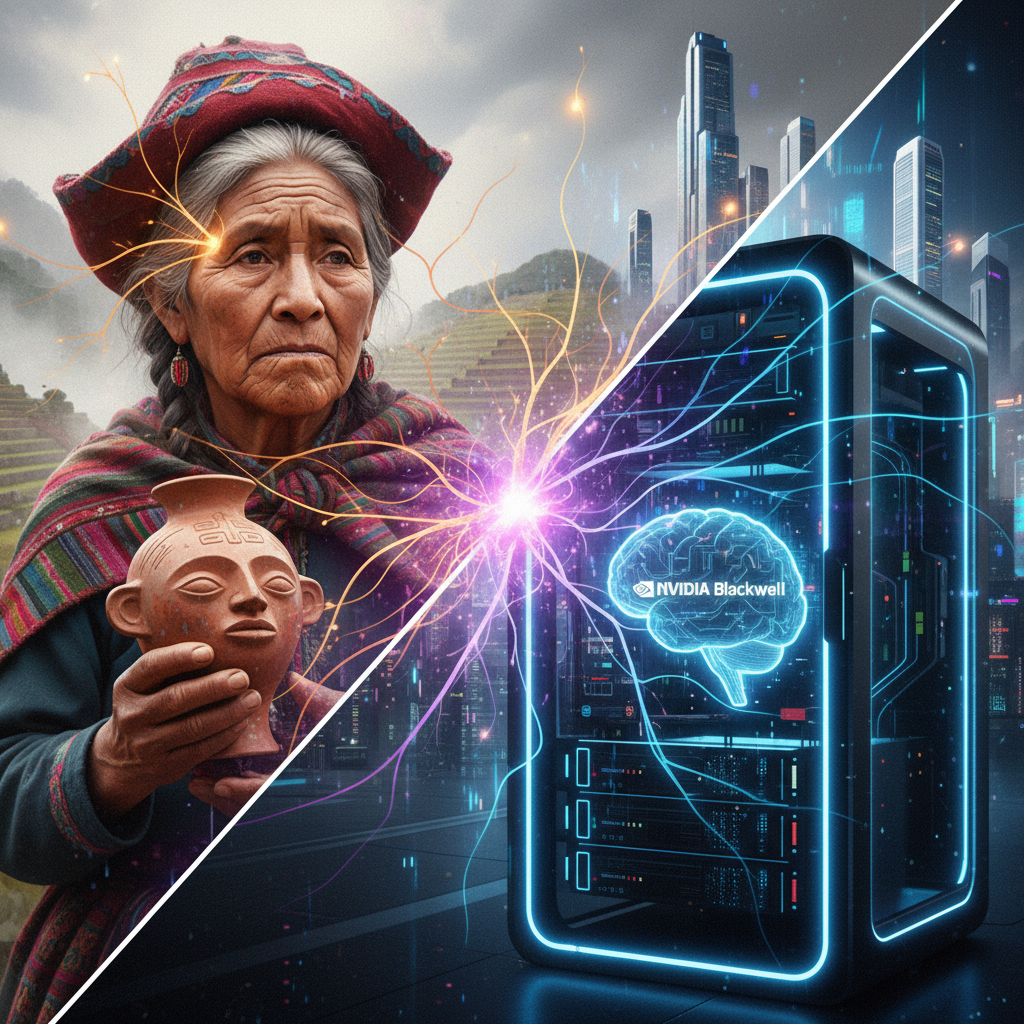

The sun was just beginning to warm the cobblestones of Cusco as I sat with Mama Rosa, a weaver whose hands have spun generations of stories into vibrant textiles. She spoke of the ayni, the reciprocal relationship between people and nature, and the pachamama, the mother earth who provides. Her wisdom, passed down through oral tradition, felt as tangible as the crisp Andean air. Then, my phone buzzed, a notification about NVIDIA's latest Blackwell architecture, a marvel of silicon and speed promising to accelerate AI training to unprecedented levels. The contrast was stark, almost jarring, and it made me wonder: how will this immense technological power, born in distant labs, truly resonate with minds shaped by such profound, ancient connections, especially here in Peru? This is a story about ancient wisdom meeting modern AI, and the quiet cognitive revolution it might bring to our people.
NVIDIA's dominance in the AI hardware space is not just a business story, it is a foundational shift in how intelligence itself is being constructed and disseminated. Their new Blackwell architecture, with its reported 208 billion transistors and capability to handle trillions of parameters, is designed to be the engine for the next generation of large language models and generative AI. Jensen Huang, NVIDIA's CEO, has often spoken about this era as a new industrial revolution, with GPUs as the factories. Indeed, companies like OpenAI, Google, and Meta are all heavily reliant on these powerful processors to train their ever-larger models, pushing the boundaries of what AI can do. The sheer scale of computation involved means that the AI systems we interact with daily, from our chatbots to our predictive algorithms, are becoming increasingly sophisticated, almost imperceptibly shaping our cognitive landscapes. Bloomberg Technology often highlights how these advancements are driving market valuations and technological progress globally.
But what does this mean for us, the people interacting with these AIs, particularly here in Peru? I have seen it in the younger generations in Lima, their fingers flying across screens, fluent in the language of algorithms. They use AI for everything from homework assistance to creating digital art inspired by pre-Columbian designs. The immediate benefit is clear: access to information, creative tools, and even new forms of communication. However, there is a subtle shift happening, a cognitive reorientation that psychologists are just beginning to understand. Dr. Elena Vargas, a cognitive psychologist at the Pontificia Universidad Católica del Perú, shared her concerns with me.