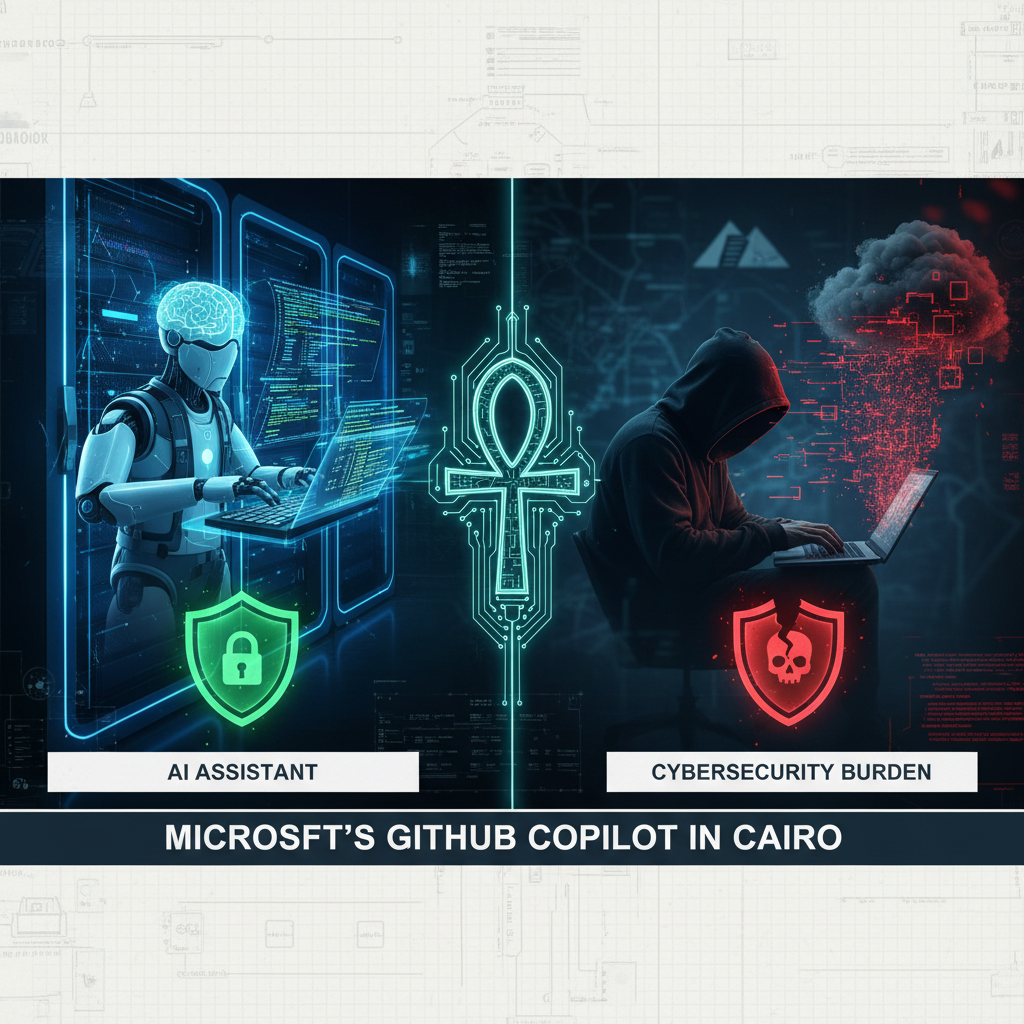

In the bustling digital souqs of Cairo, where startups bloom like jasmine in spring and young developers are coding the future, a new tool has become the talk of the town: Microsoft's GitHub Copilot. It’s an AI pair programmer, a digital genie that suggests lines of code and even entire functions as you type. For many, it feels like magic, a shortcut to faster development and fewer bugs. But as someone who has navigated the labyrinthine world of computer science and now reports on its ever-shifting landscape, I find myself asking: Is this digital assistant truly a blessing, or does it carry a hidden cybersecurity burden, especially for a nation like Egypt that is rapidly building its digital infrastructure?
Let me break this down. GitHub Copilot, powered by OpenAI's Codex model, was trained on a vast ocean of publicly available code. It learns patterns, predicts what you want to write, and offers suggestions. The initial promise was clear: boost developer productivity, reduce boilerplate code, and allow engineers to focus on higher-level problem-solving. Indeed, early reports from Microsoft and independent studies have been glowing. A paper published by researchers from GitHub and Microsoft, for example, found that developers using Copilot completed tasks significantly faster and with higher satisfaction. This is not just a marginal improvement; it's a fundamental shift in how code is written.
The Breakthrough in Plain Language: Your Digital Co-Pilot
Imagine you are building a complex application, perhaps a new e-commerce platform for artisans in Khan el-Khalili. You start typing a function, say, to process a payment. Before you can even finish the function signature, Copilot pops up with a suggestion for the entire function body, complete with error handling and data validation. It's like having an experienced senior developer looking over your shoulder, offering perfect, context-aware snippets of code. This isn't just autocomplete; it's code generation. It understands the context of your project, the comments you've written, and even the names of your variables, to produce remarkably relevant and often correct code.
Why It Matters: Productivity, Innovation, and the Global Race
For Egypt, a country with a rapidly growing youth population and an ambitious vision for digital transformation, tools like Copilot are incredibly appealing. Our government's 'Digital Egypt' strategy emphasizes fostering innovation and creating a competitive tech workforce. If Copilot can genuinely make our developers 30% or even 50% more productive, as some studies suggest, then it accelerates our journey towards becoming a regional tech hub. It means more startups, faster product cycles, and potentially, a stronger position in the global digital economy.
However, this rapid adoption isn't without its shadows. The very nature of Copilot's training data, which includes public repositories, raises questions about intellectual property and, more critically, cybersecurity. What if the code it suggests contains vulnerabilities or licenses that are incompatible with a project's requirements? This is not a hypothetical concern. Researchers have already demonstrated instances where Copilot can generate insecure code. For example, a study by researchers from Stanford University and Google found that Copilot generated insecure code in 40% of the scenarios tested, often including vulnerabilities like SQL injection or path traversal. This is a significant finding, as it means developers, especially those less experienced, might inadvertently introduce security flaws into their applications.
The Technical Details: A Deep Dive into Codex's Mind
At its core, GitHub Copilot leverages a large language model, specifically OpenAI's Codex, which is a descendant of the GPT series. Think of it this way: just as GPT-3 can generate human-like text after being trained on billions of words, Codex was trained on billions of lines of code. It doesn't understand code in the human sense; rather, it learns the statistical relationships and patterns within the code. When you type, it takes your input as a prompt and predicts the most probable next sequence of characters, which often happens to be valid and functional code.
Here's what's actually happening under the hood: when you write a comment like // function to fetch user data from database, Copilot processes this natural language prompt, combines it with the surrounding code context, and then uses its learned patterns to generate a suitable code block. The challenge lies in the fact that its training data, while vast, is not curated for security or best practices. It reflects the good, the bad, and the ugly of publicly available code. This means that if a common pattern for a particular task in the training data involves a known vulnerability, Copilot might reproduce that vulnerability in its suggestions.
Who Did the Research: Unpacking the Security Concerns
The concerns about Copilot's security implications are not mere speculation. Leading research institutions have been diligently investigating this. A notable paper, “An Empirical Study of Vulnerabilities in GitHub Copilot Generated Code” by Hammond et al. from Stanford University, published in the arXiv repository, meticulously analyzed the security of Copilot-generated code. They found that a significant portion of the code suggestions contained security vulnerabilities, particularly when developers provided vague or incomplete prompts. This suggests that while Copilot is powerful, it requires a human in the loop who understands security best practices and can critically evaluate the generated code.
Another important voice in this discussion is Dr. Hany Farid, a professor at the University of California, Berkeley, and a leading expert in digital forensics and cybersecurity. He has frequently highlighted the ethical and security challenges posed by AI-generated content, including code. While not specifically on Copilot, his work on the broader implications of AI for integrity and security resonates deeply with these concerns. As he once stated, “The promise of AI is immense, but so is the potential for misuse and the introduction of new vulnerabilities if we don't approach it with caution and rigorous testing.”
Implications and Next Steps for Egypt
For Egyptian developers and tech companies, this presents a dual challenge and opportunity. On one hand, Copilot offers an undeniable productivity boost, allowing our talent to compete more effectively on a global scale. On the other hand, it necessitates a heightened focus on cybersecurity education and code review processes. We cannot afford to simply copy and paste AI-generated code without critical scrutiny. The cost of a data breach or a system compromise, especially in critical sectors like banking or government services, is far too high.
Our universities and coding bootcamps, like ITI (Information Technology Institute) and GIZ-Egypt's initiatives, must integrate security best practices for AI-assisted development into their curricula. Developers need to be trained not just on how to use Copilot, but how to critically evaluate its suggestions for security flaws, licensing issues, and adherence to architectural principles. Tools for static code analysis and dynamic application security testing (sast and Dast) become even more crucial when AI is generating code.
Furthermore, Egyptian tech leaders and policymakers should advocate for transparency and accountability from AI tool providers like Microsoft. Understanding the provenance of the training data and the mechanisms for identifying and mitigating biases or vulnerabilities in the generated code is paramount. This isn't just about protecting our digital assets; it's about building trust in the AI tools that are rapidly becoming indispensable.
In the end, GitHub Copilot is a powerful tool, much like a modern tractor for a farmer in the fertile Nile Delta. It can dramatically increase yield and efficiency. But just as a farmer needs to understand the soil, the seeds, and the weather to cultivate a healthy crop, a developer needs to understand the code, its implications, and its potential vulnerabilities, even when an AI has helped write it. The future of software development in Egypt, and indeed globally, will be defined not just by the speed of AI, but by the wisdom and vigilance of the humans who wield it. The conversation around AI and cybersecurity is not just for Silicon Valley; it's a global imperative, and Cairo is very much a part of it. For more insights into the broader impact of AI, you can always check out TechCrunch's AI section. The journey of integrating AI responsibly is just beginning, and it requires continuous learning and adaptation from all of us.