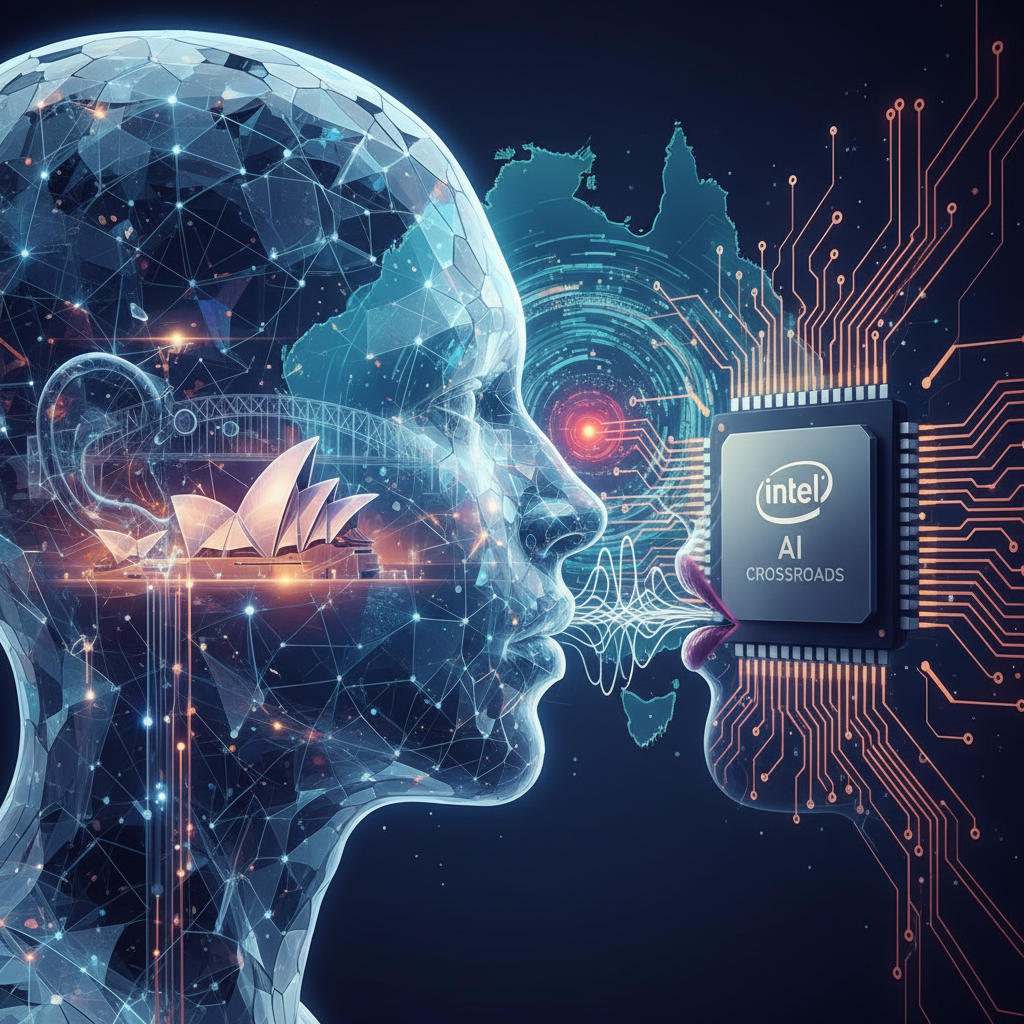

The sun was just dipping below the horizon, painting the Sydney Harbour Bridge in hues of orange and purple, a sight that usually fills me with a deep sense of calm. But for Liam, a 34-year-old architect from Bondi, that calm was a distant memory. He was hunched over his laptop, eyes glazed, trying to coax another complex render from an AI-powered design suite. "It's brilliant, Braideùn, truly revolutionary," he told me a few weeks back, his voice buzzing with the kind of excitement I usually reserve for a new renewable energy breakthrough. "I can iterate designs in minutes that used to take days. Intel's Gaudi chips, or whatever they're calling them now, are making this possible." He was convinced this new era of hyper-efficient AI, driven by powerful hardware, was going to free up his creative spirit. Now, however, the lines around his eyes were deeper, his posture slumped. The AI wasn't just assisting him, it was dictating the pace, demanding more iterations, faster decisions, and an almost constant cognitive load. He felt less like a master architect and more like a high-speed data entry clerk for an insatiable digital assistant. This isn't just Liam's story, it's a growing narrative across our sunburnt country, a fascinating, sometimes unsettling, look at the human side of the AI accelerator chip wars.
Intel, a titan of the semiconductor world, has been making a spirited charge to reclaim its place at the forefront of AI hardware, particularly with its Gaudi line of AI accelerators. While NVIDIA's Cuda platform has long been the undisputed champion, Intel's aggressive push, coupled with open-source initiatives and competitive pricing, is shaking things up. They're not just selling chips, they're selling the promise of faster, more accessible AI, from the cloud to the edge. And here in Australia, where innovation often blooms fiercely in the face of geographic isolation, businesses and individuals are eagerly adopting these new tools. From AI-driven agricultural analytics in regional Queensland to personalised learning platforms in Melbourne's schools, the computational grunt provided by these chips is transforming sectors at a dizzying pace. But as these algorithms become more sophisticated, running on ever more powerful silicon, what is the psychological toll on us, the humans interacting with them?
Recent research from the University of New South Wales, led by Dr. Anya Sharma, a cognitive psychologist, suggests a fascinating duality. "On one hand, these advanced AI systems, powered by chips like Intel's Gaudi 3, are undeniably boosting productivity and offering unparalleled creative tools," Dr. Sharma explained to me over a flat white in her campus office. "We're seeing architects like Liam, graphic designers, even researchers, achieving outputs previously unimaginable. The AI handles the grunt work, the repetitive tasks, allowing for more focus on conceptualisation. This can lead to a sense of empowerment, a feeling of augmented capability." She paused, stirring her coffee. "However, the flip side is a subtle but significant shift in cognitive load and decision-making. When AI presents optimal solutions or rapid iterations, humans can experience what we call 'automation bias' or 'algorithm aversion.' We either over-rely on the AI, reducing our critical thinking, or we distrust it entirely, leading to frustration and inefficiency." Her team's preliminary findings indicate a 15% increase in reported 'decision fatigue' among professionals heavily reliant on AI-accelerated tools over the past year, alongside a 10% decrease in self-reported 'creative autonomy.' This is the kind of data that makes you sit up and take notice.
This isn't merely about faster computers; it's about the very fabric of our mental processes. The constant feedback loops and accelerated pace of AI-driven workflows, enabled by chips that can process petabytes of data in moments, are rewiring our expectations. We become accustomed to instant gratification, to having complex problems distilled into actionable insights almost immediately. When that pace is interrupted, or when the AI falters, the frustration can be immense. "My Irish roots taught me to question, my Australian home taught me to build," and I've always seen technology as a tool for human flourishing. But this new frontier demands a deeper look at the human element.
Dr. David Chen, a behavioural economist at the University of Sydney, echoed Dr. Sharma's concerns, but with a focus on relationships. "Consider the rise of AI-powered personal assistants or even sophisticated chatbots that are now running on these faster, more responsive chips," he pointed out. "They can mimic human conversation with astonishing accuracy, offer emotional support, and even anticipate our needs. While incredibly convenient, there's a risk of what we call 'social displacement.' If our primary interactions become with perfectly calibrated, non-judgmental AI, does it subtly alter our expectations for human relationships? Do we become less tolerant of imperfection, less willing to engage in the messy, unpredictable dance of human connection?" He cited a recent study showing a 7% increase in preference for AI-generated customer service interactions over human ones among Australians under 30, a trend he finds both fascinating and a little concerning. The smooth, efficient, always-on nature of AI, powered by chips that eliminate latency and lag, might just be setting an impossibly high bar for our flesh-and-blood counterparts.
The broader societal implications here in Australia are significant. As Intel and its rivals push the boundaries of AI hardware, the accessibility of these powerful tools democratises AI development, yes, but it also means more Australians are interacting with more sophisticated AI, more often. This isn't just about work; it's about how we learn, how we play, how we connect. Imagine an AI coach for junior sports, analysing every movement with incredible precision, providing instant feedback. Or an AI companion for the elderly, offering conversation and reminders. These are wonderful applications, but they demand a conscious effort to balance efficiency with humanity. We need to teach digital literacy that goes beyond simply using the tools, but understanding their psychological impact. We need to cultivate 'AI mindfulness,' if you will, to ensure we remain the masters of our cognitive landscape, not merely passengers.
There's something happening in the Southern Hemisphere that Silicon Valley hasn't noticed yet, and it's how we're adapting, or struggling to adapt, to this new cognitive reality. It's not enough for companies like Intel to just build faster chips; they also bear a responsibility to understand the human brain that will be interacting with their creations. "The future isn't just about raw computational power, it's about harmonious human-AI symbiosis," stated Professor Eleanor Vance, head of the Australian Institute for AI Ethics in Canberra. "We need to design AI systems, and the hardware that powers them, with human psychological well-being at their core. This means building in features that encourage critical thinking, that allow for 'off-ramps' from constant digital engagement, and that promote genuine human connection, rather than displacing it." Her institute is advocating for new design principles that prioritise cognitive health, a move I wholeheartedly support.
So, what's a savvy Aussie to do? First, embrace the power, but with a healthy dose of skepticism. Use these incredible AI tools, whether they're running on Intel's latest silicon or NVIDIA's GPUs, to augment your abilities, not replace your judgment. Second, cultivate deliberate 'AI-free zones' in your day. Step away from the screen, engage in activities that demand purely human cognition, like a good old-fashioned yarn with a mate or a walk along the beach. Third, demand transparency. Ask how the AI is making its recommendations, understand its limitations, and push for ethical design from the companies building these systems. The fight for AI relevance might be about chips and market share for the tech giants, but for us, it's about safeguarding our minds and our humanity. The future is bright, truly, but only if we navigate this brave new world with our eyes wide open and our critical faculties engaged. The silicon might be getting smarter, but we need to ensure our own minds are keeping pace, and perhaps, even leading the way. For more on the psychological impacts of AI, you can always check out MIT Technology Review. And for the latest in AI business news, Reuters is always a good bet.