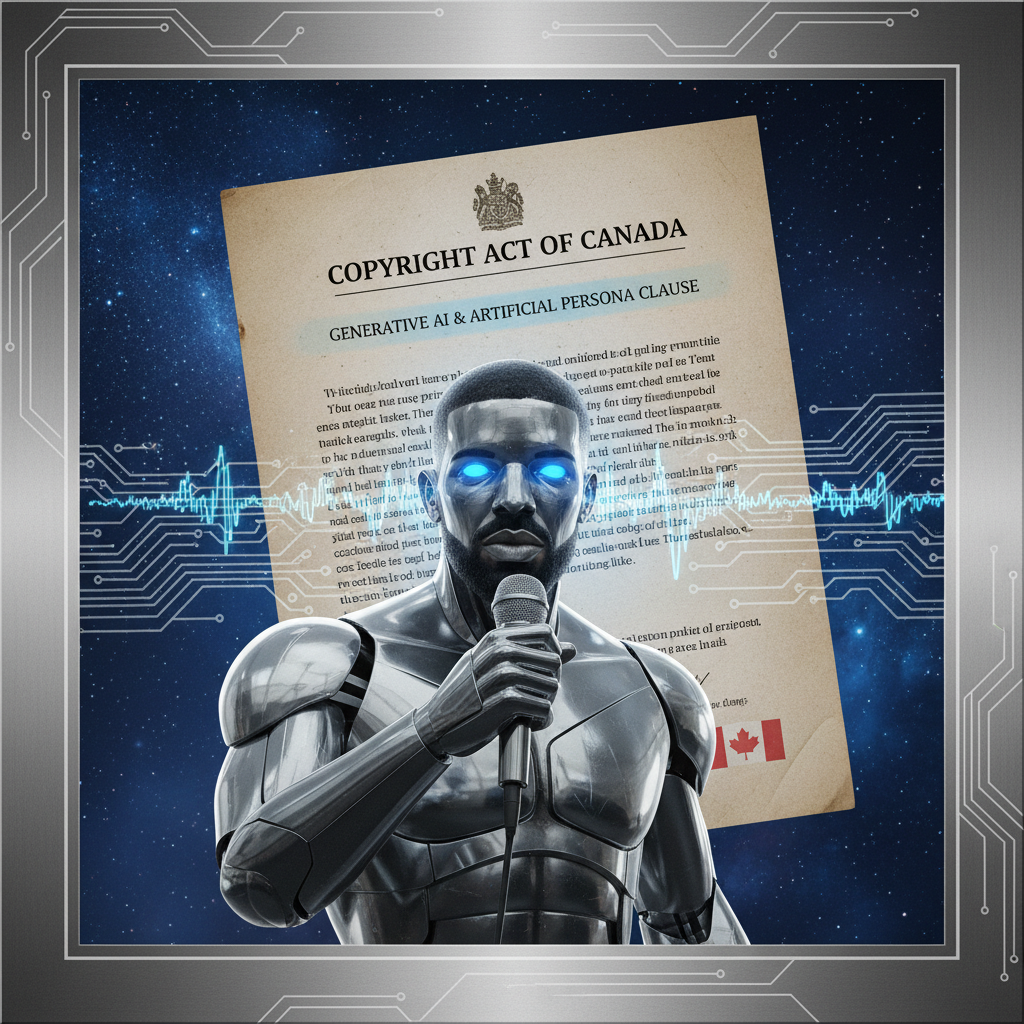

The year is 2026, and the airwaves are buzzing with a new hit. It sounds uncannily like Drake, the Toronto icon, but he never laid down the track. It is a perfectly crafted, emotionally resonant song, generated by an AI model trained on his entire discography. This is not science fiction anymore, my friends, this is the very real, very unsettling reality facing the music industry, and Canada, with its rich cultural tapestry and vibrant arts scene, is right in the thick of it.
For months now, we have seen AI-generated tracks, often mimicking popular artists, gain millions of streams on platforms like Spotify and Apple Music. Remember that 'Heart on My Sleeve' track that sounded exactly like Drake and The Weeknd? It was a viral sensation, pulled down eventually, but it served as a stark warning. The technology is advancing at a breathtaking pace, and our laws, bless their well-intentioned hearts, are struggling to keep up. It is like trying to put out a forest fire with a garden hose; the scale of the problem demands a more robust response.
The Policy Move: Modernizing Canada's Copyright Act
Recognizing this burgeoning crisis, the Canadian government has been quietly, yet urgently, working on amendments to the Copyright Act. The proposed changes, which are currently undergoing stakeholder consultations, aim to clarify ownership and remuneration for works created or heavily influenced by artificial intelligence. The core of the proposal centers on defining what constitutes 'authorship' in an AI era and establishing clear guidelines for the use of copyrighted material in training AI models. It is a delicate dance, balancing innovation with protection, much like trying to navigate a toboggan down a steep, icy hill; one wrong move and you are in for a bumpy ride.
Specifically, the draft legislation suggests a two-pronged approach. First, it proposes that for a work to be considered 'authored' and thus eligible for copyright protection, there must be a significant human intellectual contribution. This directly addresses the issue of purely AI-generated content. Second, it explores a licensing framework for data used to train AI models, suggesting that creators whose works are ingested by these systems should be compensated. This is a big one, as it directly impacts the 'free for all' mentality that has prevailed in much of the AI training landscape.
Who is Behind It and Why?
This push is not coming from a single corner. It is a chorus, if you will, of concerned voices. Innovation, Science and Industry Canada, under Minister François-Philippe Champagne, has been spearheading the legislative review. Their motivation is clear: protect Canadian artists and ensure a fair marketplace. As Minister Champagne stated in a recent press conference, “Our goal is to foster innovation while safeguarding the livelihoods of our creators. We cannot allow technology to erode the very foundation of our cultural industries.”
But it is not just the government. Major industry players, including Music Canada, the Canadian Independent Music Association (cima), and individual artist collectives, have been lobbying intensely. They are seeing their members' work being replicated, sampled, and re-imagined by algorithms without permission or compensation. Imagine a maple syrup producer finding out a factory is making 'maple-flavored' syrup using their secret recipe, but without paying a dime. That is the kind of frustration we are talking about.
What It Means in Practice: A New Era for Licensing
If these amendments pass, the practical implications will be profound. For AI developers, it means a significant shift from the current practice of scraping vast datasets without explicit licensing. Companies like Google DeepMind and OpenAI, whose models are often trained on colossal amounts of internet data, would face new obligations. They would likely need to negotiate collective licensing agreements with rights holders or face potential infringement lawsuits. This could lead to a more structured, and hopefully fairer, ecosystem for data acquisition.
For artists and record labels, it offers a glimmer of hope for fair compensation. Instead of helplessly watching their intellectual property become the fuel for AI's creative fire, they could potentially earn royalties from the use of their work in training datasets. This could also spur the creation of 'AI-friendly' licensing options, where artists can choose to license their work for AI training under specific terms, perhaps even retaining some control over how their 'digital essence' is used.
Industry Reaction: A Mix of Relief and Trepidation
The reaction from the music industry has been, predictably, a mixed bag. On one hand, there is a palpable sense of relief that the government is finally taking decisive action. Patrick Rogers, CEO of Music Canada, recently told Reuters, “This is a critical step towards creating a sustainable future for Canadian music. Our artists deserve to be compensated when their work contributes to the development of new technologies.” Reuters has been tracking this global debate closely, highlighting similar concerns in other jurisdictions.
However, there is also trepidation. Some smaller AI music startups worry that stringent licensing requirements could stifle innovation, making it prohibitively expensive to develop new tools. They argue that the sheer volume of data required for effective AI training makes individual licensing negotiations impractical. It is a valid concern, like asking every single person who picks a blueberry in Quebec to negotiate with the landowner individually. There needs to be a scalable solution.
Civil Society Perspective: The Broader Ethical Questions
Civil society groups, particularly those focused on digital rights and artistic integrity, are largely supportive of stronger protections. They emphasize the ethical dimensions of AI-generated content, particularly when it comes to deepfakes and the potential for misuse. Organizations like the Canadian Civil Liberties Association have highlighted the importance of transparency and accountability in AI development, pushing for clear labeling of AI-generated content. They argue that listeners have a right to know if the 'artist' they are enjoying is human or algorithm. It is about maintaining trust, something that is easily eroded in the digital age.
Furthermore, there is a growing debate about the very nature of creativity. If an AI can perfectly emulate a human artist, what does that mean for the human experience of art? This is a philosophical question that goes beyond mere economics. It touches on our identity as creators and consumers of culture. MIT Technology Review has published some thought-provoking pieces on this very topic, exploring the future of human creativity in an AI-dominated world.
Will It Work? The Long Road Ahead
So, will Canada's updated Copyright Act be the silver bullet the music industry needs? The research is fascinating, and the intentions are certainly good, but the path ahead is fraught with challenges. Enforcement will be a monumental task. How do you track every piece of copyrighted material used in training a global AI model? It is a bit like trying to count every snowflake in a Canadian winter storm; nearly impossible.
Moreover, the global nature of AI development means that Canada cannot act in isolation. If other major jurisdictions do not adopt similar frameworks, Canadian artists could still find their work being used by AI models trained elsewhere, without compensation. International cooperation, perhaps through bodies like the World Intellectual Property Organization, will be crucial. This is not just a Canadian problem; it is a global one, and it requires a global solution.
However, Canada, with its strong commitment to cultural protection and its world-class AI research community, particularly in Montreal, is uniquely positioned to lead this conversation. Montreal's AI scene is world-class, here's the proof: the city is home to Mila, the Quebec Artificial Intelligence Institute, a hub of cutting-edge research. Yoshua Bengio, one of the 'godfathers' of AI and head of Mila, has consistently advocated for responsible AI development and ethical considerations. His influence, and the work coming out of institutions like Mila, lends significant weight to Canada's stance on AI governance.
This legislative effort is a vital first step, a declaration that human creativity still holds value in an age of intelligent machines. It will not solve every problem overnight, but it sets a precedent. It tells the world that Canada believes artists deserve to be compensated, whether their work is consumed by humans or by algorithms. The symphony of steel may be playing, but the human voice, I believe, will always find a way to sing the loudest.