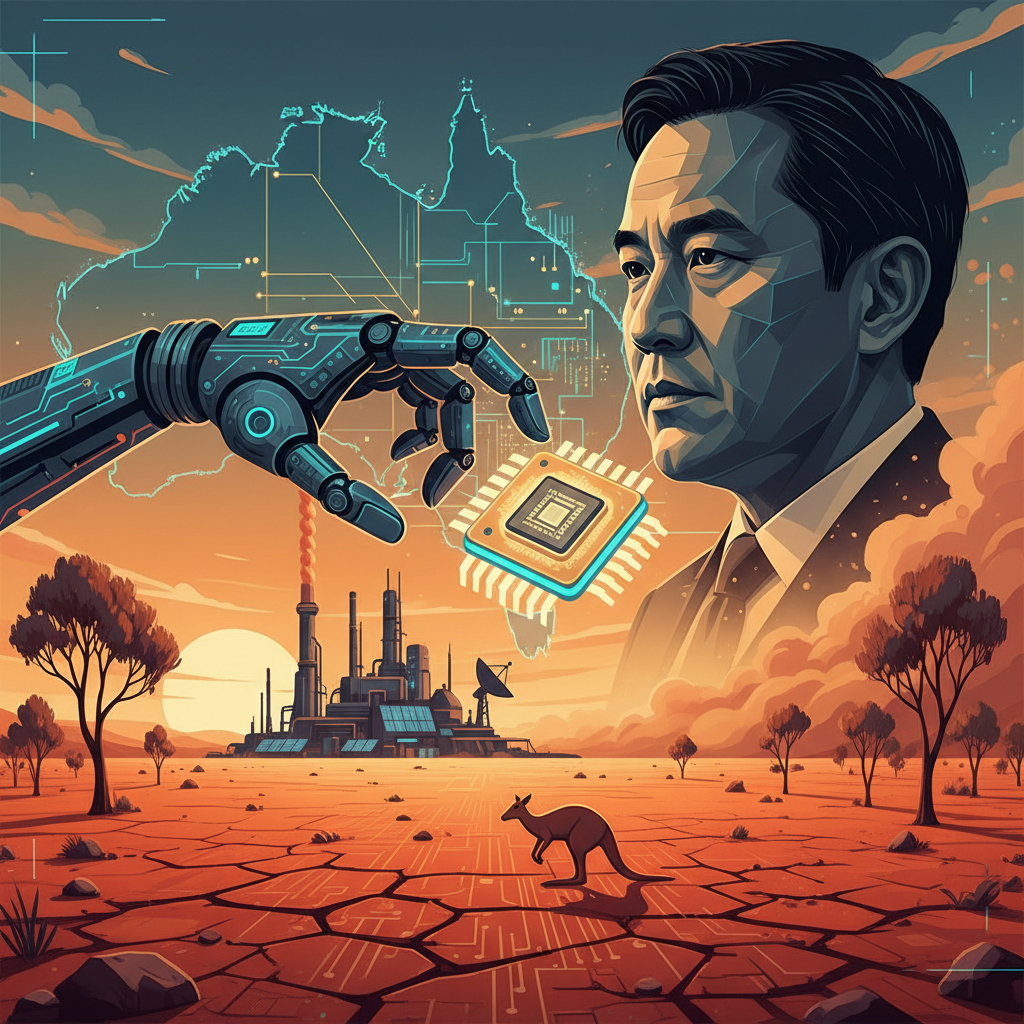

Let's be frank, the global tech supply chain used to be about efficiency, about finding the cheapest, fastest way to get a silicon wafer from one side of the planet to the other. Those days, mate, are as dead as a dodo. We are now living in an era where geopolitics has elbowed its way into every circuit board and every line of code, turning what was once a logistical puzzle into a high stakes game of global chess. And from where I am sitting, Down Under, it is becoming increasingly clear that Australia, often seen as a resource quarry or a nice holiday spot, is suddenly a very important piece on that board.
Take the ongoing chip wars, for instance. Everyone is talking about Taiwan and the US, about Intel and Tsmc, about who gets to churn out the next generation of semiconductors. But what about the raw materials that go into those chips? The rare earths, the lithium, the copper, the nickel, the stuff that literally makes the digital world tick. Guess who has got a fair chunk of that in the ground, just waiting to be dug up? That is right, us. We are not just supplying the ingredients, we are becoming a critical pinch point, and the world is finally starting to notice.
"The notion of a purely globalized, frictionless supply chain is a relic of the past," says Dr. Eleanor Vance, a senior economist at the Australian National University. "Nations are prioritizing resilience and strategic autonomy, and that means looking beyond traditional manufacturing hubs. Australia's mineral wealth, coupled with our stable political environment, makes us an increasingly attractive, albeit complex, partner in this new landscape." She is not wrong. The scramble for secure supply lines is real, and it is reshaping alliances and trade policies faster than you can say 'critical minerals strategy.'
Now, some might argue that Australia is just a quarry, a passive participant in this grand tech drama. They might say our tech sector is too small, too niche, to really influence the big players like Apple or Samsung or even NVIDIA. And sure, we are not going to be building cutting edge fabs in the desert overnight, but that misses the point entirely. Our influence is not just in manufacturing, it is in the foundational elements, the very earth that these companies rely on. And our tech scene, while perhaps not as flashy as Silicon Valley, is like a good flat white, better than you would expect, innovating in areas like mining automation, agricultural tech, and even quantum computing, which are all becoming increasingly vital to a diversified global supply chain.
Consider the push for 'friendshoring' or 'ally-shoring,' where countries are trying to build supply chains with trusted partners. Australia, with its strong democratic institutions and existing alliances, is naturally positioned to benefit from this. We have seen increased interest from the US and European Union in securing our critical mineral output, and that is not just about buying resources, it is about building long term strategic partnerships. This is not just a transactional relationship, it is about embedding Australia deeper into the global tech ecosystem, not just as a supplier, but as a strategic node.
"The current geopolitical climate has accelerated a re evaluation of risk in supply chains," states Marcus Chen, CEO of 'MineSense AI,' an Australian startup developing AI solutions for resource extraction. "We are seeing unprecedented demand for our AI driven optimization tools, not just to increase efficiency, but to provide greater transparency and traceability for critical minerals. Companies want to know exactly where their materials are coming from, and that is where Australian innovation can shine." This is a prime example of how our local expertise is feeding into global solutions.
Of course, it is not all sunshine and lamingtons. There are challenges. For one, we need to move beyond simply digging stuff up and shipping it off. There is a massive opportunity for value adding, for processing these critical minerals here, creating more jobs and greater economic benefit. We also need to be wary of becoming too reliant on any single trading partner, even a friendly one. Diversification is key, both in who we supply and who we source from. The lessons of past commodity booms and busts are still fresh in the memory.
Another counterpoint might be that Australia's labor costs are too high, our population too small, to ever compete with established manufacturing powerhouses. While that holds true for mass production of consumer electronics, it overlooks our strengths in specialized areas. Think about the precision robotics used in our mining operations, or the advanced agricultural tech that helps us feed a continent with limited water. These are areas where Australian innovation is world class, and they are directly relevant to building more resilient and automated supply chains globally. Mate, this AI thing is getting interesting, and it is not just about chatbots, it is about intelligent machines doing the heavy lifting, literally, in our resource sector.
"We are seeing a significant uptick in foreign direct investment in Australian tech companies focused on supply chain resilience and advanced manufacturing," notes Fiona McGregor, head of trade and investment at Austrade. "It is a clear signal that the world views Australia as more than just a raw materials provider, but as a source of innovative solutions for complex global problems." This shift in perception is crucial, and it opens up new avenues for collaboration and growth.
So, what is the takeaway for us, perched on the edge of the Asia Pacific, watching the global tech titans duke it out? It is that we are no longer just spectators. Our resources, our stable governance, and our burgeoning tech talent are making us an indispensable, if sometimes understated, player in the new global tech order. We need to leverage this position wisely, investing in local processing capabilities, fostering innovation in advanced materials and robotics, and building strong, diversified partnerships. The world is looking for secure, ethical, and resilient supply chains, and Down Under, we do things differently, often with a pragmatic ingenuity that is perfectly suited for these turbulent times. The future of tech, from the most advanced AI chip to the simplest circuit, might just depend on what comes out of our red earth. It is time we started acting like it. For more insights into how global events are shaping the tech landscape, check out Reuters Technology or MIT Technology Review. You can also find more about the broader implications of these shifts on TechCrunch.