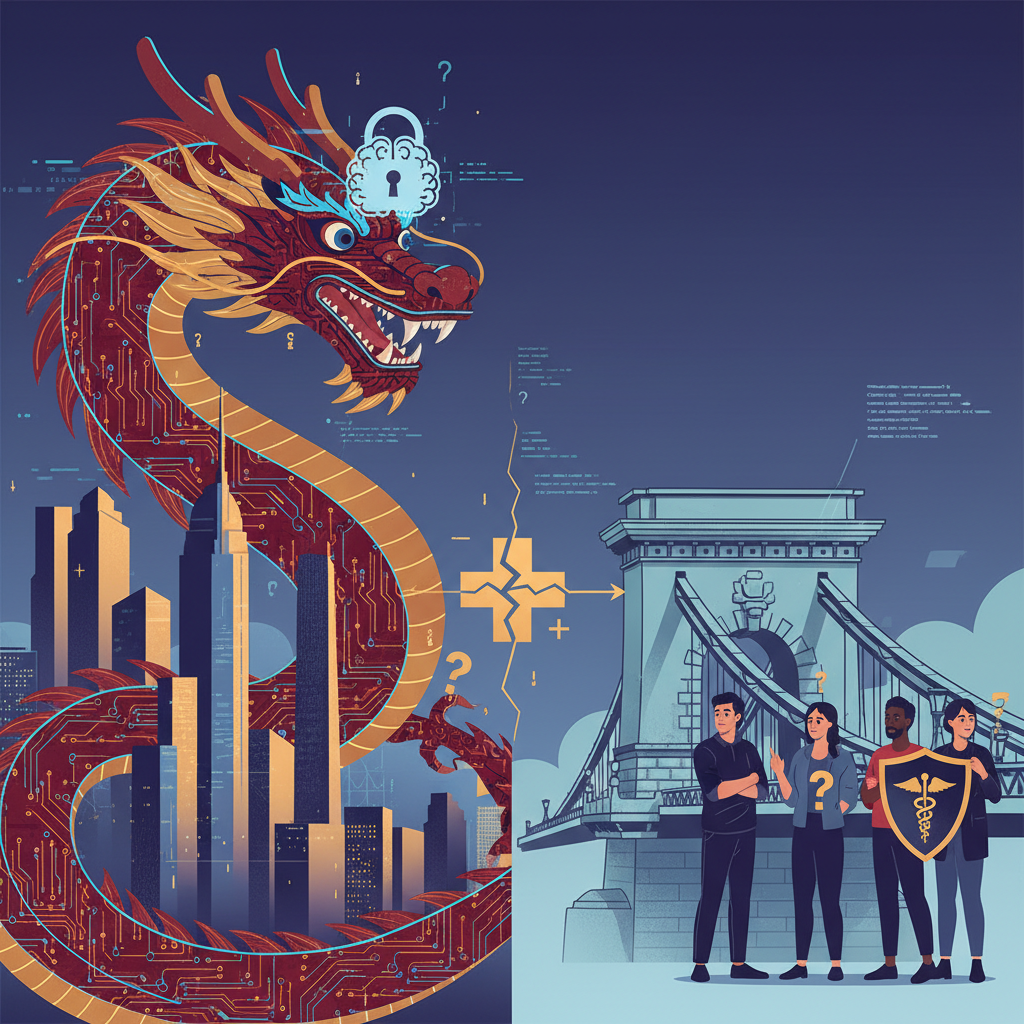

The global tech punditry, particularly those in the gilded cages of Silicon Valley and Brussels, loves to dissect China's approach to artificial intelligence. They marvel at its scale, its speed, its sheer audacity. When it comes to healthcare AI, the narrative becomes almost reverential: a centralized, data-rich ecosystem capable of breakthroughs the West can only dream of. But from where I sit, here in Budapest, I see a different picture, one painted with shades of gray and a healthy dose of suspicion. The Hungarian perspective nobody wants to hear is this: China's model of 'innovation with state control' is a Faustian bargain, especially in the sensitive realm of healthcare, and it's one Europe should eye with extreme caution.
Let's be clear, the achievements are undeniable. China has poured billions into AI research and development, creating a formidable ecosystem. Companies like Baidu, Alibaba, and Tencent are not just mimicking Western tech, they are innovating at a blistering pace, often with direct state backing. In healthcare, this translates into AI-powered diagnostic tools, drug discovery platforms, and personalized treatment plans that are reportedly transforming patient care. We hear tales of AI systems diagnosing diseases with greater accuracy than human doctors, of algorithms sifting through vast genomic datasets to identify novel therapeutic targets. The numbers are often staggering: a reported 90% accuracy in early cancer detection, a 50% reduction in diagnostic time for certain conditions. These figures, if true, are impressive.
However, the very foundation of this success, the ubiquitous state control and the unfettered access to personal data, is precisely where the alarm bells should be ringing. In China, the lines between state, industry, and individual are blurred to the point of non-existence. Healthcare data, from medical records to genetic information, is often considered a national asset, not a private individual's right. This allows for the rapid aggregation of massive datasets, which are the lifeblood of deep learning models. While Western nations grapple with stringent data privacy regulations like GDPR, China operates under a different philosophy, one where collective progress often trumps individual autonomy. This is the engine of their AI healthcare boom, but it's an engine fueled by something we in Europe should find deeply unsettling.
Consider the implications. When an AI system, developed and overseen by the state, becomes the primary arbiter of your health, what recourse do you have if it makes a mistake? What if its algorithms are biased, perhaps inadvertently, against certain demographics or medical histories? In a system where dissent is not tolerated and transparency is often a luxury, the potential for abuse, or simply for uncorrected errors, is immense. "The state's pervasive influence in China's AI development, particularly in sensitive sectors like healthcare, creates a unique set of ethical challenges that Western democracies are only beginning to comprehend," noted Dr. Kai-Fu Lee, a prominent AI investor and author, in a recent interview with Bloomberg Technology. He speaks of the efficiency, yes, but the underlying structure is what truly matters.
Some will argue that the ends justify the means. They will point to the sheer number of people in China, the immense public health challenges, and suggest that a more centralized, data-driven approach is simply necessary for scale. They might say that Western democracies, with their fragmented healthcare systems and obsession with individual privacy, are simply too slow, too inefficient, to compete. They might even suggest that our regulatory frameworks, like the EU's AI Act, are stifling innovation, creating a bureaucratic quagmire that prevents our own AI breakthroughs. "Europe risks falling behind if it prioritizes regulation over rapid deployment and data utilization," warned Margrethe Vestager, the EU's competition commissioner, in a recent address, expressing concerns about the bloc's competitive stance.
Contrarian? Maybe. Wrong? Prove it. I say this is a profoundly naive view, one that sacrifices fundamental human rights on the altar of technological progress. The idea that we must choose between innovation and privacy is a false dilemma, a dangerous narrative pushed by those who stand to gain from unchecked data exploitation. Our fragmented systems, while imperfect, are designed to protect the individual, to ensure accountability. The GDPR, for all its perceived complexity, is a bulwark against the very kind of data free-for-all that powers China's AI. It forces companies and governments to think critically about data provenance, consent, and purpose. It demands transparency, something often absent in state-controlled systems.
Moreover, the notion that state control inherently leads to superior innovation is questionable. While China's top-down approach can mobilize resources quickly, it often stifles the very creativity and independent thinking that drives true scientific advancement. Innovation thrives on open discourse, on challenging assumptions, and on the freedom to fail without fear of political repercussions. When a government dictates the direction of research, when data is a tool for surveillance as much as for discovery, genuine breakthroughs can become subservient to political agendas. This isn't just about healthcare; it's about the very nature of scientific inquiry. As Professor Max Tegmark of MIT has often articulated, the alignment of AI with human values is paramount, and that includes individual liberty and privacy. His work, often highlighted on MIT Technology Review, consistently emphasizes the ethical dimensions of AI development.
We in Europe, and especially in Central Europe, understand the dangers of unchecked state power. Our history is replete with examples of governments using technology, and information, to control populations. The idea of a benevolent state using AI to optimize our health might sound appealing on paper, but the potential for mission creep, for the expansion of surveillance under the guise of public good, is a very real threat. Budapest has a message for Brussels: do not be swayed by the siren song of efficiency if it means compromising our core values. Do not mistake a lack of individual freedom for a shortcut to progress.
The path forward for European healthcare AI must be one that balances innovation with robust ethical frameworks and strong data governance. It means investing in federated learning approaches, where data remains decentralized and privacy-preserving. It means fostering a diverse ecosystem of startups and academic institutions, free from undue state influence, where competition and collaboration drive progress. It means holding companies and governments accountable for the algorithms they deploy. It means learning from China's technological prowess, yes, but rejecting its underlying philosophy of control.
Ultimately, the question is not whether AI can transform healthcare, but how. Will it be a tool for empowerment and individual well-being, or another instrument of state power? For all the dazzling statistics emerging from Beijing, the true measure of an AI system, especially one dealing with our most intimate data, is not just its accuracy, but its humanity. And in that regard, China's model, for all its innovation, leaves me deeply unconvinced. We cannot afford to trade our freedoms for a faster diagnosis. That's a cure worse than the disease. For more on the EU's approach to AI, you might find our previous discussion on Brussels' AI Act [blocked] insightful.