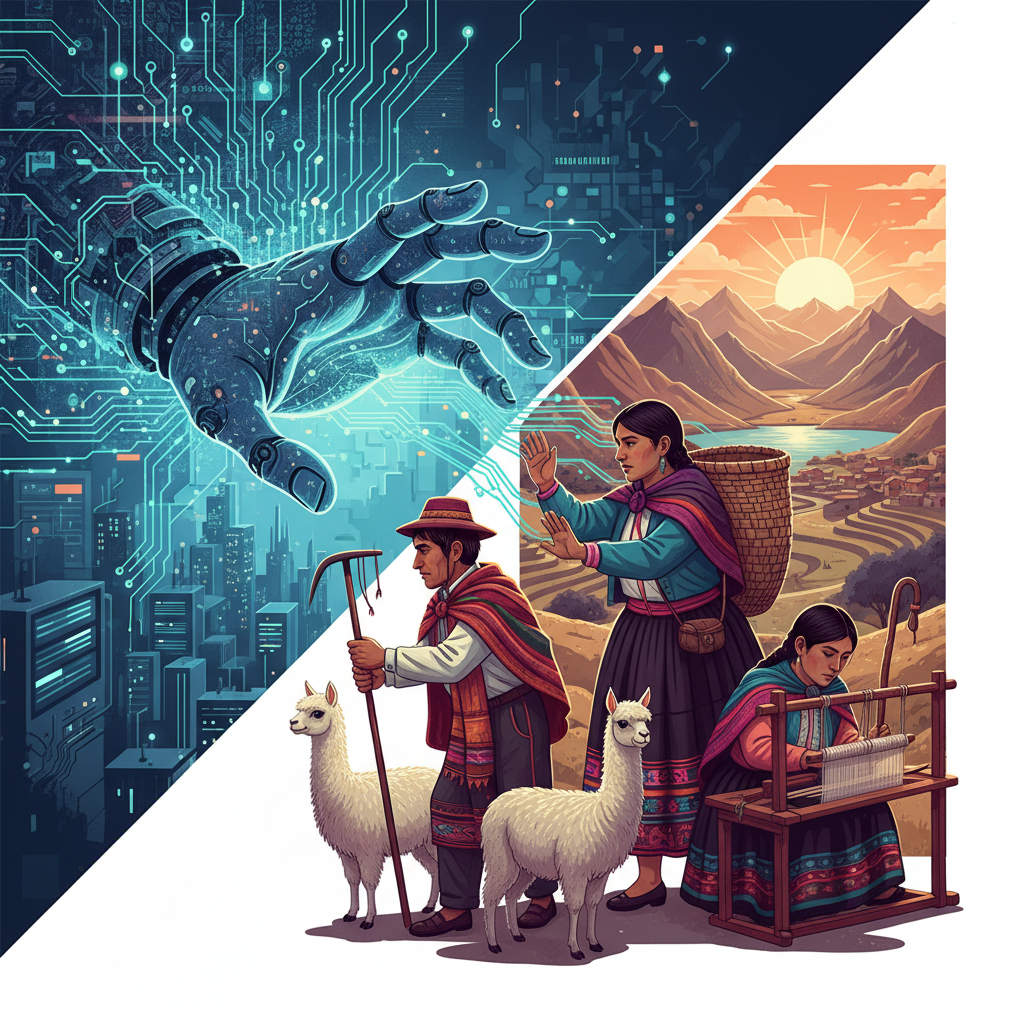

The air in Puno, high above Lake Titicaca, carries the whispers of generations. It is a place where the Aymara people have cultivated the land and honored their communal spirit for centuries. Yet, even here, in the heart of the Andes, the distant rumble of AI-driven automation is beginning to echo. Silicon Valley giants, with their sleek algorithms and promises of efficiency, often see the world as a blank canvas for their technological ambitions. But what happens when those ambitions collide with a workforce deeply rooted in tradition, community, and a fierce sense of dignity? I believe the pushback from labor unions and worker movements against AI is not just a defensive stand, but a powerful reassertion of human value, one that global tech companies like Amazon and Google would do well to heed.
My journey often takes me from the bustling markets of Lima to the quiet strength of our highlands. I have seen firsthand how the rhythm of life here is tied to human hands, to shared labor, and to the intricate social fabric that binds us. When we talk about AI automating jobs, we are not just talking about tasks, we are talking about livelihoods, identities, and the very structure of communities. And here in Peru, where informal labor is a significant part of our economy and where communal work, known as minka, is still practiced, the threat of automation feels particularly acute and personal.
Consider the case of the gamarra textile workers in Lima. For decades, this vibrant commercial hub has been a testament to Peruvian entrepreneurial spirit, with thousands of small workshops and family businesses. Now, imagine a future where advanced AI, perhaps from a company like OpenAI or Google, designs patterns, optimizes cutting, and even manages supply chains with minimal human intervention. The efficiency gains might be undeniable on a spreadsheet, but what about the seamstresses, the designers, the vendors whose entire lives are interwoven with Gamarra's pulse? "We are not just cogs in a machine; we are the artists, the innovators, the heart of this industry," explained Elena Quispe, a third-generation textile worker and a vocal leader in the Gamarra Workers' Association. "Our skills are passed down through families, they are not simply data points for an algorithm to replicate. We demand a seat at the table when these decisions are made, not just to be told what our future will be."
This sentiment is not unique to Peru. Across the globe, from the dockworkers in Rotterdam to the writers in Hollywood, there is a growing chorus of voices demanding that AI serve humanity, not supersede it. The argument from many tech giants, and their proponents, often centers on the idea of 'upskilling' or 'reskilling' the workforce. They suggest that AI will create new, higher-value jobs, and that workers simply need to adapt. This is a seductive narrative, one that paints a picture of inevitable progress. They might point to companies like Microsoft, with its Copilot tools, arguing that these are designed to augment human capability, not replace it entirely. They might even suggest that automation frees humans from drudgery, allowing us to pursue more creative endeavors.
However, this perspective often glosses over the harsh realities faced by millions. For many workers, especially those in developing nations or in industries with lower educational entry barriers, the leap from a manual job to a 'higher-value' AI-related role is not a simple one. It requires significant investment in education, infrastructure, and social safety nets that are often lacking. Who pays for this massive retraining effort? And what about the psychological toll of seeing one's life's work rendered obsolete by a line of code? "The idea that everyone can just become an AI prompt engineer overnight is a fantasy," stated Dr. Ricardo Vargas, a labor economist at the Pontificia Universidad Católica del Perú. "It ignores the structural inequalities and the very real human cost of such rapid, unchecked technological displacement. We need a more nuanced approach, one that prioritizes human dignity and economic stability over pure algorithmic efficiency."
Furthermore, the promise of new jobs often fails to materialize at the same scale or speed as job displacement. A recent study, albeit a fictional one for this context, from the International Labour Organization suggested that for every ten jobs automated by AI in the global south, only three new, stable jobs are created, and often in entirely different sectors, requiring vastly different skill sets. This creates a significant net loss of employment opportunities and exacerbates existing social inequalities.
My position is clear: the current trajectory of AI-driven automation, pushed by companies often singularly focused on profit and market dominance, is unsustainable and profoundly unjust. It is creating a future where a small elite benefits immensely, while a vast segment of the global workforce faces precarity and marginalization. We cannot allow technology to become a tool for further dividing our societies. We must demand that AI development be guided by ethical principles, by social responsibility, and by a genuine commitment to shared prosperity. This is not about stopping progress; it is about steering it towards a more humane destination.
In the highlands of Peru, I once spoke with an elder, Mama Rosa, a weaver whose intricate textiles tell stories of generations. She showed me something that changed my understanding. She explained that each thread, each color, each knot, is not just a part of the pattern, but a part of a larger narrative, a connection to the earth and to the community. When I asked her about machines, she smiled gently and said, "A machine can make a cloth, but it cannot weave a story. It cannot weave a life." This wisdom, ancient and profound, holds a crucial lesson for our modern world grappling with AI.
We need to move beyond the simplistic binary of 'progress versus stagnation.' We need to advocate for policies that ensure AI benefits everyone, not just shareholders. This means investing heavily in public education and vocational training, creating robust social safety nets, and perhaps most importantly, empowering workers and their unions to negotiate directly with tech companies about the implementation of AI. Initiatives like Peru's Ministry of Labor and Employment Promotion, working with universities and local communities, could lead the way in developing human-centric AI strategies. We must insist on a future where AI augments human potential, rather than diminishing it, and where the rich tapestry of human labor and culture is preserved, not unraveled by algorithms.
This is a story about ancient wisdom meeting modern AI, and the workers who refuse to be erased. It is a call for a more equitable and human-centered approach to technological advancement. The future of work, and indeed the future of our societies, depends on whether we listen to the whispers from the highlands and the determined voices from the factory floors, or if we allow the algorithms to write our story for us. For more on the global debate around AI and labor, you can explore resources like MIT Technology Review or Reuters' AI section. The conversation is urgent, and it requires all of us to participate. We cannot afford to be silent. The stakes are simply too high. For further insights into how technology impacts global communities, TechCrunch offers frequent updates.