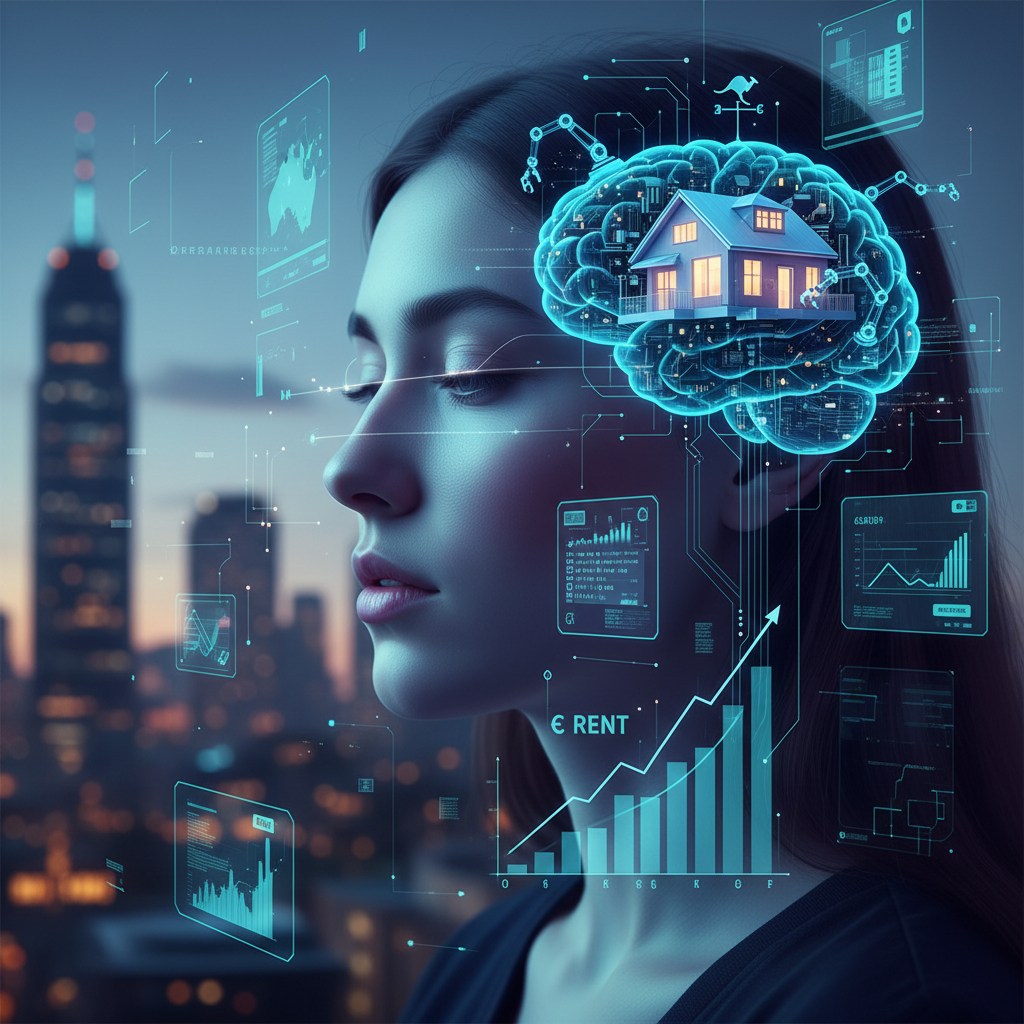

Let's be honest, the Australian housing market has always been a bit of a beast, a national obsession bordering on a contact sport. But lately, it feels like the beast has grown a whole new set of teeth, powered by algorithms and the relentless march of artificial intelligence. It's not just about finding a house anymore; it's about navigating a digital labyrinth where machines are increasingly calling the shots, from how much you pay to how you live inside your own four walls. And mate, this AI thing is getting interesting, especially when you consider what it's doing to our heads.
Picture this: you're scrolling through property listings, heart pounding, trying to snag a rental in Sydney or Melbourne. Prices are soaring, and every second counts. You click on a promising place, only to find the rent has mysteriously jumped by fifty bucks since yesterday. Was it a human landlord having a cheeky punt, or an algorithm from a property management platform, perhaps leveraging something akin to OpenAI's latest pricing models, that decided your budget needed a stretch? This isn't science fiction; it's the daily grind for countless Aussies. These algorithmic pricing tools, often fed by vast datasets including local amenities, school ratings, public transport access, and even social media sentiment, are designed to maximise landlord returns. They can adjust prices in real time, reacting to demand spikes, seasonal changes, and even how many people clicked on the listing in the last hour. For us, the punters, it creates a constant state of anxiety, a feeling of being perpetually outmanoeuvred.
Dr. Eleanor Vance, a cognitive psychologist from the University of Sydney, points out the insidious nature of this digital dance. "When pricing becomes opaque and dynamic, controlled by an unseen algorithm, it erodes our sense of fairness and control," she told me recently. "Humans crave predictability, especially around fundamental needs like shelter. When that's removed, and replaced by an inscrutable, ever-shifting digital hand, it can lead to increased stress, feelings of helplessness, and even a form of learned helplessness where people stop trying to understand the market, simply accepting what the algorithm dictates." It's like trying to haggle with a vending machine, utterly pointless and deeply frustrating.
Then there's the smart home, the promised land of convenience, now increasingly standard in new builds and renovations. Fridges that order your milk, lights that dim when you say the magic words, thermostats that learn your preferred temperature. Many of these systems, from Google's Nest to Amazon's Alexa, are powered by sophisticated AI that learns your habits, predicts your needs, and subtly influences your behaviour. On the surface, it's brilliant. Who doesn't want their house to anticipate their every whim? But what happens when the convenience comes at the cost of cognitive autonomy? When your smart home nudges you to buy certain products, or subtly encourages energy-saving habits you didn't explicitly choose, are you still making free choices, or are you just following an algorithmic script?
Professor David Chalmers, a philosopher and cognitive scientist at New York University and an occasional visitor to Australian conferences, has often discussed the extended mind hypothesis, where our tools become part of our cognitive processes. He posits that AI, particularly in smart environments, could extend our cognitive abilities, but also reshape them. "The danger isn't just about privacy, though that's a huge concern," Professor Chalmers noted in a recent interview with The Verge. "It's about the subtle shift in our decision-making processes. If the AI in our home is constantly optimising for comfort or efficiency, we might lose the cognitive muscle for making those decisions ourselves, or even for noticing when those decisions are being made for us." It's a bit like having a personal assistant who's so good, you forget how to tie your own shoelaces.
This isn't just about individual psychology, mind you. The broader societal implications are staggering. Algorithmic pricing, for instance, can exacerbate existing inequalities. If an algorithm identifies a high-demand area with limited supply, it will push prices up, potentially pricing out lower-income individuals and contributing to gentrification, all without a human landlord needing to make a conscious decision to do so. It's a feedback loop, where data about human behaviour feeds algorithms that then shape human behaviour, often with unintended and inequitable consequences. We're seeing this play out in our cities, where the digital divide isn't just about internet access, but about access to affordable living itself.
Australia's tech scene is like a good flat white, better than you'd expect, and we've got our own innovators in this space. Companies like Local Logic, though not Australian, are examples of firms using AI to provide hyper-local insights for real estate, and similar local startups are emerging. They promise efficiency and data-driven decisions, which sounds great on paper. But the human element, the messy, unpredictable, emotional side of buying or renting a home, often gets lost in the data points. The psychological toll of this constant algorithmic pressure, this feeling of being a data point in a vast, impersonal system, is something we're only just beginning to understand.
So, what's a regular Aussie to do? First, awareness is key. Understand that the prices you see aren't always set by a human with a gut feeling, but by complex models. Question the 'smart' features in your home. Do you really need your fridge to tell you you're out of milk, or are you just giving another data point away? Secondly, advocate for transparency. We need clearer regulations around algorithmic pricing and data usage in real estate. The black box nature of these systems is a breeding ground for anxiety and potential exploitation. Thirdly, and perhaps most importantly, don't let the algorithms completely dictate your life. Maintain your critical thinking, your sense of what's fair, and your ability to make independent choices. Down Under, we do things differently, and that includes not letting the robots completely run the show, at least not without a good hard look at the consequences.
Ultimately, the convergence of AI and the housing market is a fascinating, if sometimes terrifying, experiment in human-machine interaction. It promises efficiency and convenience, but it also subtly rewires our expectations, our behaviours, and our very sense of control over our most fundamental needs. As we embrace these technologies, we must remain vigilant, asking not just what AI can do for us, but what it's doing to us, especially when it comes to the roof over our heads. For more on how AI is reshaping our world, check out the latest from TechCrunch. The future of home ownership, and indeed, human cognition, might just depend on it.