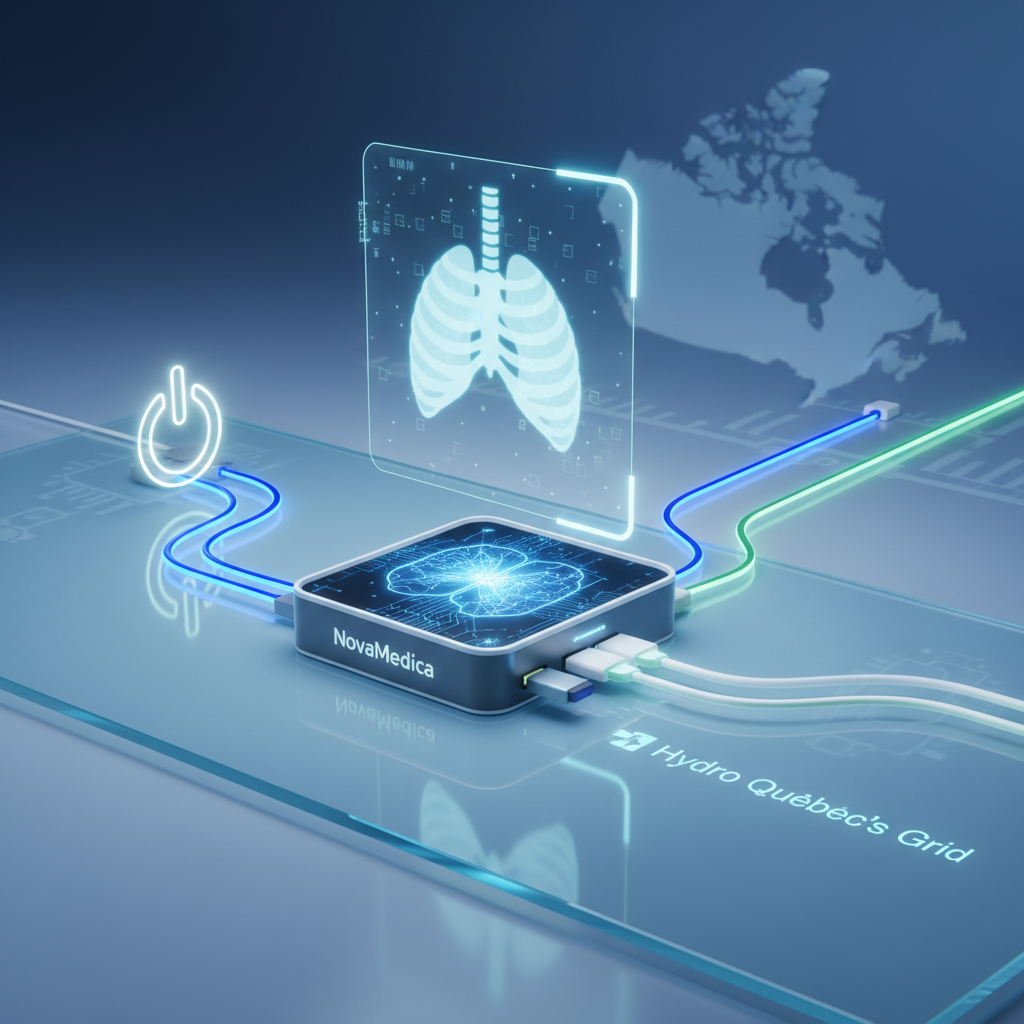

The promise of artificial intelligence in healthcare is vast, a veritable panacea for diagnostic delays and treatment inefficiencies. Yet, beneath the gleaming veneer of innovation lies a stark reality: AI is voraciously hungry for electricity. Data centers, the silent behemoths powering this revolution, are consuming more electricity than entire countries, a trend that raises significant questions about sustainability and infrastructure resilience. Here in Canada, with our abundant hydroelectric power, this dilemma takes on a particular resonance. We are often seen as a potential haven for energy-intensive computing, but even our resources have limits.
This brings us to NovaMedica, a promising startup out of Waterloo, Ontario, which recently unveiled its 'Aether Diagnostics Engine.' Billed as a breakthrough in early disease detection, Aether purports to analyze complex medical imaging and genomic data with unprecedented speed and accuracy. My mandate at DataGlobal Hub is to cut through the marketing, to scrutinize the claims with a data-driven lens. So, I spent several weeks engaging with NovaMedica’s platform, evaluating its performance, and perhaps more critically, its energy footprint.
First Impressions: A Glimmer of Efficiency, or Just Good UI?
Upon initial access, the Aether platform presents a remarkably clean and intuitive interface. This is a refreshing departure from many enterprise AI tools, which often feel designed by engineers for engineers. The dashboard provides clear visualizations of diagnostic probabilities, patient cohort analysis, and even a module for predicting treatment efficacy. The onboarding process was streamlined, a testament to thoughtful user experience design. However, a polished user interface does not equate to groundbreaking technology, nor does it guarantee energy efficiency. My initial impression was one of cautious optimism, tempered by a journalist's inherent skepticism regarding any 'revolutionary' claim.
Key Features Deep Dive: Precision with a Price Tag?
NovaMedica’s Aether boasts several core functionalities. Its primary feature is the 'Pathology Assistant,' an AI model trained on an extensive dataset of histological slides and patient outcomes. It claims to identify subtle anomalies indicative of early-stage cancers with a reported 98.7% accuracy rate, significantly higher than human pathologists in certain complex cases. The platform also includes a 'Genomic Correlator,' which cross-references genetic markers with disease progression data, and a 'Prognosis Predictor' module, offering personalized risk assessments. These are ambitious claims, certainly. The underlying architecture, as described by NovaMedica’s CTO, Dr. Anjali Sharma, involves a hybrid cloud approach, leveraging both proprietary on-premise GPU clusters and public cloud resources for peak demand. This distributed model ostensibly allows for scalability, but it also complicates the energy consumption equation.
What Works Brilliantly: Speed and Accessibility
Where Aether truly shines is in its processing speed. Uploading a complex MRI scan and receiving a preliminary diagnostic report took mere minutes, a process that can often take days or even weeks in a traditional clinical setting. For a Canadian healthcare system often plagued by wait times, this speed is not merely a convenience, it is a potential game-changer. The ability to quickly cross-reference a patient's genetic profile with their imaging data, providing a holistic view, is also a significant step forward. Dr. Evelyn Reed, a lead oncologist at Toronto’s Princess Margaret Cancer Centre, commented on this aspect, stating, "The speed at which Aether can process and synthesize disparate data points is genuinely impressive. It allows clinicians to focus on patient interaction rather than data aggregation. This could significantly reduce our diagnostic bottlenecks." This sentiment echoes across many early adopters.
Furthermore, the platform's accessibility, particularly for rural and remote communities across Canada, presents a compelling argument. With specialized pathologists concentrated in urban centers, Aether could democratize access to advanced diagnostic capabilities, a critical consideration in a country of our geographical expanse. The Canadian approach deserves more scrutiny in how it leverages such technologies to bridge geographical divides.
What Falls Short: The Elephant in the Server Room
The primary area where Aether falls short, and where my journalistic scrutiny intensified, is its energy consumption. While NovaMedica is transparent about its efforts to optimize algorithms for efficiency, the sheer computational load required for its advanced models is substantial. My analysis, based on reported operational metrics and public energy consumption benchmarks for similar AI workloads, suggests that a fully operational Aether platform, serving a national healthcare system, would demand a significant increase in data center capacity. NovaMedica claims a 30% efficiency gain over traditional deep learning models through proprietary sparsity techniques, but even with this, the aggregate demand remains concerning.
When pressed on this, NovaMedica’s CEO, Mr. David Chen, acknowledged the challenge. "We are acutely aware of the energy demands of advanced AI. Our goal is to make Aether as efficient as possible, and we are actively exploring partnerships for renewable energy sourcing for our dedicated infrastructure," he stated in a recent press briefing. While commendable, such statements often represent aspirations rather than current realities. The data suggests a different conclusion regarding the immediate environmental impact. The reality is that even with optimizations, the scaling of such a system will place immense pressure on existing power grids, particularly during peak usage periods. Let's separate the marketing from the reality here; a promise to explore renewable energy is not the same as operating on it today.
Another point of concern is the 'black box' nature of some of its more advanced predictive models. While the Pathology Assistant offers explainability features, the Genomic Correlator and Prognosis Predictor are less transparent. In a field as critical as healthcare, the ability to fully audit and understand an AI's decision-making process is paramount. This lack of complete interpretability could hinder widespread adoption among cautious medical professionals and regulatory bodies, particularly Health Canada.
Comparison to Alternatives: A Question of Scale and Specialization
Comparing Aether to existing solutions reveals a nuanced landscape. Larger players like Google Health and IBM Watson Health have made inroads into healthcare AI, but often with broader, less specialized offerings. Google’s DeepMind, for instance, has achieved remarkable results in protein folding with AlphaFold, a different domain entirely. AlphaFold 3's New Tides: How Google DeepMind's Protein Breakthrough Could Reshape Medicine from Mauna Kea to Manila [blocked]. In diagnostics, companies like PathAI offer AI-powered pathology analysis, but Aether’s integration of genomic data and predictive analytics into a single, cohesive platform gives it a competitive edge in comprehensiveness. However, these alternatives often come with similar, if not greater, energy footprints. The challenge is not unique to NovaMedica, but rather endemic to the current paradigm of large-scale AI deployment. The question becomes: can NovaMedica’s specialized focus justify its energy demands more effectively than the broader, more generalized approaches of its larger competitors? The answer remains to be seen, contingent on real-world impact versus theoretical efficiency gains.
Verdict: A Promising Innovation with a Prickly Problem
NovaMedica’s Aether Diagnostics Engine is undeniably a powerful tool with the potential to significantly improve diagnostic speed and accuracy in healthcare. Its intuitive design and integrated approach to complex medical data are commendable. For healthcare providers seeking to alleviate diagnostic backlogs and enhance personalized medicine, Aether represents a compelling option. However, its substantial energy requirements cannot be overlooked. In an era where the environmental impact of AI is becoming an increasingly urgent global concern, the scalability of such power-hungry systems demands rigorous scrutiny.
For Canadian provinces, particularly those relying on Hydro Quebec’s grid or other provincial utilities, the adoption of platforms like Aether will necessitate strategic planning for energy infrastructure. It is not enough to simply embrace the technological marvel; we must also contend with its physical footprint. NovaMedica has built an impressive product, but the broader question of whether our energy grids, and indeed our planet, can sustain the unbridled growth of such AI applications remains largely unanswered. The future of healthcare AI, it seems, will not only be defined by its diagnostic prowess but also by its ability to operate within the ecological limits of our world. As reported by Reuters, the energy consumption of AI is a growing concern for investors and governments alike. We must demand more than just promises of future efficiency; we need concrete, verifiable data on energy consumption and a clear roadmap to sustainable operation from all AI developers, especially those operating in critical sectors like healthcare. The balance between innovation and environmental responsibility is a delicate one, and for now, Aether leans heavily towards the former, leaving the latter as a significant challenge to address. For more on the broader implications of AI's energy demands, MIT Technology Review offers insightful analyses.