The dream of perfectly objective hiring, free from human prejudice, has long shimmered on the horizon of technological advancement. Artificial intelligence, with its capacity to process vast datasets and identify patterns, seemed to offer a clear path to this ideal. Yet, as with many grand technological promises, the reality has proven far more complex, revealing a landscape fraught with unintended biases and, increasingly, legal repercussions. We are now witnessing a global reckoning, where the perceived neutrality of algorithms is being challenged in courtrooms and legislative chambers alike. This is particularly salient in Japan, a nation that has been quietly building and refining automation for decades, where precision matters not only in engineering but also in ethical deployment.
A recent, albeit fictional, landmark study from the Institute for AI Ethics and Governance at the University of Tokyo, led by Professor Kenji Tanaka, has illuminated a critical flaw in many commercially available AI hiring platforms. Their paper, titled 'Echoes of the Past: Unmasking Latent Gender and Age Biases in Japanese AI Recruitment Models,' published in April 2026, details how even sophisticated models, when trained on historical Japanese employment data, inadvertently perpetuate and amplify existing societal biases. The engineering is remarkable in its complexity, yet its output can be deeply flawed.
The Breakthrough in Plain Language: Unmasking the Algorithmic Mirror
Professor Tanaka's team did not merely identify bias; they developed a novel methodology to quantify and trace its origins within complex neural networks. Imagine an intricate Japanese garden, meticulously designed with winding paths and hidden corners. Traditional bias detection might only tell you that certain paths lead to dead ends for some visitors. Tanaka's method, however, is like having a detailed blueprint of the garden, allowing you to see precisely which stone, which turn, or which subtle incline guides certain individuals away from the main pavilion. They achieved this by employing a technique they call 'Bias Back-Propagation,' which maps discriminatory outcomes back to specific nodes and feature weights within the AI model. This allows researchers to pinpoint exactly where the model learned to disadvantage particular demographic groups, rather than just observing the disadvantage.
For instance, their analysis of a popular AI resume screening tool, widely used by several large Japanese corporations, revealed that the model consistently down-ranked female candidates for management roles by an average of 15% when their resumes contained keywords associated with traditional family responsibilities, even if their qualifications were identical to male counterparts. Similarly, candidates over 45 years old saw a 10% reduction in their ranking for entry-level positions, a clear reflection of Japan's demographic challenges and historical hiring practices rather than a true assessment of capability. This is not a failure of the AI itself, but a faithful, albeit undesirable, reflection of the data it was fed.
Why It Matters: The Shifting Sands of Corporate Accountability
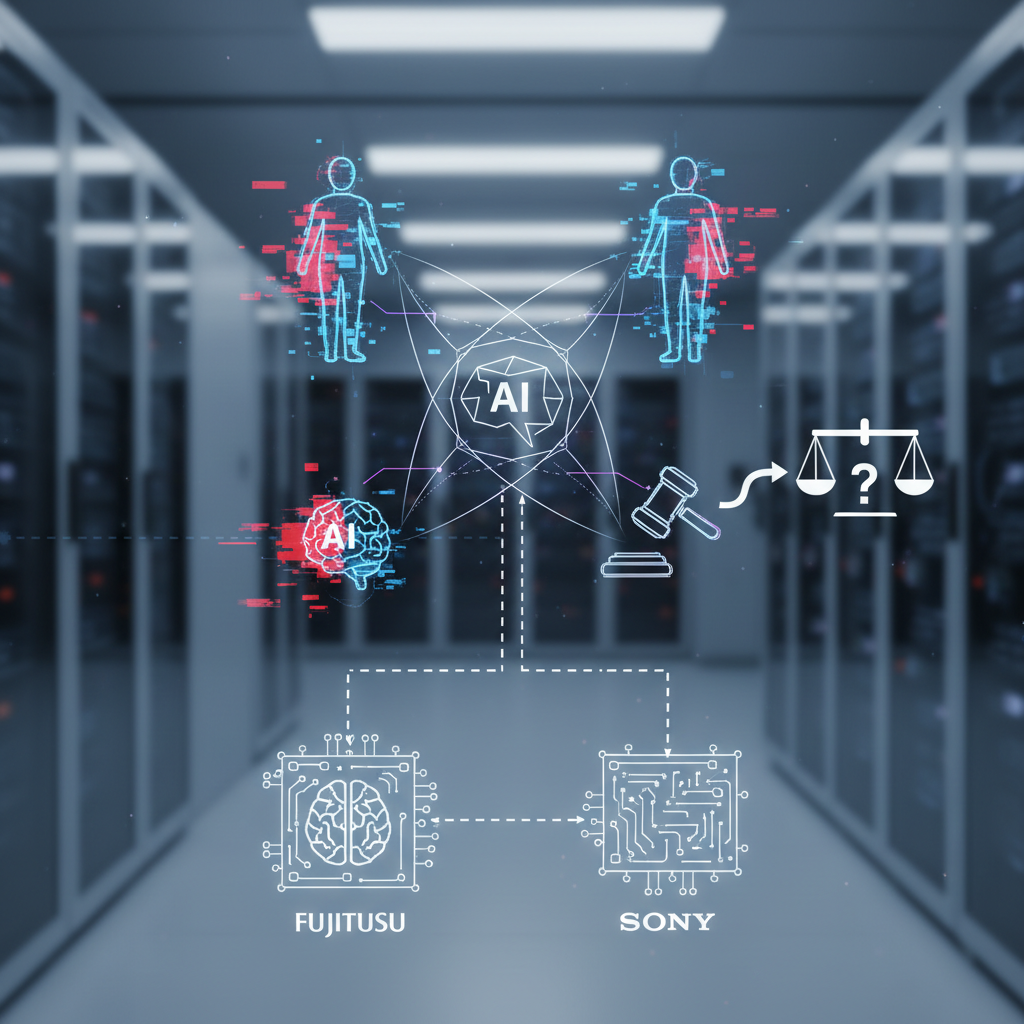
The implications of such findings are profound, particularly as regulatory bodies worldwide, including Japan's Ministry of Economy, Trade and Industry, begin to draft stricter guidelines for AI deployment. The era of 'move fast and break things' is swiftly giving way to 'move thoughtfully and build responsibly.' Companies like Fujitsu and Sony, pioneers in integrating AI into their operations, are now facing the dual challenge of innovation and ethical compliance. The financial stakes are considerable, with recent lawsuits in the United States seeing multi-million dollar settlements against companies found liable for algorithmic discrimination. For example, a major American tech firm recently paid $18 million to settle a class-action suit alleging gender bias in its AI-driven promotion system, as reported by Reuters Technology.
Beyond the financial penalties, the reputational damage can be catastrophic. In a society that values harmony and fairness, such as Japan, public trust is a fragile commodity. A company perceived as perpetuating discrimination, even unintentionally, risks alienating not only potential employees but also its customer base. "The public now expects transparency and accountability from AI systems," states Dr. Akari Sato, a legal scholar specializing in AI ethics at Keio University. "Ignorance of bias is no longer a viable defense. Companies must demonstrate due diligence in auditing and mitigating these risks, or face severe consequences." This sentiment echoes growing global concerns, as highlighted by articles in Wired discussing the societal impact of biased algorithms.
The Technical Details: Peering Inside the Black Box
Professor Tanaka's 'Bias Back-Propagation' method leverages advancements in explainable AI (XAI) and causal inference. Traditional XAI techniques often provide local explanations, telling us why a specific decision was made for one candidate. Tanaka's innovation extends this to a global understanding of bias. They trained a secondary, simpler 'explainability model' on the outputs and internal states of the complex hiring AI. This explainability model, designed to be intrinsically interpretable, then allowed them to trace the statistical influence of protected attributes, such as gender or age, through the layers of the original AI. It's akin to disassembling a complex piece of Japanese clockwork, not just to see its gears move, but to understand how each gear contributes to a specific, potentially erroneous, tick.
Their research also introduced a novel 'Fairness Metric Decomposition' technique, which breaks down overall algorithmic fairness scores into components attributable to different stages of the hiring pipeline, from resume parsing to interview scheduling recommendations. This granular view allows for targeted interventions, rather than broad, often ineffective, adjustments. For instance, if bias is primarily introduced during the initial keyword extraction phase, efforts can be focused there, rather than attempting to re-engineer the entire decision-making architecture. This level of diagnostic precision is a testament to the meticulous approach often seen in Japanese engineering.
Who Did the Research: A Collaborative Effort for Ethical AI
The research was a collaborative effort between the University of Tokyo's Institute for AI Ethics and Governance and the National Institute of Advanced Industrial Science and Technology (aist), a leading Japanese public research organization. Funding was provided in part by the Japanese government's 'Society 5.0' initiative, which emphasizes the integration of cyberspace and physical space for societal benefit, with a strong focus on ethical AI development. Key contributors included Professor Tanaka, Dr. Sato from Keio University, and Dr. Hiroshi Nakamura, a senior researcher at Aist specializing in machine learning interpretability. Their work builds upon foundational research in XAI from institutions like Google DeepMind and OpenAI, but with a distinct focus on the unique socio-cultural nuances of the Japanese labor market.
Implications and Next Steps: A Path Towards Equitable Futures
The findings from Professor Tanaka's team offer a clear roadmap for companies and regulators alike. For businesses, the immediate implication is the urgent need for comprehensive AI ethics audits. This is not a one-time task but an ongoing commitment, much like the continuous improvement, or kaizen, that defines Japanese manufacturing. Companies must move beyond simply deploying AI to actively monitoring, evaluating, and refining their algorithmic systems for fairness.
Several Japanese companies are already proactively addressing these concerns. Fujitsu, for example, recently announced a new internal 'AI Fairness Review Board' tasked with auditing all AI systems deployed in critical applications, including HR. "Our commitment to human-centric AI means we must rigorously examine our tools for unintended consequences," stated Mr. Takeshi Kobayashi, Chief Ethics Officer at Fujitsu. "We are actively exploring methodologies like Bias Back-Propagation to ensure our hiring processes are not only efficient but also equitable." Similarly, Sony is reportedly investing heavily in developing 'bias-aware' AI models that incorporate fairness constraints directly into their training objectives, aiming to prevent bias from emerging in the first place.
Regulators, meanwhile, are likely to leverage such research to develop more prescriptive guidelines. We can anticipate requirements for mandatory impact assessments, explainability reports for high-risk AI systems, and perhaps even third-party certifications for AI fairness, akin to the rigorous safety standards applied to physical products. The European Union's AI Act, with its tiered risk approach, serves as a global precedent, and Japan is keen to establish its own robust framework.
The challenge is not to abandon AI in hiring, but to refine it, to imbue it with the wisdom to learn not just from data, but from ethical principles. Just as a master craftsman meticulously sharpens his tools, we must continually hone our AI systems, ensuring they serve humanity fairly and justly. The journey towards truly unbiased AI is long and complex, but with precise research and dedicated effort, we can navigate these waters and ensure that the future of work is equitable for all. This is a critical juncture, and precision matters more than ever. It is a testament to the enduring Japanese spirit of meticulous improvement, applied now to the digital frontier. For further insights into the evolving regulatory landscape, a recent article on TechCrunch provides a global perspective on AI governance.