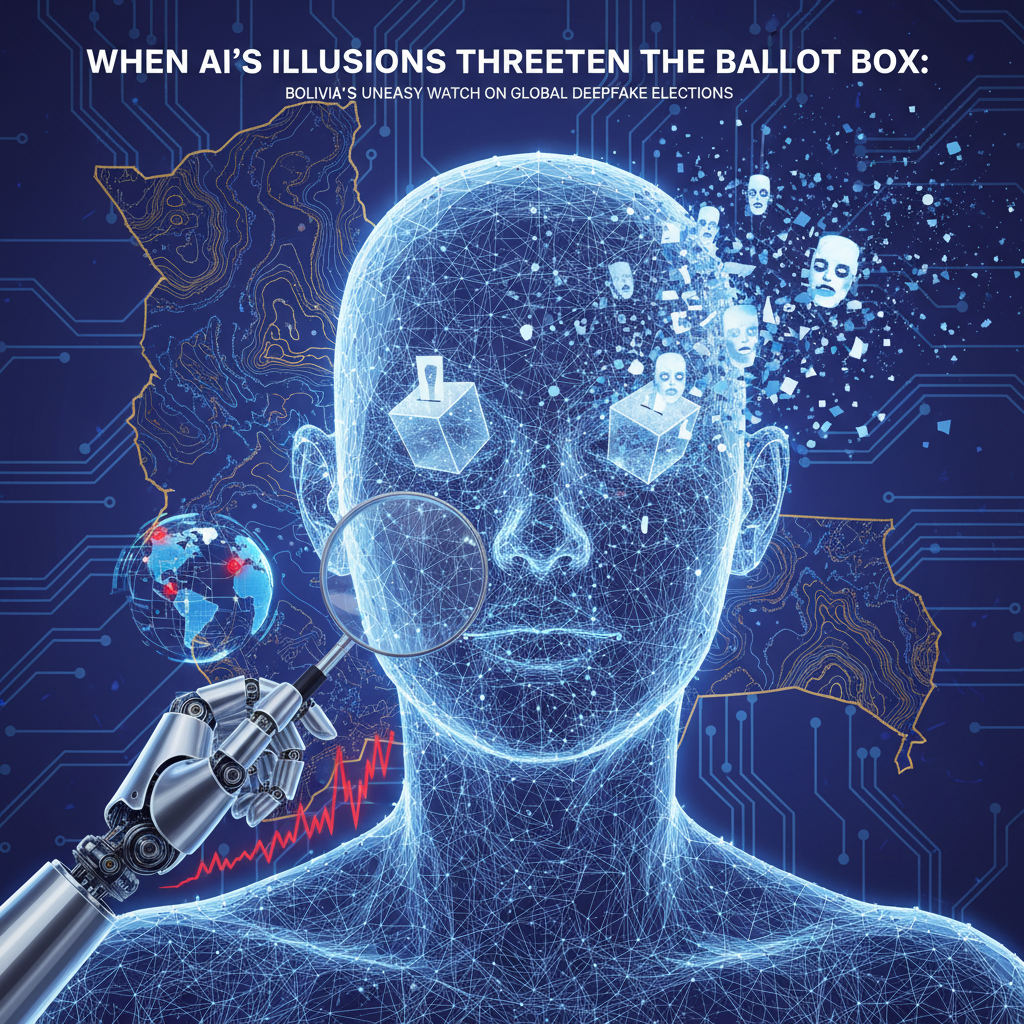
Is the digital ghost of AI-generated deepfakes merely a fleeting apparition, or has it become a permanent resident in the electoral chambers of our global democracies? This is not a theoretical question for academics in distant universities, but a pressing reality for nations like Bolivia, where the fragility of democratic institutions has been tested repeatedly. From the high plains of El Alto to the lowlands of Santa Cruz, the integrity of our elections is paramount, and the insidious spread of synthetic media threatens to erode the very foundations of trust upon which governance is built.
The concept of manipulating public perception is hardly new. History offers a long, uncomfortable lineage of propaganda, disinformation, and character assassination. From the printing press to radio and television, each technological leap has provided new avenues for those seeking to sway public opinion through deceit. However, the advent of generative artificial intelligence, particularly in the last five years, represents a qualitative shift. What once required significant resources, technical skill, and time can now be accomplished with relative ease and speed, often by individuals with access to readily available tools. The barrier to entry for creating convincing, yet entirely fabricated, audio and visual content has plummeted.
Consider the historical context. In the early 20th century, radio broadcasts were powerful tools for political messaging, susceptible to manipulation. Later, television brought visual elements, making doctored footage a concern, though often detectable by the discerning eye. Today, AI models such as OpenAI's Dall-e and Sora, Google's Gemini, and Meta's Llama models, while not designed for malicious intent, have demonstrated capabilities that can be repurposed. These tools can generate photorealistic images, compelling video sequences, and eerily accurate voice clones, blurring the lines between reality and fabrication to an unprecedented degree. The speed of dissemination through social media platforms only amplifies their potential impact.
Data points from recent electoral cycles across the globe paint a sobering picture. A report by the AI Democracy Initiative in late 2025 indicated a 400% increase in detected deepfake content related to political campaigns compared to the 2022 midterm elections in the United States. While many of these were crude, a significant percentage were sophisticated enough to deceive a substantial portion of the population. In India, ahead of its general elections, researchers identified several instances of AI-generated audio clips mimicking political figures, spreading false statements. These incidents, though often debunked eventually, sow seeds of doubt and distrust, which can be difficult to eradicate.
Here in Bolivia, our unique socio-political landscape presents particular vulnerabilities. A diverse population, with multiple indigenous languages, and varying levels of digital literacy, creates a complex environment for information consumption. A deepfake video of a prominent indigenous leader making inflammatory remarks, or an audio clip of a presidential candidate promising impossible benefits, could ignite social unrest or sway critical votes in a closely contested election. The altitude of innovation may be high in Silicon Valley, but the altitude of political tension is often higher in La Paz, making such threats acutely dangerous. Bolivia's challenges require Bolivian solutions, tailored to our specific cultural and technological realities.
Experts worldwide are grappling with the implications. Dr. Hany Farid, a leading expert in digital forensics and deepfake detection at the University of California, Berkeley, has repeatedly warned about the escalating threat. He stated in a recent interview,