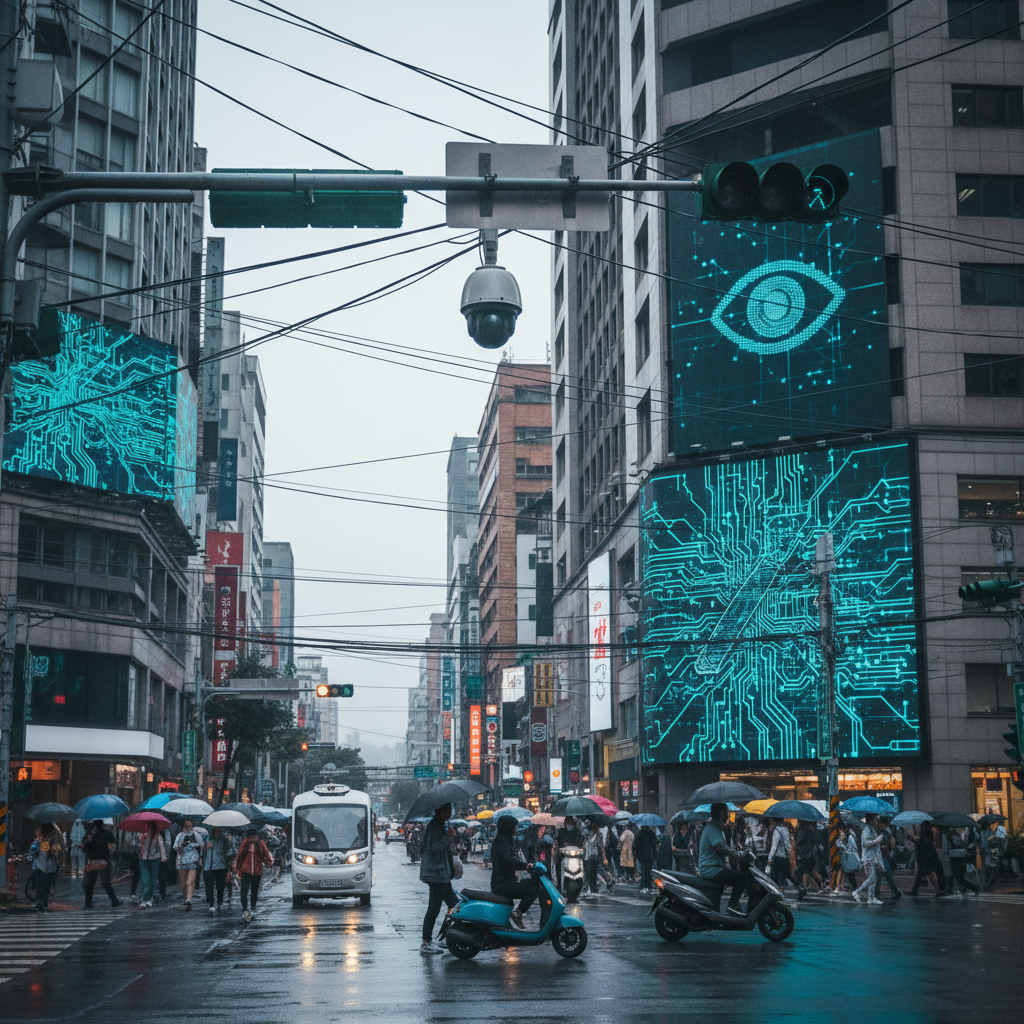

The vision of a smart city, where urban infrastructure anticipates needs and enhances public safety, is compelling. In Taiwan, a nation perennially at the forefront of technological adoption, this vision is rapidly materializing. However, beneath the gleaming promise of efficiency and security lies a complex technical and ethical landscape, particularly concerning AI-powered surveillance. As a journalist based here, observing the swift deployment of these systems, one cannot help but ask: at what point does enhanced safety morph into pervasive monitoring? Let's separate fact from narrative and delve into the technical underpinnings.
The technical challenge at the heart of AI-powered urban surveillance is formidable. We are not merely talking about static cameras; we are discussing real-time, high-volume data ingestion, processing, and analysis from myriad sources. The problem is to extract actionable intelligence, such as identifying anomalies, tracking specific objects or individuals, or predicting potential incidents, from petabytes of unstructured video and sensor data, all while maintaining low latency and high accuracy. This demands robust, scalable architectures that can operate continuously, often in challenging environmental conditions.
An architecture overview for a typical smart city surveillance system reveals several critical components. At the edge, we have an array of sensors: high-resolution cameras, thermal imagers, acoustic sensors, and IoT devices. These devices often incorporate edge AI processors, such as those from NVIDIA Jetson series, for preliminary processing, like object detection or motion analysis, to reduce bandwidth requirements. This initial processing might involve running lightweight convolutional neural networks (CNNs) to filter out irrelevant data or detect predefined events. The processed data streams are then transmitted over secure networks, often 5G or dedicated fiber, to a central data ingestion layer. This layer typically employs message brokers like Apache Kafka to handle the high throughput and ensure data reliability.
Following ingestion, the data enters a distributed processing pipeline. Here, sophisticated AI models, often deployed on cloud or on-premise GPU clusters, perform deeper analysis. This includes advanced computer vision tasks: facial recognition, gait analysis, crowd behavior analysis, and vehicle identification. For instance, a common approach for object tracking might involve a combination of Yolo You Only Look Once for detection and DeepSORT for multi-object tracking. The output of these models, typically metadata and alerts, is then stored in optimized databases, such as time-series databases for sensor data and graph databases for relational information like person or vehicle trajectories. A visualization and alert management system then presents this information to human operators, often integrated with existing command and control centers, such as those used by the Taipei City Police Department.
Key algorithms and approaches are diverse. For facial recognition, deep learning models like FaceNet or ArcFace are prevalent, trained on massive datasets. For anomaly detection, techniques range from simple rule-based systems to more complex autoencoders or generative adversarial networks (GANs) that learn normal patterns and flag deviations. Consider a conceptual example for crowd anomaly detection:
# Conceptual Pseudocode for Crowd Anomaly Detection
function detect_crowd_anomaly(video_stream):
 frame_buffer = []
 while True:
 frame = capture_frame(video_stream)
 frame_buffer.append(frame)
 if len(frame_buffer) > Window_size:
 frame_buffer.pop(0)

 # Feature extraction (e.g., optical flow, density map)
 features = extract_motion_and_density_features(frame_buffer)

 # Anomaly scoring using a pre-trained model (e.g., autoencoder)
 anomaly_score = anomaly_model.predict(features)

 if anomaly_score > Threshold:
 log_alert("Crowd anomaly detected", frame.timestamp, anomaly_score)
 trigger_human_review(frame)

 sleep(PROCESSING_INTERVAL)
# Conceptual Pseudocode for Crowd Anomaly Detection
function detect_crowd_anomaly(video_stream):
 frame_buffer = []
 while True:
 frame = capture_frame(video_stream)
 frame_buffer.append(frame)
 if len(frame_buffer) > Window_size:
 frame_buffer.pop(0)

 # Feature extraction (e.g., optical flow, density map)
 features = extract_motion_and_density_features(frame_buffer)

 # Anomaly scoring using a pre-trained model (e.g., autoencoder)
 anomaly_score = anomaly_model.predict(features)

 if anomaly_score > Threshold:
 log_alert("Crowd anomaly detected", frame.timestamp, anomaly_score)
 trigger_human_review(frame)

 sleep(PROCESSING_INTERVAL)
Implementation considerations are paramount. Scalability is a constant concern; a city like Taipei generates immense amounts of data. This necessitates distributed computing frameworks like Kubernetes for orchestration and Apache Spark for large-scale data processing. Data privacy and security must be baked in from the design phase, not as an afterthought. This involves robust encryption for data in transit and at rest, strict access controls, and anonymization techniques where possible. The computational demands are also significant, requiring substantial investment in GPU infrastructure. Moreover, model bias is a persistent issue. If training data is not diverse and representative, models can exhibit discriminatory performance, leading to false positives or negatives that disproportionately affect certain demographics. This is a critical ethical point often overlooked in the rush to deploy.
When we consider benchmarks and comparisons, the landscape is competitive. Commercial offerings from companies like Hikvision, Dahua, and SenseTime dominate the market, often boasting high accuracy rates on specific tasks like facial recognition, sometimes exceeding 99 percent in controlled environments. However, these figures often decline significantly in real-world scenarios due to varying lighting, occlusions, and camera angles. Open source alternatives like OpenCV and various TensorFlow or PyTorch implementations offer flexibility but require significant in-house expertise for deployment and optimization. The trade-off is typically between out-of-the-box performance and customization potential. For instance, a proprietary system might offer a simpler deployment but less transparency regarding its internal workings or data handling, a concern for many privacy advocates.
For code-level insights, developers frequently leverage Python with libraries such as TensorFlow, PyTorch, and OpenCV. For real-time stream processing, frameworks like Apache Flink or Kafka Streams are invaluable. Containerization with Docker and orchestration with Kubernetes are standard practices for managing complex microservices architectures. Edge deployment often involves Onnx Runtime or TensorRT for optimized inference on specialized hardware. The choice of database, whether PostgreSQL for structured metadata or MongoDB for flexible document storage, depends heavily on the specific data types and query patterns required.
Real-world use cases are emerging globally. In Singapore, the Smart Nation initiative employs AI for traffic management, public safety, and infrastructure monitoring. Shenzhen, China, has deployed extensive AI surveillance for public security and law enforcement, reportedly achieving significant reductions in certain crime rates. Closer to home, some districts in New Taipei City have piloted AI-enhanced traffic monitoring systems to optimize signal timing and detect traffic violations. These deployments showcase the potential for efficiency gains, but they also underscore the need for robust governance frameworks.
However, there are significant gotchas and pitfalls. The 'black box' nature of many deep learning models makes auditing and explaining their decisions challenging, complicating accountability. False positives can lead to misidentification and harassment, while false negatives can create a false sense of security. Data breaches are a constant threat, and the aggregation of vast amounts of personal data creates an attractive target for malicious actors. Furthermore, the legal and ethical frameworks often lag behind technological capabilities. Taiwan's Personal Data Protection Act, while robust, faces new challenges in the context of pervasive AI surveillance. The data tells a more nuanced story than simple crime statistics might suggest, often omitting the social costs of constant monitoring.
Taiwan's position is more complex than headlines suggest. While our semiconductor industry provides the foundational hardware for much of this global AI infrastructure, our democratic values and commitment to individual freedoms necessitate a careful approach to surveillance technologies. The balance between public safety and individual privacy is a delicate one, demanding not just technical solutions, but also robust public discourse and transparent regulatory oversight. We must ensure that the tools we build to protect our society do not inadvertently erode the very freedoms they are meant to safeguard.
For those seeking to delve deeper into the technical aspects and ethical considerations, resources abound. Academic papers on computer vision and privacy-preserving AI can be found on arXiv. Organizations like the AI Now Institute publish critical research on the social implications of AI. Furthermore, the ongoing debates surrounding the EU AI Act offer valuable insights into regulatory approaches, as highlighted in discussions around The EU AI Act's Silent Shadow [blocked]. Understanding these complex interactions is crucial for any developer or policymaker navigating the future of smart cities.