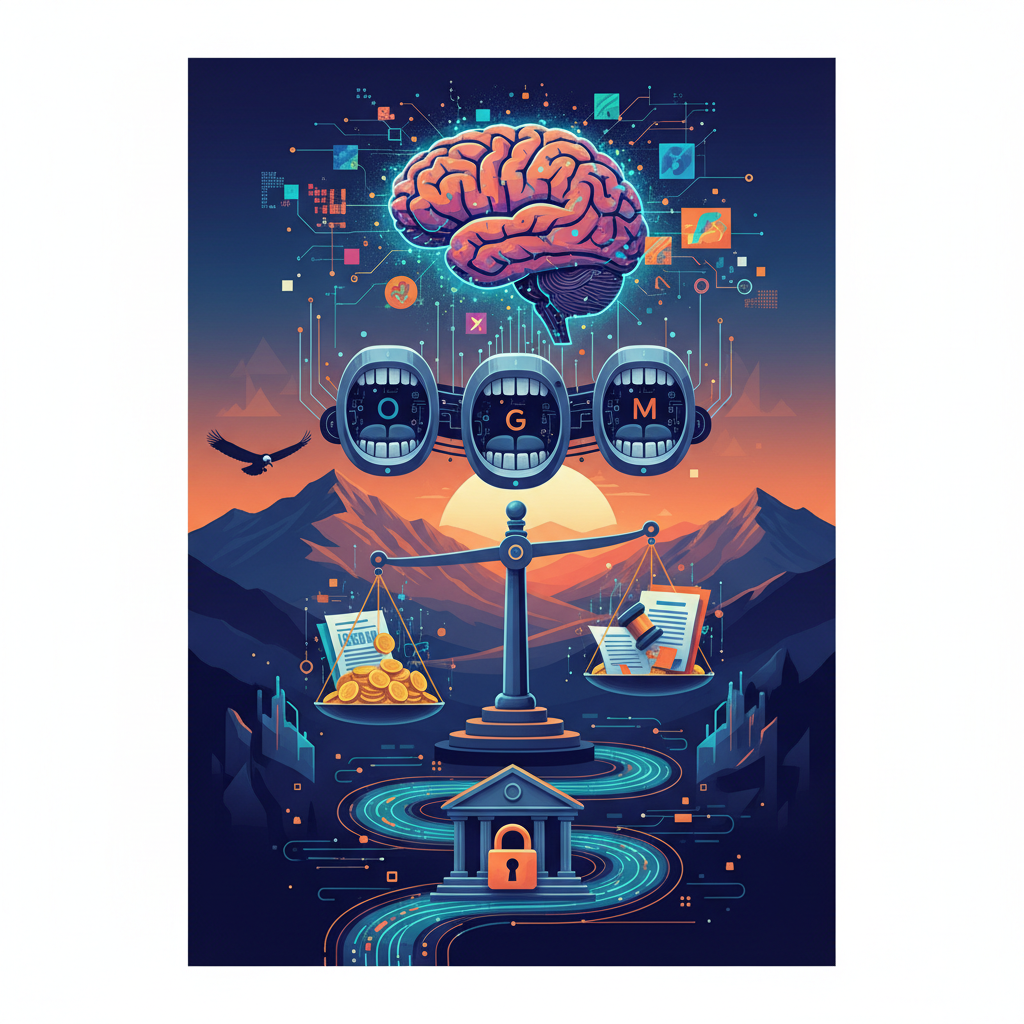
Is the ongoing legal skirmish between creators and artificial intelligence developers a mere passing phase, a temporary disruption before a new equilibrium is found, or does it signal a profound and permanent redefinition of intellectual property in the digital age? From my vantage point in La Paz, where the daily struggle for recognition and fair compensation is a constant reality, this question carries significant weight, not just for Silicon Valley but for every artist, author, and musician across the globe, including those navigating Bolivia's challenging creative landscape.
The history of technological advancement is replete with instances where new tools challenged existing legal frameworks. Photography once threatened portrait painters, the phonograph upended sheet music sales, and the internet fundamentally altered publishing and distribution. Each wave brought cries of existential threat, followed by adaptation, new business models, and revised legal interpretations. The current wave, driven by generative AI, feels different in its scale and the fundamental nature of its operation: it learns by ingesting vast quantities of existing human creativity.
Consider the operational models of leading AI developers. Companies like OpenAI, Google, and Meta have trained their large language models and image generators on colossal datasets, many of which contain copyrighted works. This ingestion, often without explicit permission or compensation, forms the core of the current legal contention. Artists, authors, and musicians argue that their work, their intellectual property, is being appropriated to build commercial products that directly compete with them or diminish the value of their original creations.
Data from recent filings illustrate the scope of this dispute. As of early 2026, over two dozen significant lawsuits have been filed against major AI companies in the United States alone, with similar actions emerging in Europe and other jurisdictions. The Authors Guild, representing thousands of writers, has been particularly vocal, arguing that the unauthorized use of copyrighted books to train models like OpenAI's GPT and Google's Gemini constitutes mass infringement. Similarly, visual artists and photography agencies have launched actions against image generation platforms such as Stability AI and Midjourney, claiming their styles and specific works have been replicated without consent.
One prominent case involves Sarah Silverman and other authors suing OpenAI, alleging copyright infringement for the use of their books in training data. While these cases are complex and will likely take years to resolve, the sheer volume of litigation suggests this is no isolated incident. The stakes are immense. Analysts estimate the generative AI market could reach hundreds of billions of dollars within the next decade, making the question of who profits from the foundational creative input a critical one.
Historically, courts have grappled with the concept of fair use, a legal doctrine that permits limited use of copyrighted material without acquiring permission from the rights holders. AI companies often invoke fair use, arguing that their models transform the input data, creating something new and distinct, much like a human artist might be inspired by existing works. However, critics counter that the scale and systematic nature of AI's ingestion, coupled with its ability to generate outputs that closely mimic original styles or even specific works, moves beyond traditional notions of fair use.
“The legal system is always playing catch-up with technology,” observed Professor Jane C. Ginsburg, a leading intellectual property scholar at Columbia Law School, in a recent interview with Wired. “The challenge here is that AI’s ‘learning’ process is so opaque and its output so potentially derivative, that fitting it into existing copyright paradigms is like trying to put a square peg in a round hole.” This sentiment resonates deeply. For creators in Bolivia, where intellectual property protections can be less robust and enforcement more challenging, the global precedent set by these cases will be crucial.
Consider the Bolivian musician, whose traditional melodies and indigenous rhythms are part of a rich cultural heritage. If an AI trained on publicly available recordings can generate new compositions in that distinct style, potentially without attribution or compensation, what does that mean for the preservation and economic viability of cultural expression? Bolivia's challenges require Bolivian solutions, but the global nature of AI development means that legal frameworks forged in New York or London will inevitably cast long shadows over La Paz.
Some tech leaders are attempting to find common ground. Sam Altman, CEO of OpenAI, has publicly acknowledged the need for compensation models, stating in a blog post that “we want to build models that are useful for everyone, including creators, and that means figuring out fair compensation.” However, the specifics of such models remain elusive, and the current legal battles suggest that creators are not waiting for tech companies to unilaterally define what constitutes fairness.
One proposed solution involves licensing agreements, where AI developers pay for access to copyrighted datasets. Adobe, for instance, has taken steps in this direction with its Firefly generative AI, which is reportedly trained on licensed content and public domain images. This approach offers a clearer path to compensation, but scaling it to encompass the vast and diverse world of creative works presents immense logistical challenges.
Another perspective comes from Dario Amodei, CEO of Anthropic, who emphasizes the importance of ethical AI development. While not directly addressing copyright, his focus on safety and responsible deployment implicitly acknowledges the need to respect human values and contributions. The question for creators is whether this ethical stance will translate into concrete, enforceable mechanisms for protecting their livelihoods.
From a data-driven perspective, the trend is clear: the volume of legal challenges is increasing, and the courts are being forced to confront these issues head-on. This is not a fad. The fundamental economics of generative AI, which relies on vast datasets, means the question of data provenance and intellectual property will remain central. The altitude of innovation may be dizzying, but the legal ground beneath it must be firm.
What does this mean for us, particularly in regions like Bolivia? It means a heightened awareness is necessary. Our local artists, authors, and musicians must understand their rights and advocate for their protection. It means our policymakers must engage with these complex legal and technological issues, perhaps drawing lessons from international developments while tailoring solutions to our unique context. Let's talk about what actually works at 4,000 meters, not just what is theorized in Silicon Valley boardrooms.
The verdict: This is not a fad. The AI copyright war is the new normal. It is a foundational conflict that will shape the future of creative industries and the very nature of digital ownership. The outcomes of these lawsuits, the legislative responses, and the new business models that emerge will define how human creativity interacts with algorithmic intelligence for decades to come. For countries like Bolivia, this is not a distant concern, but a pressing issue that demands proactive engagement to ensure our rich cultural heritage is not inadvertently commodified and diminished by the relentless march of technology. We must ensure that the benefits of AI are shared equitably, and that the creative spirit, the very essence of human expression, is not undermined but rather empowered by these powerful new tools. The legal frameworks must evolve to protect the creators, not just the machines that learn from them. This is a battle for the soul of creativity itself. It is far from over.```