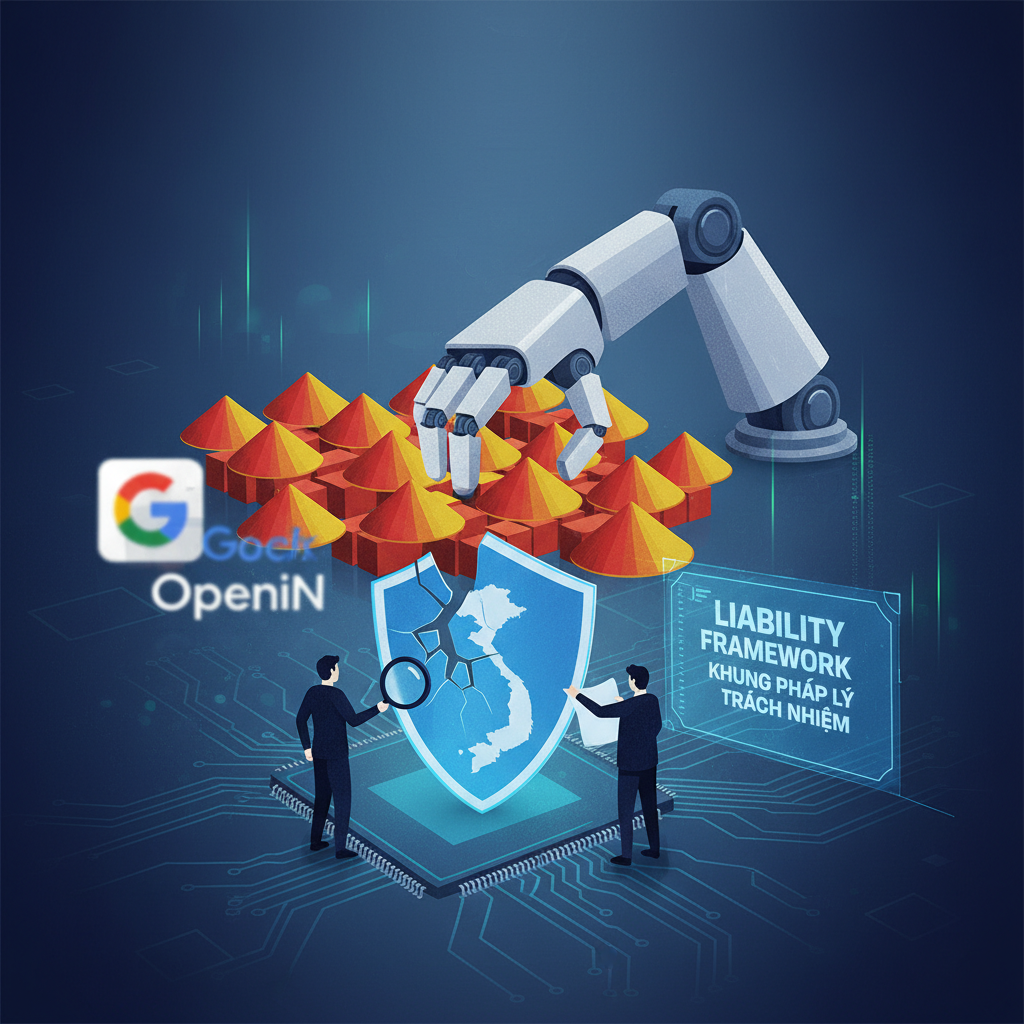

The hum of servers in Ho Chi Minh City never sleeps, especially its coders, and neither does the relentless march of artificial intelligence. Every day, new AI applications emerge, promising to revolutionize everything from healthcare diagnostics to autonomous logistics. We are talking about incredible leaps, truly. But amidst all this exhilarating progress, a crucial, often uncomfortable, question looms large: who is responsible when AI, with all its dazzling complexity, causes harm?
This is not a philosophical debate for a distant future. This is a present-day reality, a challenge that demands our immediate attention and a clear, actionable framework. My perspective, shaped by the dynamic, no-nonsense spirit of Vietnam's tech landscape, is this: the primary responsibility for AI-induced harm must fall squarely on the shoulders of the developers and the deployers, not the end-users. We need a liability blueprint that reflects the true power dynamics and technical intricacies of AI, moving beyond the outdated paradigms of product liability that simply cannot keep pace with these intelligent systems.
Think about it. When a self-driving car, powered by an NVIDIA chip and Google's Waymo software, makes a decision that leads to an accident, is it the passenger who should be held accountable? When a diagnostic AI, perhaps trained on vast datasets by OpenAI or DeepMind, misidentifies a medical condition, leading to incorrect treatment, is the doctor solely to blame? Absolutely not. These systems are opaque, complex, and often operate in ways even their creators cannot fully predict. The end-user, whether a driver or a doctor, is often merely interacting with a black box.
Our current legal systems, largely built on principles of negligence and product liability, struggle with AI. They were designed for tangible products with clear manufacturing defects or human actions with discernible intent. AI, however, introduces a new layer of complexity: autonomous decision-making, emergent behaviors, and the 'black box' problem where even engineers cannot always fully explain why an AI made a particular choice. This is why Vietnam is the dark horse of AI, not just in innovation but in its pragmatic approach to regulation. We understand that innovation must be paired with responsibility.
Take the case of a logistics company in Da Nang using an AI-powered route optimization system. This system, developed by a startup leveraging Meta's Llama models, promises to cut delivery times by 15% and fuel costs by 10%. Sounds fantastic, right? But what if, due to a subtle bias in its training data or an unforeseen interaction with real-world traffic conditions, the AI directs a truck through a residential area during school hours, leading to a tragic incident? Who is liable? The truck driver following instructions? The logistics company? Or the startup that built the AI, or even Meta for providing the foundational model?
My argument is that the creators and implementers of these systems possess the deepest understanding of their capabilities, limitations, and potential risks. They are the ones who design the algorithms, curate the training data, set the parameters, and decide where and how the AI will be deployed. They are the ones with the resources and expertise to implement robust testing, safety protocols, and continuous monitoring. This is where accountability must begin.
“We are seeing a clear need for what I call 'developer responsibility by design,'” explains Dr. Lê Thị Mai, a leading legal scholar specializing in AI ethics at the National University of Ho Chi Minh City. “Just as we expect car manufacturers to ensure their vehicles are safe before they hit the road, we must expect AI developers to build safety and accountability into their systems from the ground up. This includes rigorous testing, transparency in data sourcing, and clear documentation of an AI's operational boundaries.”
Some might argue that this approach could stifle innovation. They might say that placing such a heavy burden on developers could make them hesitant to deploy cutting-edge AI, slowing down progress. They might point to the inherent unpredictability of advanced AI models, suggesting that even the most diligent developers cannot foresee every possible failure mode. I hear these concerns, and they are valid. We do not want to extinguish the vibrant entrepreneurial spirit that drives our tech sector, especially here in Vietnam where startups are blooming like lotus flowers in spring.
However, I believe this is a false dilemma. Responsible innovation is not an oxymoron; it is the only sustainable path forward. A lack of clear liability actually creates a different kind of risk: a wild west scenario where companies might rush to deploy untested AI, knowing that the blame could be diffused or deflected. This ultimately erodes public trust, which is far more damaging to innovation in the long run. As Ms. Nguyễn Thị Lan, CEO of a burgeoning AI safety startup in Binh Duong, recently told me, “Our clients, especially in manufacturing and healthcare, demand not just efficiency, but reliability and trustworthiness. Without clear liability, that trust is impossible to build. It is not about stifling innovation, it is about building sustainable, ethical innovation.”
Consider the precedent set by regulations like the European Union's proposed AI Act, which, while complex, attempts to categorize AI systems by risk and assign responsibilities accordingly. While Vietnam might forge its own path, the underlying principle of greater accountability for high-risk AI is sound. We need to move towards a framework that mandates comprehensive risk assessments, robust safety testing, and clear mechanisms for redress when things go wrong. This is not just about punitive measures; it is about incentivizing responsible development.
What does this look like in practice? It means that companies like Samsung, developing AI for their smart home devices, or Tesla, pushing the boundaries of autonomous driving, need to be held to a higher standard of due diligence. It means that when a large language model from Anthropic or Google's Gemini is integrated into a critical application, the responsibility for its safe and ethical deployment rests with the integrator and the original developer.
“The current legal landscape is like trying to navigate a modern highway with a horse and cart,” says Mr. Trần Văn Hùng, a senior policy advisor at the Ministry of Science and Technology in Hanoi. “We need new rules of the road. We are exploring models that involve mandatory insurance for high-risk AI applications, clear audit trails for AI decisions, and even a 'no-fault' compensation fund for certain types of AI harm, funded by industry contributions. This is a complex challenge, but one we are determined to solve with a uniquely Vietnamese blend of forward-thinking policy and practical implementation.”
This startup just changed the game, not just in Vietnam but globally, by demonstrating how integrating AI safety protocols from day one can be a competitive advantage. Their new AI-powered quality control system, deployed in a major electronics factory near Ho Chi Minh City, has not only reduced defects by 20% but also incorporates a transparent logging system that traces every AI decision, allowing for immediate identification of potential issues and accountability. This proactive approach, not reactive blame, is the future.
Ultimately, the goal is not to punish innovation, but to guide it responsibly. By placing the onus of liability on those best equipped to understand, mitigate, and prevent AI-related harm, we create a powerful incentive for safer, more ethical, and more trustworthy AI systems. This will not just protect individuals; it will foster greater public acceptance and accelerate the beneficial integration of AI into our society. The future of AI is too important to leave to chance, and Vietnam, with its vibrant tech spirit, is ready to lead the conversation on how to build it responsibly. For more insights into how technology is shaping our world, you can always check out TechCrunch or Wired. The discussions are happening now, and we must be part of them. The stakes are simply too high to look away.