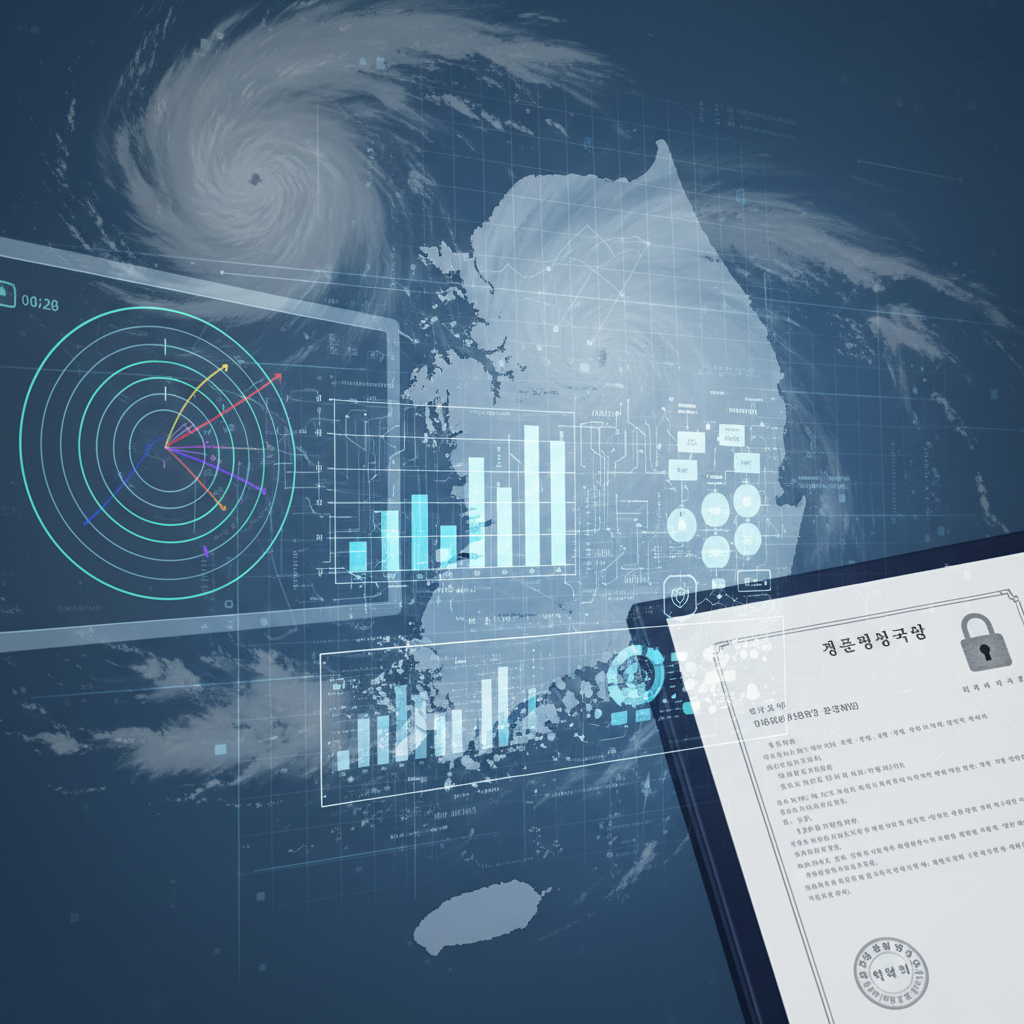

The sky above Seoul is a capricious beast. One moment, a clear, crisp spring day, the next, a sudden downpour, or worse, the looming threat of a typhoon. For decades, we've relied on the Korea Meteorological Administration, KMA, and their supercomputers, but now, a new oracle has emerged: artificial intelligence. AI weather forecasting is not just incrementally better, it is outperforming traditional models by orders of magnitude, a fact that has sent ripples, or perhaps tsunamis, through the halls of power and industry here in South Korea.
Everyone's wrong about this if they think it is just about better forecasts. This isn't merely a technological leap, it is a profound shift in how we understand and prepare for the world around us. And with such power comes immense responsibility, or at least, that is what the National Assembly seems to think. They have just passed the 'AI-Powered Environmental Data Governance Act,' a mouthful, I know, but one that promises to reshape how AI models access, process, and utilize critical environmental data, especially for something as vital as weather prediction.
The Policy Move: A New Climate for Data
The new Act, which is expected to take full effect by early 2027, establishes a tiered system for AI models dealing with sensitive environmental data. It mandates strict data provenance tracking, requires independent audits for model bias and accuracy, and perhaps most controversially, introduces a licensing framework for commercial AI weather forecasting services that utilize KMA's proprietary data or models trained on it. The stated goal is noble: to ensure accuracy, prevent misuse, and maintain public trust in predictions that can literally save lives and billions in economic damage. Think about the typhoons that routinely batter our coastline, or the unprecedented heatwaves that have plagued our summers. Accurate, timely warnings are paramount.
Who's Behind It and Why: A Question of Sovereignty and Safety
This legislative push is largely spearheaded by Representative Kim Min-joon of the ruling party, a vocal advocate for digital sovereignty. "We cannot allow critical national infrastructure, even predictive infrastructure, to be solely in the hands of foreign entities or unregulated private corporations," Kim stated in a recent parliamentary session. "The KMA invests heavily in its data collection and modeling. We must protect that investment and ensure its benefits serve the Korean people first." His sentiment resonates deeply in a nation acutely aware of its technological prowess and its geopolitical vulnerabilities. The KMA itself has been a strong proponent, citing concerns over data security and the potential for commercial entities to monetize publicly funded data without proper oversight.
This move also comes amidst a global scramble for AI dominance. When Google DeepMind's GraphCast made headlines for its superior medium-range forecasts, outperforming even the European Centre for Medium-Range Weather Forecasts, Ecmwf, it became clear that traditional meteorological agencies were facing an existential challenge. Seoul has a different answer than simply watching from the sidelines. They want to regulate the playing field, not just participate in the game.
What It Means in Practice: Red Tape or Responsible AI?
For companies developing AI weather models, this means a significant increase in compliance overhead. They will need to demonstrate transparent data pipelines, submit to regular audits, and potentially pay licensing fees for accessing or building upon KMA's vast historical datasets. The Act also includes provisions for a national AI weather data repository, aiming to centralize and standardize data access, theoretically leveling the playing field for smaller Korean startups. However, the devil, as always, is in the details. The exact fee structures and audit criteria are still being hammered out by the Ministry of Science and ICT.
Industry Reaction: A Mixed Forecast
The industry's response has been, predictably, mixed. Major Korean conglomerates with significant AI divisions, like Samsung SDS and LG CNS, have expressed cautious optimism. "Responsible AI governance is crucial for long-term growth and public acceptance," said Dr. Lee Ji-hoon, head of AI research at Samsung SDS, in a recent interview with a local tech publication. "While the compliance burden is real, a clear regulatory framework can foster innovation by building trust." They see an opportunity to position themselves as trusted, compliant providers in a newly regulated market.
However, smaller AI startups, particularly those focused on niche applications like agricultural weather forecasting or localized disaster prediction, are more apprehensive. "This could stifle innovation," argued Park Seo-yeon, CEO of SkyPredict, a Seoul-based startup specializing in hyper-local weather models. "The costs associated with licensing and auditing could be prohibitive for us. We need access to data to compete, not more bureaucratic hurdles." Park's concerns are valid. The capital required to navigate complex regulatory landscapes often favors established players, potentially crushing the very innovation the government claims to foster. You can read more about the challenges faced by AI startups in this evolving landscape on TechCrunch's AI section.
Civil Society Perspective: Trust and Transparency
Civil society groups, particularly those focused on data privacy and algorithmic accountability, have largely welcomed the Act. "When AI models are making predictions that affect public safety and economic stability, transparency is not a luxury, it is a fundamental right," stated Choi Eun-kyung, director of the Korean Digital Rights Coalition. "This Act is a vital first step towards ensuring that these powerful systems are accountable to the public, not just to their developers." They emphasize the need for clear mechanisms for public recourse if an AI model's erroneous prediction leads to harm, a point often overlooked in the rush for technological advancement.
There is also a strong undercurrent of concern about the potential for overreach. While the KMA's data is publicly funded, the question of whether the government should control access to any environmental data, even that gathered by private sensors or satellite networks, remains a point of contention. The line between public good and private innovation is a blurry one, and this Act attempts to draw it, perhaps imperfectly.
Will It Work? The K-Wave is Coming for AI Too
So, will Seoul's ambitious AI-Powered Environmental Data Governance Act succeed? It is too early to tell. On one hand, it addresses legitimate concerns about data sovereignty, public safety, and the responsible deployment of increasingly powerful AI. It attempts to put guardrails on a technology that often feels like a runaway train. This proactive regulatory stance could set a precedent, much like how South Korea has often led in digital infrastructure and e-governance. The K-wave is coming for AI too, and it might just be a regulatory one this time.
However, the success hinges on careful implementation. If the licensing fees are too high, or the audit processes too cumbersome, it risks creating a bottleneck for innovation, especially for the nimble startups that often drive true breakthroughs. The government must strike a delicate balance between oversight and fostering a dynamic AI ecosystem. It needs to be a framework that encourages collaboration, not just compliance. The world is watching to see if Korea can navigate this storm, creating a model for AI governance that is both robust and conducive to progress. For more insights on global AI policy, you might find articles on MIT Technology Review useful. The stakes are high, not just for our weather forecasts, but for the future of AI regulation worldwide. It is a forecast I am watching very closely.