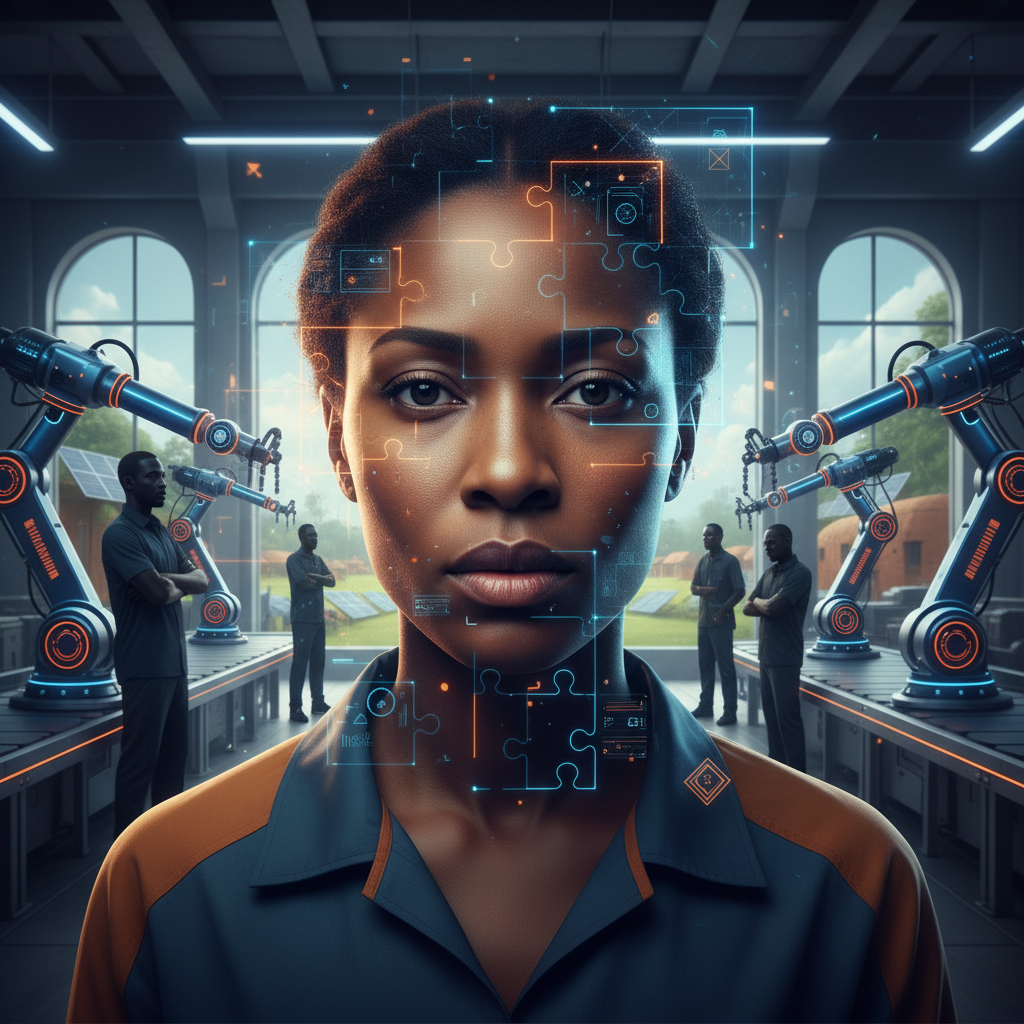

The air in the Aba shoe market, Enyimba City, always hums with a particular energy. It's the sound of hammers on leather, the rhythmic whir of sewing machines, the banter of apprentices, and the sharp, knowing eyes of master craftsmen. This isn't just commerce, it's a symphony of human labor, passed down through generations. Now imagine that symphony silenced, replaced by the sterile whir of automated arms, churning out footwear faster, cheaper, perhaps even 'better.' This isn't a distant dystopian future for Nigeria, it's a conversation happening right now, in boardrooms and, more importantly, in union halls across the country.
We see the headlines touting AI's efficiency, the promise of increased productivity, and the gleaming factories of tomorrow. Reuters often reports on these advancements. But what about the human cost, particularly in a nation where labor is not just a means to an end, but often the very bedrock of identity and community? Unpopular opinion: while Silicon Valley celebrates every new AI breakthrough, I'm looking at the faces of Nigerian workers and asking, 'What happens to them?'
Take the story of the National Union of Textile, Garment and Tailoring Workers of Nigeria (nutgtwn). They've been fighting for decades to protect jobs in an industry already battered by imports. Now, they face a new, more insidious threat: AI-driven automation. Imagine a textile factory in Kano, where generations have spun cotton and woven intricate patterns. Suddenly, a new 'smart' loom, perhaps powered by NVIDIA's latest chips, promises to do the work of twenty skilled hands. The management sees cost savings, global competitiveness. The workers see their livelihoods, their skills, and their very sense of self evaporating.
Psychologically, this isn't a simple equation of 'job lost, find another.' For many Nigerians, especially those in manufacturing and service sectors, their work is deeply intertwined with their social standing, their family's welfare, and their community's stability. When AI threatens to automate these roles, it doesn't just create unemployment; it can trigger a profound crisis of identity and purpose. Dr. Ngozi Okonjo-Iweala, the Director-General of the World Trade Organization, has often spoken about the need for inclusive growth and development. She has said, 'We must ensure that technological advancements benefit all, not just a select few, and that we invest in people to adapt to these changes.' This sentiment resonates deeply here.
Research backs this up. Studies on the psychological impact of automation in developed economies, while not directly replicating the Nigerian context, offer stark warnings. They point to increased anxiety, depression, and a sense of alienation among workers whose tasks are taken over by machines. The cognitive effects are particularly concerning. When repetitive, manual tasks are automated, workers are often 'upskilled' to monitor the machines. This shift from active, hands-on engagement to passive oversight can lead to a decline in certain cognitive functions, such as problem-solving skills related to manual dexterity, and a sense of diminished agency. The human brain thrives on challenge, on mastery, on the tangible outcome of its efforts. When that is removed, what fills the void?
Professor Olufemi Bamiro, a distinguished Nigerian engineer and former Vice-Chancellor of the University of Ibadan, has been a vocal proponent of local innovation and human capital development. He once remarked, 'Our greatest resource is our people. Any technology that does not uplift and empower our people, but rather displaces them without viable alternatives, must be approached with extreme caution.' This isn't anti-technology; it's pro-humanity. It's about ensuring that the pursuit of efficiency doesn't inadvertently erode the very societal structures it claims to serve.
Let's talk about what nobody wants to discuss: the power dynamics. When global tech giants like Google or Microsoft push their AI solutions into African markets, they often come with narratives of progress and development. But who truly benefits? Is it the local worker, or is it primarily the company's bottom line and the interests of a few well-connected elites? This is where the pushback from labor unions becomes not just an economic struggle, but a psychological and cultural defense. They are fighting to maintain a sense of control over their destinies, to prevent a future where their labor is deemed obsolete by algorithms designed thousands of miles away.
Consider the dockworkers in Apapa, Lagos. Their unions have historically been powerful, protecting their members' interests. Now, with talks of automating port operations using advanced robotics and AI systems to optimize cargo handling, the psychological toll on these workers is immense. The fear of job displacement is palpable, leading to stress, uncertainty, and a feeling of being undervalued. This isn't just about losing a paycheck; it's about losing a role that has defined generations of families in Lagos. The collective identity of a 'dockworker' is at stake, and with it, the social cohesion of entire communities.
What can be done? The answer isn't to reject AI outright, that would be foolish. But it's also not to blindly embrace it. We need a uniquely Nigerian, uniquely African approach. This means prioritizing human-centric AI development, investing massively in reskilling and upskilling programs that genuinely prepare workers for new roles, and fostering a culture of local innovation that allows Nigerians to build and control their own AI solutions, rather than simply being passive consumers or, worse, victims of foreign technology. The MIT Technology Review has highlighted the global challenges of AI and labor, but our solutions must be localized.
We need stronger social safety nets, robust educational reforms to equip the next generation with AI literacy, and, crucially, a seat at the table for labor unions in policy discussions about AI deployment. Their voices, often dismissed as resistant to progress, are in fact the guardians of human dignity and social stability. Ignoring them is not just an economic misstep, it's a psychological blunder that could unravel the very fabric of our society. The future of work in Nigeria, and indeed across Africa, depends on whether we choose to automate with empathy, or simply automate away our humanity. This is a battle for the mind, and it is just beginning.