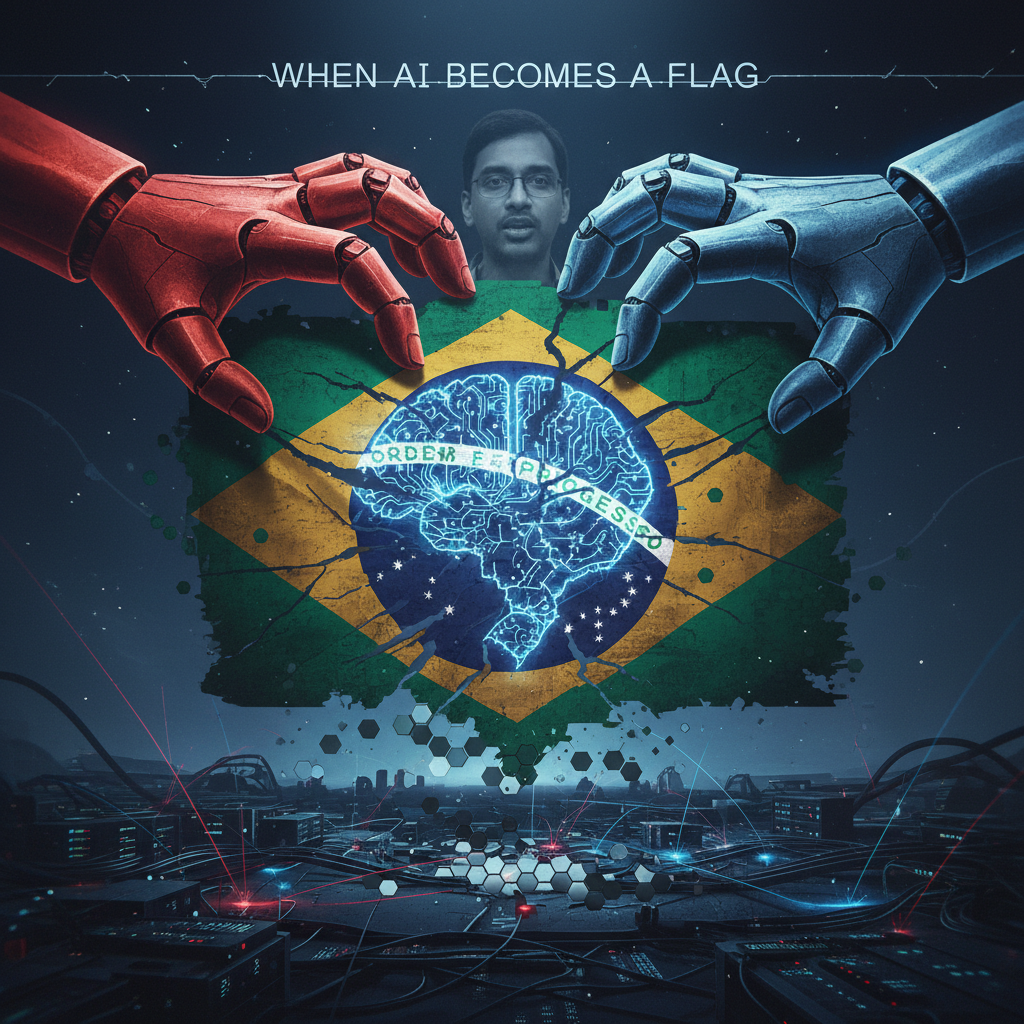
The air in São Paulo, much like the global tech landscape, often feels thick with a certain kind of tension, a hum of unseen forces at play. For us in Brazil, this isn't just about traffic or the price of pão de queijo, it's increasingly about the silent, invisible battle unfolding in the digital realm: the AI technology cold war.
For years, we've watched as the United States and China, the two titans of the tech world, have pushed the boundaries of artificial intelligence. Their competition, once a friendly rivalry, has hardened into something more akin to a geopolitical chess match. And as the pieces move, nations like ours, with burgeoning tech sectors and a deep desire for self-determination, find ourselves navigating a treacherous board.
The Risk Scenario: A Divided Digital Future
The most immediate risk is fragmentation. Imagine a world where AI ecosystems are not interoperable, where data standards differ so wildly that a model trained in one bloc cannot function effectively, or at all, in another. This isn't just an inconvenience, it's a fundamental barrier to global progress. For a country like Brazil, which thrives on open exchange and collaboration, this scenario is particularly alarming. Our developers, who often bridge Portuguese and English tech communities with remarkable agility, could find themselves walled off from crucial tools and research.
Consider the implications for healthcare AI, the category for this article. Brazil has made significant strides in leveraging AI for public health, from predicting dengue outbreaks to assisting in early cancer detection. We have projects using AI to analyze medical images in remote Amazonian communities, where specialists are scarce. If the foundational AI models, the very cérebro of these systems, become subject to export controls or incompatible standards dictated by distant powers, our ability to deliver life-saving solutions could be severely hampered. Imagine a critical diagnostic tool, developed with a specific chip architecture from one superpower, suddenly being unusable because of a political decree from the other. The code tells the real story, and if that code is locked behind geopolitical walls, our patients suffer.
Technical Explanation: The Architecture of Division
Let me explain the architecture of this potential division. At its core, the AI cold war manifests across several layers: hardware, software, and data. On the hardware front, we're talking about the specialized chips, primarily GPUs, that power modern AI. Companies like NVIDIA, based in the US, dominate this market. China, acutely aware of this dependency, is investing billions in domestic chip manufacturing, seeking self-sufficiency. This creates a dual-track development where chip designs and manufacturing processes could diverge significantly.
Then there's the software layer. This includes the AI frameworks, like Google's TensorFlow or Meta's PyTorch, and the large language models themselves, such as OpenAI's GPT series, Anthropic's Claude, or Baidu's Ernie Bot. While many of these are open source or have open components, the most advanced versions often remain proprietary. If geopolitical tensions escalate, access to these cutting-edge models, or even the ability to fine-tune them with local data, could be restricted. This is not a hypothetical fear. We've seen precedents with sanctions impacting access to software and services in other tech sectors.
Finally, data. Data is the fuel of AI. Different regulatory environments, particularly around data privacy and sovereignty, could lead to 'data balkanization.' If Brazil's healthcare data, for instance, cannot be processed by AI models hosted in certain foreign clouds due to legal or political restrictions, it forces us to build entirely new, costly infrastructure, potentially delaying critical advancements. This isn't just about data residency, it's about the entire data pipeline, from collection to model training and deployment.
Expert Debate: Navigating the Chasm
Experts are divided on the severity and inevitability of this fragmentation. Some, like Google CEO Sundar Pichai, have repeatedly warned about the dangers. In a 2020 interview with the BBC, Pichai stated, "AI is one of the most important things humanity has ever worked on. It's more profound than fire or electricity. I think it's important that we come together, as countries, to think about how to tackle this." His concern underscores the belief that AI's benefits are best realized through global collaboration, not isolation. More recently, he reiterated these sentiments, emphasizing the need for global norms and guardrails, a sentiment echoed across many tech boardrooms, as reported by Reuters.
On the other hand, some policymakers argue that national security interests necessitate a more protectionist approach. General H.R. McMaster, former National Security Advisor, has often spoken about the need for technological decoupling to protect critical infrastructure and intellectual property. He might argue that relying on foreign AI systems, especially in sensitive areas like healthcare or defense, poses an unacceptable risk. This perspective suggests that a certain degree of technological independence is not just desirable, but essential for national sovereignty.
Then there are voices like Dr. Fei-Fei Li, co-director of Stanford's Institute for Human-Centered AI, who advocates for 'human-centered AI' and warns against the weaponization of the technology. She emphasizes that the focus should be on ethical development and ensuring AI serves humanity, rather than becoming another tool in a geopolitical struggle. Her work, often highlighted in publications like MIT Technology Review, pushes for a global ethical framework that transcends national interests, a truly ambitious goal in the current climate.
Real-World Implications for Brazil
For Brazil, the implications are stark. We risk becoming a consumer of AI rather than a co-creator. If we cannot access the latest chips or the most advanced models, our ability to innovate and compete on the global stage diminishes. This impacts our startups, our universities, and ultimately, our economic growth. Brazil's developer community is massive and talented, but they need access to the best tools. Imagine a brilliant Brazilian AI researcher, perhaps from a federal university in Minas Gerais, having to choose between using a state-of-the-art model from one bloc or a less capable, but politically 'safe,' alternative from another. This is not conducive to scientific progress.
Furthermore, this cold war could force Brazil into difficult choices. Do we align with one technological ecosystem over another, potentially alienating a major trading partner? Or do we attempt to build our own parallel infrastructure, a monumental and costly undertaking for a developing nation? The custo Brasil, already a challenge, would only grow.
In healthcare, this could mean delays in adopting cutting-edge diagnostic tools, slower drug discovery processes, and reduced access to personalized medicine. Our public health system, the SUS, already faces immense challenges. Adding geopolitical tech barriers to that equation is a recipe for exacerbating existing inequalities.
What Should Be Done: A Path Forward for Brazil
So, what is Brazil's strategy in this high-stakes game? First, we must prioritize digital sovereignty. This means investing in our own AI research and development capabilities, fostering local talent, and building robust data infrastructure. It's not about isolation, but about having the foundational capacity to make independent choices. We need to support initiatives that promote open source AI, ensuring that critical technologies remain accessible to all, regardless of national origin. This is where the spirit of collaboration, so vital to the open source movement, can act as a counterbalance to protectionist tendencies. Projects like the Brazilian Portuguese GPT, being developed by local researchers, are crucial steps in this direction.
Second, Brazil should actively engage in multilateral forums to advocate for global AI governance and ethical standards. We need to be a voice for cooperation, pushing back against fragmentation. Our diplomatic efforts should emphasize the shared benefits of AI for humanity, particularly in areas like climate change and global health, where collective action is paramount. We can leverage our position as a significant emerging economy and a bridge between North and South to champion a more inclusive vision for AI's future.
Finally, we must diversify our technological dependencies. This means exploring partnerships with a wider range of countries and companies, avoiding over-reliance on any single source for critical AI components. It's about building resilience, much like a diversified investment portfolio. For our healthcare sector, this translates to demanding interoperability and open standards from vendors, ensuring that our systems are not locked into proprietary ecosystems that could become geopolitical liabilities.
The AI cold war is not just a distant skirmish between superpowers, it's a force reshaping our world, and Brazil must navigate it with wisdom and foresight. Our future, and the well-being of our people, depends on it. We must ensure that the promise of AI, a technology that holds so much potential for good, does not become another casualty of geopolitical rivalry. The time for proactive engagement, for building our own path, is now, before the walls become too high to climb.