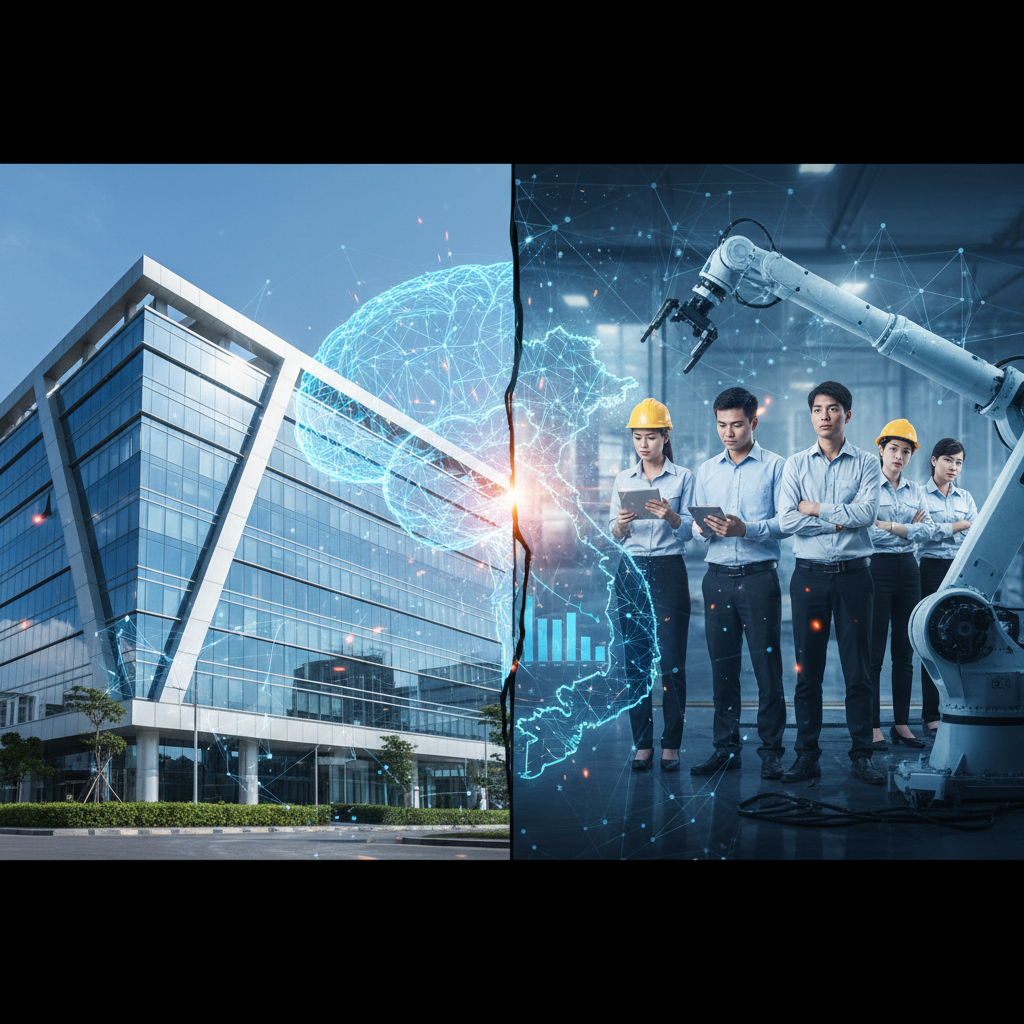

The air in Taipei’s Xinyi District, even amidst the gleaming towers of finance and technology, often carries the scent of street food and the hum of countless scooters. It is a city where tradition and relentless innovation coexist, sometimes uneasily. This dynamic tension, between progress and its human cost, is something Sarita Chen understands intimately. At 36, Chen is not developing the next large language model or a new semiconductor. Instead, she is building LaborStack, a company focused on equipping labor unions and workers with the data and analytical capabilities to negotiate with employers deploying AI-driven automation.
Her journey began not in a Silicon Valley garage, but in the bustling, often overlooked, industrial zones of Taiwan and later, Southeast Asia. Chen’s defining moment, she recounts, came during a field visit to a textile factory in Taoyuan. The factory, once a cornerstone of the local economy, was in the midst of implementing a new robotic system for quality control and packaging. Workers, many of them older, with decades of experience, watched with a mixture of fear and resentment as the machines performed tasks they had perfected over lifetimes. The factory management presented the automation as an inevitable march of progress, a necessity for global competitiveness. Yet, Chen saw the human cost, the erosion of dignity, and the profound lack of agency among the workforce. “It wasn’t just about lost jobs,” Chen explained during a recent interview in her understated office near Taipei 101. “It was about the fundamental power imbalance. The company had all the data, all the projections. The workers had only their anxieties.”
Chen’s origin story is rooted in this very landscape. Born in Tainan, a city renowned for its historical depth and traditional crafts, she grew up observing the gradual transformation of Taiwan’s manufacturing base. Her father, an engineer at a precision machinery plant, often spoke of the relentless drive for efficiency. Her mother, a primary school teacher, instilled in her a deep sense of social responsibility. This dual influence shaped her academic path. She pursued a degree in Industrial Engineering at National Taiwan University, where she developed a keen understanding of process optimization and supply chain management. However, her interest soon veered towards the human element of these systems. She completed a master’s degree in Labor Relations at Cornell University, focusing on the impact of technological change on employment.
After graduation, Chen worked for several years as a consultant for international labor organizations, advising unions in various Asian countries on collective bargaining strategies. It was during this period that she met her co-founder, Dr. Kenji Tanaka, a Japanese data scientist specializing in predictive analytics. Tanaka, then working for a multinational logistics firm in Singapore, had developed sophisticated models to forecast labor demand based on automation adoption rates. He was, however, growing increasingly uncomfortable with how his work was being used. “My models were designed to optimize, but optimization often meant reducing headcount,” Tanaka admitted. “I realized the tools I was building could also be used to empower, to inform, rather than just to displace.”
Their shared disillusionment with the prevailing narrative of automation as an unmitigated good, coupled with a belief in the power of data, led to their breakthrough. They realized that if companies were using data to justify automation, then labor should have access to similar, if not superior, data to negotiate its terms. LaborStack was conceived as a platform to democratize this data. It would aggregate publicly available economic data, industry reports, and company-specific information, then apply AI and machine learning to analyze the potential impact of automation on specific job roles and skill sets. The goal was not to stop automation, but to ensure a just transition, advocating for retraining programs, revised job descriptions, and fair compensation for displaced workers.
Building LaborStack was not without its challenges. Initial funding was difficult to secure. Venture capitalists, accustomed to investing in disruptive technologies that promised exponential growth and efficiency gains, were skeptical of a platform designed to empower labor. “Many investors saw us as anti-innovation, as a hurdle to progress,” Chen recalled. “But we argued that sustainable innovation requires social license, and that means bringing workers along, not leaving them behind.” They eventually secured a seed round from a consortium of impact investors and a Taiwanese family office with a history of supporting social enterprises. Their early team comprised a mix of data scientists, labor economists, and software engineers, many of whom shared Chen and Tanaka’s vision for a more equitable future of work.
Today, LaborStack has grown significantly. It has partnered with several major labor unions in Taiwan, South Korea, and parts of Southeast Asia, providing them with critical insights ahead of collective bargaining negotiations. The platform’s analytics have been instrumental in helping unions secure commitments for reskilling initiatives, extended severance packages, and even co-creation programs where workers contribute to the design of new automated systems. For example, in a recent negotiation with a major electronics manufacturer in Vietnam, LaborStack’s data helped a union demonstrate that a proposed automation rollout would disproportionately affect female workers in assembly lines, leading to a revised plan that included targeted retraining for higher-skilled roles within the company. Reuters has reported on the growing trend of unions leveraging data in these disputes.
What drives Sarita Chen is a deep-seated conviction that technology, while powerful, is ultimately a tool shaped by human intent. “The data tells a more nuanced story than the headlines often suggest,” Chen insists. “It’s not just about robots replacing humans. It’s about how we choose to manage that transition, how we value human capital, and whether we prioritize short-term profit over long-term societal stability.” She frequently references the concept of gong ban (共辦), a Taiwanese term for collaborative effort, emphasizing that the future of work requires shared responsibility and dialogue, not just top-down directives.
Looking ahead, LaborStack plans to expand its reach into more industries, particularly those heavily impacted by generative AI, such as customer service, content creation, and administrative roles. Chen also aims to develop predictive models that can identify at-risk job categories even before automation plans are announced, allowing unions and governments to proactively prepare. She believes that Taiwan, with its robust manufacturing base and strong, albeit evolving, labor movement, can serve as a crucial testbed for these solutions. “Taiwan’s position is more complex than headlines suggest,” Chen muses, reflecting on the island’s dual role as a global technology powerhouse and a society grappling with the implications of that power. “We have the opportunity to show the world that AI can be a tool for empowerment, not just displacement, if we choose to wield it responsibly.” The challenge, as always, lies in translating this vision into tangible, equitable outcomes for the millions whose livelihoods hang in the balance. The conversation around AI and labor is only just beginning, and Chen’s LaborStack is ensuring that workers have a voice, and data, at the table. For further reading on the societal impact of AI, MIT Technology Review offers insightful analyses. The broader implications for workers are also being studied by organizations globally, as highlighted by articles on Wired.