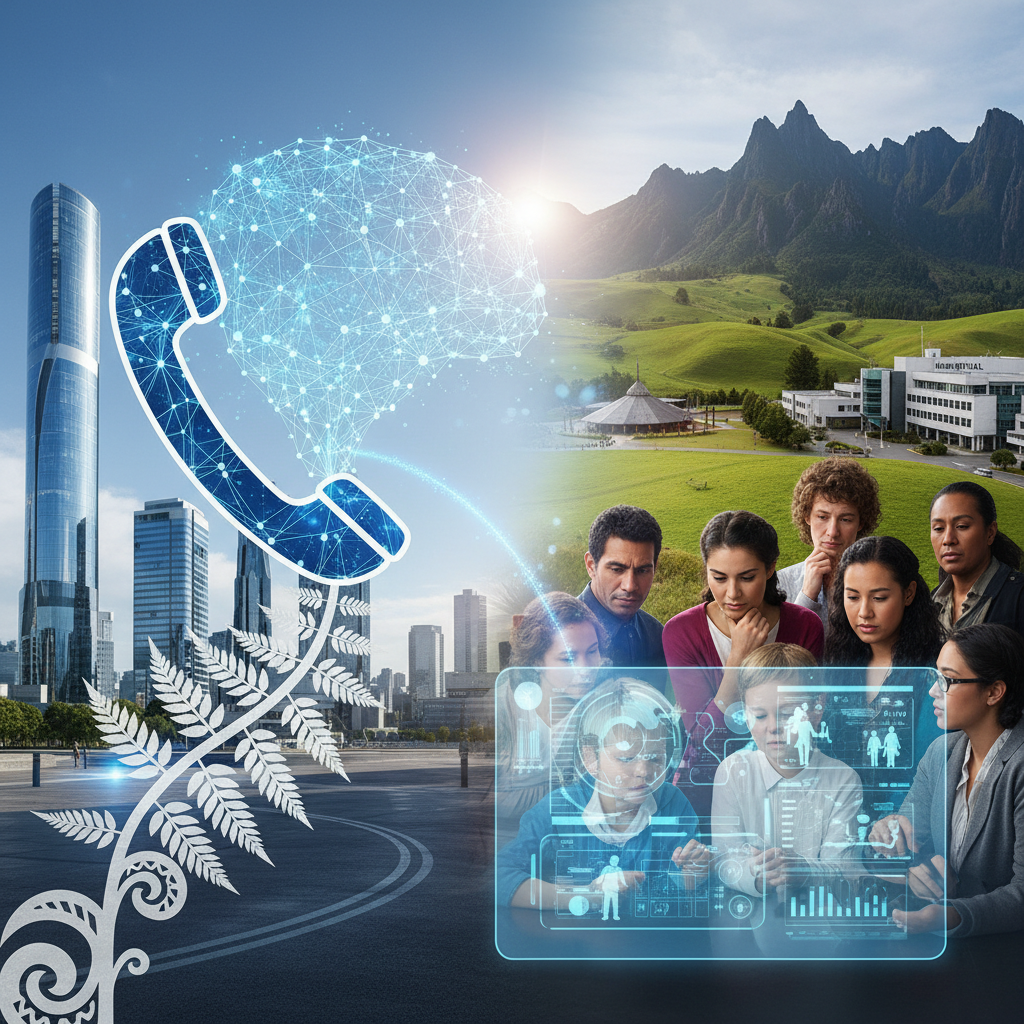
The digital waves of innovation keep crashing onto our shores, sometimes with the gentle lapping of progress, other times with the force of a tsunami. Right now, the talk of the town, at least in certain tech circles, is Sierra AI. Founded by two titans of the industry, Bret Taylor, formerly co-CEO of Salesforce, and Clay Bavor, a long time Google executive, this startup has rocketed to a reported $4 billion valuation. Their mission: to revolutionize customer service using advanced artificial intelligence. On the surface, it sounds like another Silicon Valley success story, a testament to bold vision and deep pockets. But for us in Aotearoa, and indeed for many communities globally, the question isn't just about valuation. It's about value, about how this technology will touch the lives of real people, and whether it aligns with our values.
The Headline Development: A $4 Billion Bet on AI Customer Service
Sierra AI burst onto the scene with a clear, ambitious goal: to create AI agents capable of handling complex customer interactions, moving far beyond the rudimentary chatbots we've all grown to tolerate, or perhaps, dread. Their founders, Taylor and Bavor, bring a formidable pedigree. Taylor's tenure at Salesforce saw him at the helm of a cloud software giant, while Bavor led Google's Ar/vr efforts and played a significant role in many of its consumer products. Their combined experience in enterprise software and consumer AI makes Sierra a compelling player. They are reportedly building a platform that allows businesses to deploy highly sophisticated AI assistants that can understand context, learn from interactions, and even proactively resolve issues, aiming to reduce wait times, improve efficiency, and free up human agents for more nuanced tasks. The sheer scale of their funding, reportedly from major venture capital firms, underscores the industry's belief in their potential to disrupt a multi trillion dollar customer service market. This is not just a small tech experiment, it is a significant bet on the future of how we interact with companies, big and small.
Why Most People Are Ignoring It: The Quiet Revolution in Our Everyday Lives
For many, the news of another AI startup, even one with such high-profile founders and a hefty valuation, might barely register. We are bombarded daily with headlines about generative AI, autonomous vehicles, and the latest advancements from giants like OpenAI and Google. Customer service AI, while ubiquitous, often feels like background noise, an irritating necessity rather than a groundbreaking innovation. We see it in the endless phone trees, the frustrating chatbot loops, and the often impersonal email responses. The promise of a better AI customer service often sounds like a distant dream, or perhaps, a thinly veiled threat to jobs. People are busy with their lives, their mahi, their whānau. They are navigating the rising cost of living, the challenges of climate change, and the complexities of modern society. The intricacies of a startup's valuation or its underlying large language model architecture feel far removed from their immediate concerns. Yet, this quiet revolution in how businesses interact with their customers is precisely why we need to pay attention. It is a foundational shift that will ripple through every industry, every transaction, and every interaction, whether we actively notice it or not.
How It Affects YOU: The Human Connection at Stake
Imagine calling your bank, your internet provider, or even your local council here in Aotearoa. Instead of a human voice, you encounter an AI that sounds perfectly natural, understands your query, and resolves your issue with startling efficiency. Sounds great, right? For simple tasks, perhaps. But what happens when your situation is unique, emotionally charged, or requires a level of empathy and discretion that current AI still struggles to replicate? What about the elderly kuia who prefers to speak Te Reo Māori to a person who understands not just the words, but the cultural nuances behind them? In Te Reo Māori, we have a word for this, 'whanaungatanga,' which speaks to the importance of relationships, kinship, and a sense of belonging. Can an AI truly embody whanaungatanga? When a customer service role is automated, we lose not just a job, but often a point of human connection, a chance for genuine understanding. For many, especially in smaller, more community focused nations like New Zealand, these interactions are not merely transactions, they are part of the social fabric. If Sierra AI delivers on its promise of hyper efficient AI agents, it will undoubtedly change the employment landscape for countless customer service representatives, a sector that employs a significant number of people globally. This isn't just about convenience, it's about the quality of our daily interactions and the livelihoods of our people.
The Bigger Picture: Equity, Access, and the Digital Divide
Sierra AI's rise highlights a broader trend: the increasing reliance on AI for essential services. While this can bring efficiencies, it also raises critical questions about equity and access. Will these advanced AI systems be trained on diverse enough data to understand the myriad accents, dialects, and cultural contexts of a global population? What happens if an AI system, however sophisticated, is biased against certain demographics, or struggles to understand someone speaking with a strong regional accent, or in a language less commonly represented in its training data? In a country like New Zealand, where we have two official languages, Te Reo Māori and New Zealand Sign Language, and a rich tapestry of cultures, ensuring AI systems are inclusive is paramount. If a customer service AI cannot effectively serve all segments of our population, it risks deepening the digital divide and marginalizing those who already face barriers. Furthermore, the concentration of such powerful AI technology in the hands of a few well funded startups in Silicon Valley raises concerns about data sovereignty and control. Who owns the data generated by these interactions? How is it protected? These are not trivial questions, especially for indigenous communities who have long advocated for control over their own data, their 'mātauranga.'
What Experts Are Saying: A Mix of Optimism and Caution
Experts are watching Sierra AI with a blend of excitement and trepidation. Dr. Ruha Benjamin, a prominent scholar on race, technology, and justice at Princeton University, has often spoken about the need for critical vigilance in AI development. She cautions against the uncritical adoption of technology, stating, “We must ask not only if technology can do something, but if it should.” Her work consistently reminds us that technology is not neutral, it reflects the biases and priorities of its creators. Similarly, Professor Alistair Knott, a leading AI researcher at Victoria University of Wellington, emphasizes the importance of local context. “For AI to truly serve New Zealand, it needs to be developed with our unique cultural and linguistic landscape in mind,” he told a recent AI forum. “Generic, off the shelf solutions from overseas often fail to capture the nuances that are essential for effective communication and service delivery here.”
From the business side, Satya Nadella, CEO of Microsoft, has frequently articulated a vision where AI augments human capabilities rather than replaces them entirely. He has stated, “AI is the most transformative technology of our time, but its true power lies in empowering people, not in automating them out of existence.” This perspective suggests that companies like Sierra AI should focus on creating tools that make human agents more effective, rather than solely on full automation. However, the economic pressures on businesses to reduce costs often push them towards maximum automation. This tension is at the heart of the debate. Finally, Sam Altman, CEO of OpenAI, whose company's models likely power much of the underlying technology, has spoken about the immense potential of AI to improve productivity across all sectors. He believes that while jobs will change, new and better ones will emerge. “We are entering an era of abundance, where AI will make everything cheaper and more accessible,” Altman remarked in a recent interview with Reuters. This optimistic view often underpins the massive investments in companies like Sierra AI.
What You Can Do About It: Shaping Our Digital Future
So, what can we, as individuals and communities, do? Firstly, demand transparency. When you interact with an AI, you have a right to know it is an AI, and to request a human agent if needed. Secondly, advocate for ethical AI development. Support policies and initiatives that prioritize fairness, accountability, and cultural responsiveness in AI. Here in New Zealand, organizations like the AI Forum NZ are working to shape a responsible AI future, and our government is exploring frameworks for ethical AI. Thirdly, participate in the conversation. Share your experiences, both good and bad, with AI customer service. Your voice matters. Finally, for businesses, consider how you can integrate AI in a way that enhances human connection, rather than diminishes it. Technology must serve the people, not the other way around. This means investing in training for human agents to handle more complex, empathetic interactions, and ensuring AI tools are designed to support them, not replace them wholesale.
The Bottom Line: Why This Will Matter in 5 Years
In five years, the impact of companies like Sierra AI will be undeniable. Customer service, as we know it, will be fundamentally transformed. Many routine interactions will be handled seamlessly by AI agents, potentially leading to faster resolutions and lower operational costs for businesses. However, the quality of these interactions, and their accessibility to all, will depend heavily on the ethical choices made today. Will we see a future where only the privileged can access human support, while the rest are relegated to imperfect algorithms? Or will we harness AI to create more equitable and efficient systems that truly serve everyone, respecting cultural diversity and upholding the importance of human connection? The $4 billion valuation of Sierra AI is a stark reminder of the immense financial capital flowing into this space. It is up to us, the users and citizens, to ensure that the social and cultural capital is also well invested, building a future that reflects our values, here in Aotearoa and across the globe.