
Ah, space. The final frontier, they say. For us mere mortals stuck on terra firma, it is a realm of wonder, mystery, and frankly, a lot of very expensive rockets. But what if I told you that the silent, tireless workhorse making much of this cosmic ballet possible is not some intrepid astronaut, but a bunch of algorithms, a dash of machine learning, and a whole lot of very clever code? We are talking about Artificial Intelligence in space exploration, and let me tell you, it is far more than just a fancy buzzword.
What is AI in Space Exploration, Anyway?
Simply put, AI in space exploration refers to the application of artificial intelligence technologies to various aspects of space missions, from planning and execution to data analysis and discovery. Think of it as giving our spacecraft and ground systems a brain, or at least a very sophisticated set of analytical tools, to handle tasks that are too complex, too dangerous, or too time-consuming for humans alone. It is about making autonomous decisions, optimizing operations, and uncovering patterns in vast datasets that would otherwise remain hidden.
We are talking about everything from guiding a rover across the Martian surface without human intervention for every pebble, to sifting through radio signals from deep space looking for that elusive sign of extraterrestrial intelligence. It is not just about robots, mind you, it is about intelligence, learning, and adaptation in environments where a human touch is either impossible or impractical.
Why Should You Care? Because the Universe is Big, and We Are Small.
Why should a good Portuguese citizen, perhaps enjoying a pastel de nata by the Tagus, care about AI in space? Well, for starters, the universe is an impossibly vast place. Our current methods of exploration, while impressive, are painfully slow and limited. Sending a human to Mars, for example, is a monumental undertaking, fraught with peril and expense. AI offers a way to extend our reach, to be present, in a sense, without actually being there.
Moreover, the data we collect from space is astronomical, literally. Telescopes like the James Webb Space Telescope or missions mapping distant galaxies generate petabytes of information. No human team, however brilliant, can process all of that. AI acts as our cosmic librarian, our tireless analyst, finding the needles in the galactic haystack. This directly impacts our understanding of the universe, the origins of life, and perhaps, our place within it. And let us not forget the practical applications. The same AI that helps navigate a Mars rover might one day optimize self-driving cars here on Earth, or the algorithms that process satellite imagery to monitor climate change could be refined by their extraterrestrial counterparts. It is all connected, like a good cozido à Portuguesa, many ingredients making a rich whole.
How Did This Cosmic Brain Develop?
The idea of intelligent machines in space is not new, of course. Science fiction has been dreaming it up for decades. But the reality began to take shape with the advent of more powerful computing and the development of machine learning algorithms in the late 20th and early 21st centuries. Early applications were relatively simple, like automated fault detection in satellites or optimizing communication schedules.
However, as AI capabilities grew, particularly with deep learning and neural networks, so did its potential in space. NASA, the European Space Agency (ESA), and private companies like SpaceX and Blue Origin began to invest heavily. The Mars rovers, for instance, have progressively become more autonomous. Spirit and Opportunity, launched in 2003, had some basic AI for hazard avoidance, but Curiosity and Perseverance, launched in 2011 and 2020 respectively, possess far more advanced AI for navigation, scientific targeting, and even sample collection. This evolution mirrors the general progression of AI on Earth, moving from rule-based systems to learning systems capable of adapting to unforeseen circumstances.
How Does It Work in Simple Terms? Think of a Smart Navigator and a Super-Sleuth.
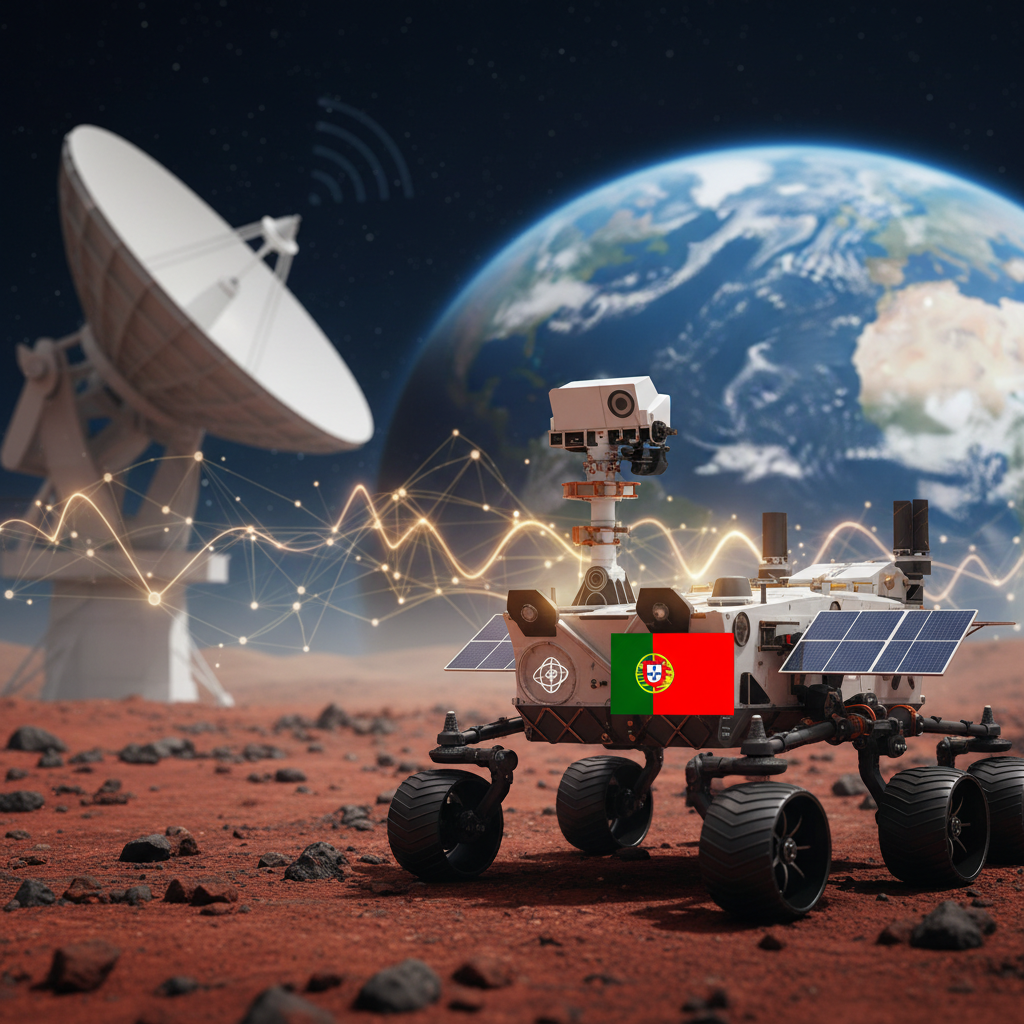
Imagine you are driving a car through an unknown, rugged terrain, but you cannot see anything and can only receive instructions every few hours. That is roughly the challenge for a Mars rover. AI, in this scenario, acts as a very smart navigator. It takes in data from cameras and sensors, builds a 3D map of the surroundings, identifies obstacles, and plots the safest and most efficient path forward, all in real-time and without waiting for commands from Earth. This is called onboard autonomy.
For satellite AI, think of it as a super-sleuth. Earth-observing satellites collect mountains of images and data daily. Instead of humans painstakingly sifting through every pixel, AI algorithms are trained to spot specific patterns: deforestation, urban expansion, crop health, or even illegal fishing vessels. It is like having a digital detective that never sleeps, constantly monitoring and reporting anomalies. For the search for extraterrestrial intelligence (seti), AI is the ultimate pattern recognizer, listening to the static of the universe and trying to distinguish a meaningful signal from cosmic noise. It is essentially a very advanced filter, trained on what we know about communication and patterns, looking for anything that stands out from the natural background radiation.
Real-World Examples: From Red Planet Rovers to Listening for Little Green Men
-
Mars Rovers (NASA's Perseverance and Curiosity): These robotic geologists are perhaps the most famous examples. Their advanced AI allows them to navigate complex terrain, identify scientifically interesting rocks, and even prioritize targets for study. Perseverance, for example, uses its AutoNav system to drive itself for significant distances, making decisions about its path dozens of times per second. This is crucial given the communication delay between Earth and Mars, which can be over 20 minutes each way. Imagine waiting 40 minutes for a simple 'turn left' command; it is simply not practical for efficient exploration. You can read more about NASA's AI applications.
-
Satellite Constellations (Planet Labs, ESA's Copernicus): Companies like Planet Labs operate vast constellations of Earth-observing satellites. AI is critical here for processing the daily deluge of imagery, identifying changes, and extracting actionable insights for agriculture, environmental monitoring, and disaster response. The European Space Agency's Copernicus program also heavily relies on AI to process data from its Sentinel satellites, providing crucial information on land, ocean, and atmospheric conditions. It is a massive undertaking, and Portugal, with its long maritime tradition, certainly understands the value of good observation, even if it is from space.
-
seti (Breakthrough Listen Initiative): The search for extraterrestrial intelligence is a prime candidate for AI. Projects like Breakthrough Listen, a massive scientific program searching for signs of intelligent life in the universe, use machine learning algorithms to analyze petabytes of radio and optical telescope data. These algorithms are trained to distinguish potential technosignatures, like narrow-band signals that might indicate artificial origin, from the vast amount of natural cosmic phenomena. It is a needle in a cosmic haystack, and AI is the only tool capable of sifting through it all.
-
Mission Planning and Optimization (ESA, SpaceX): Beyond the hardware, AI is also used on the ground for optimizing mission parameters, predicting equipment failures, and managing complex schedules. For example, AI can help plan the most fuel-efficient trajectories for spacecraft or predict when a component on the International Space Station might need maintenance. SpaceX, for instance, uses advanced simulations and AI to optimize rocket launches and landings, constantly learning from each flight.
Common Misconceptions: No, Skynet is Not Taking Over the Mars Rover
One common misconception is that AI in space means fully sentient, self-aware robots like HAL 9000 from 2001: A Space Odyssey. While fascinating for fiction, current space AI is far from general artificial intelligence. It is highly specialized, designed to perform specific tasks very well, not to develop consciousness or rebel against its human creators. These systems are tools, albeit incredibly sophisticated ones, for extending human capabilities, not replacing them entirely. Another myth is that AI makes human involvement obsolete. Far from it, AI frees human scientists and engineers from tedious, repetitive tasks, allowing them to focus on higher-level analysis, strategic planning, and interpreting the novel discoveries AI helps to uncover. It is a partnership, not a takeover.
What to Watch For Next: The Autonomous Frontier
The future of AI in space exploration is incredibly exciting. We are moving towards even greater autonomy for spacecraft and rovers. Imagine missions to distant moons like Europa or Titan, where communication delays are even longer, requiring true onboard decision-making for scientific discovery. We will see AI-powered telescopes that can automatically identify and prioritize interesting celestial events, or AI systems that can help design and manufacture components in space, perhaps even for future lunar or Martian bases. The sardine can of European tech is actually a treasure chest, and our contributions to this field, while perhaps less flashy than Silicon Valley, are vital.
Expect to see more collaboration between space agencies and leading AI companies like Google DeepMind and OpenAI, pushing the boundaries of what is possible. The integration of quantum computing with AI could also unlock unprecedented data processing capabilities for future missions. As we continue to gaze at the stars, it is clear that AI will be our most trusted companion, helping us to not just observe the cosmos, but to truly understand it. The universe is waiting, and AI is helping us pack our bags, one algorithm at a time. It is a journey that will undoubtedly continue to surprise and inspire, much like discovering a new, exquisite Portuguese wine you never knew existed. The best, I believe, is yet to come. For more on the future of AI, keep an eye on MIT Technology Review.