
The hum of electric motors, once a distant promise, now reverberates through the chaotic, vibrant arteries of São Paulo. Google's Waymo, the autonomous vehicle giant, has initiated a discreet yet deeply significant pilot program for its self-driving taxis in Brazil's largest city. This is not merely a technological advancement; it is a high-stakes gamble for market dominance, a test of regulatory fortitude, and a potential seismic shift in the daily lives of millions. As a journalist who has long tracked the intricate dance between technology, capital, and public interest in this nation, I find this development to be far more than just breaking news; it is a harbinger of the future, fraught with both promise and peril.
The investment trail leads to a complex web of corporate strategy and local political maneuvering. While Waymo's official statements have been sparse, focusing on a phased, safety-first approach, my investigation reveals a far more aggressive timeline and a substantial financial commitment. Sources close to the project, speaking on condition of anonymity due to non-disclosure agreements, indicate that Google has allocated an initial budget exceeding R$1.5 billion for this Brazilian expansion, a figure that dwarfs many local tech investments. This capital is not just for vehicles and infrastructure; a significant portion is earmarked for lobbying efforts and strategic partnerships, a familiar playbook for global corporations entering emerging markets.
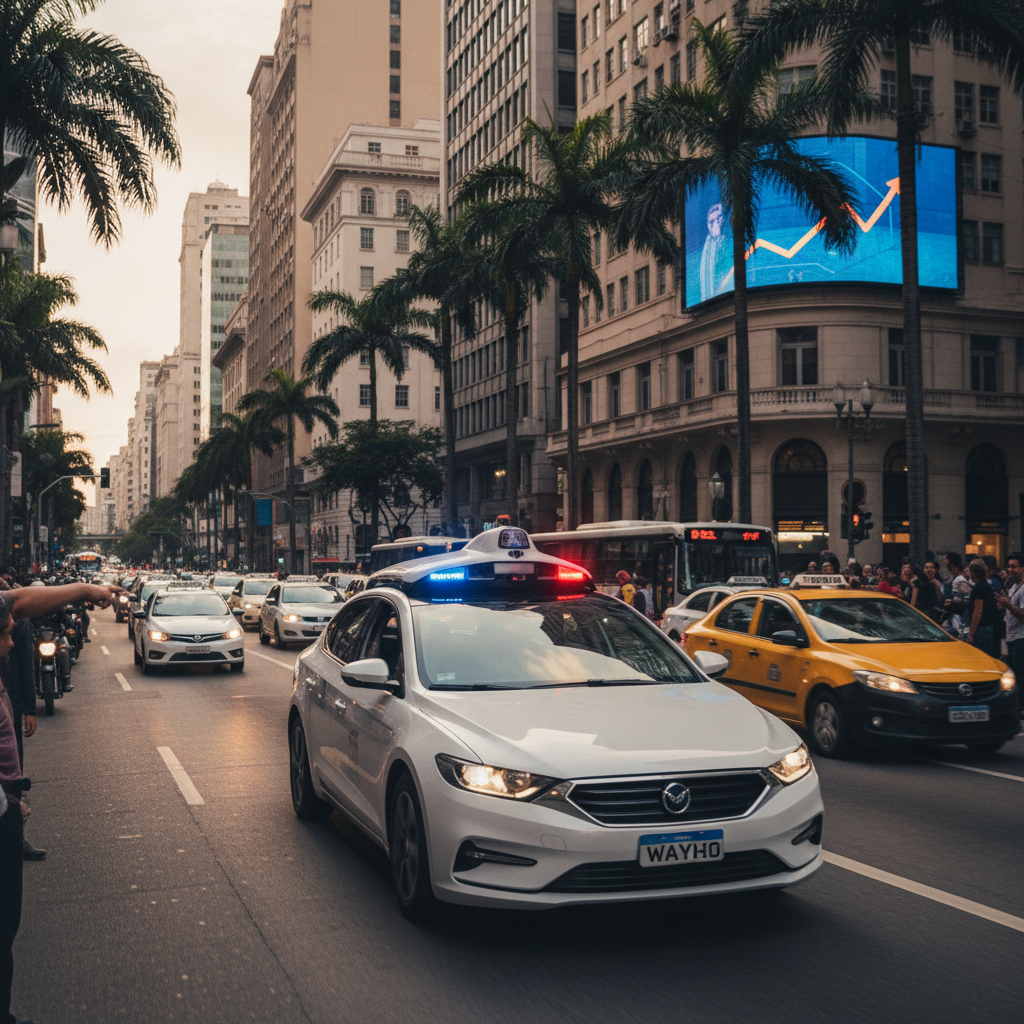
The pilot, currently confined to a meticulously mapped zone encompassing parts of the Vila Olímpia and Pinheiros districts, employs a small fleet of modified Jaguar I-pace vehicles. These vehicles, operating initially with safety drivers, are collecting vast amounts of data, navigating São Paulo's notoriously unpredictable traffic, its unique road signage, and the often-unwritten rules of its urban landscape. The choice of São Paulo is strategic, a crucible for autonomous technology. If Waymo can conquer the garrafas (traffic jams) and the dynamic pedestrian flows of this metropolis, it can likely operate anywhere.
Official reactions have been a mixed bag, reflecting the polarized views on such disruptive technology. Mayor Ricardo Nunes, while cautious, expressed a degree of enthusiasm. "São Paulo has always been a city of innovation, a city that embraces the future," he stated in a recent press conference. "We are working closely with Waymo and federal agencies to ensure that any deployment prioritizes public safety and benefits our citizens. This technology has the potential to transform our public transport system, reducing congestion and pollution." His words, however, carry the subtle undertone of a politician balancing economic opportunity with public apprehension.
Conversely, labor unions representing traditional taxi and ride-share drivers have voiced vehement opposition. "This is an attack on Brazilian workers, a direct threat to the livelihoods of thousands of families," declared João Carlos Martins, president of the São Paulo Taxi Drivers' Union. "We will not stand by as foreign corporations use robots to steal our jobs. The streets of São Paulo belong to the people, not to algorithms." His sentiment echoes a broader concern about job displacement, a critical issue in a country grappling with high unemployment rates.
Expert analysis paints a nuanced picture. Dr. Ana Paula Costa, a leading urban planning specialist at the University of São Paulo, highlighted the regulatory void. "Brazil's AI funding landscape hides surprises, but the lack of a comprehensive legal framework for autonomous vehicles is not one of them," she explained. "We have fragmented legislation, state by state, municipality by municipality. This creates an environment of uncertainty that Waymo is clearly exploiting, pushing the boundaries before clear rules are established. While the technology promises efficiency, we must first address questions of liability, data privacy, and equitable access." Her concerns are valid; the absence of clear guidelines leaves ample room for interpretation and, potentially, exploitation.
Indeed, the legal and ethical implications are profound. Who is liable in the event of an accident involving an autonomous vehicle? How will the vast amounts of data collected by these cars be used, and protected, in a country with a relatively nascent data protection framework? These are not trivial questions; they strike at the heart of public trust and sovereignty. The National Traffic Department, Denatran, has yet to issue specific regulations for Level 4 or 5 autonomous vehicles, leaving a significant regulatory gap that Waymo is navigating with calculated risk.
Furthermore, the social impact cannot be overlooked. São Paulo, like many Brazilian cities, is characterized by stark socio-economic disparities. Will autonomous taxis primarily serve the affluent districts, exacerbating the existing transport divide? Or will they be integrated into a broader, more equitable public transport strategy? "The promise of autonomous vehicles must extend beyond the wealthy enclaves," argued Dr. Roberto Almeida, a technology policy analyst at the Getúlio Vargas Foundation. "If this technology is to truly benefit Brazil, it must be accessible and affordable for all, not just another luxury for the privileged few. Otherwise, we risk creating a new form of digital exclusion in our urban centers." This perspective is crucial, reminding us that technological progress must be evaluated through a lens of social justice.
What happens next is a critical phase for both Waymo and Brazil. The pilot program is expected to expand gradually, both in terms of operational area and fleet size. Sources suggest that Waymo aims for a broader public launch within 18 to 24 months, contingent on regulatory approval and public acceptance. This timeline is ambitious, given the complexities involved. The company is actively engaging with local universities and research institutions, attempting to build a local talent pipeline and foster goodwill, a strategy often employed by tech giants seeking to embed themselves within a new ecosystem. For instance, a recent partnership with the Polytechnic School of USP aims to develop localized AI models for Brazilian traffic conditions, a smart move to address local specificities.
Why should readers care? Because this is not just about Google or Waymo; it is about the future of our cities, our jobs, and our regulatory sovereignty. The entry of autonomous vehicles into Brazil represents a critical juncture, a moment where technological advancement collides with societal values and economic realities. My investigation reveals that while the allure of efficiency and innovation is strong, the underlying currents of corporate ambition, regulatory unpreparedness, and social inequality demand our unwavering scrutiny. As these silent, self-driving machines begin to carve out their paths on our streets, we must ensure that the path they forge is one that genuinely serves the people of Brazil, not just the bottom line of a global tech behemoth. The stakes are too high to simply watch from the sidelines. This is a story that will unfold rapidly, and its implications will be felt for generations. For more insights into how AI is reshaping urban landscapes, you can read analyses on MIT Technology Review and Reuters Technology. The future of mobility, and indeed, the future of work, is being written on the streets of São Paulo, one autonomous mile at a time. The public and policymakers must engage critically, or risk being driven over by the pace of change. The internal article Is NVIDIA's Jensen Huang Fueling a Canadian AI Gold Rush or Just a Mirage, as Tech Giants Bet Billions? [blocked] also touches on the broader themes of tech investment and its impact on national economies, a parallel worth considering as Waymo expands its footprint in Brazil.