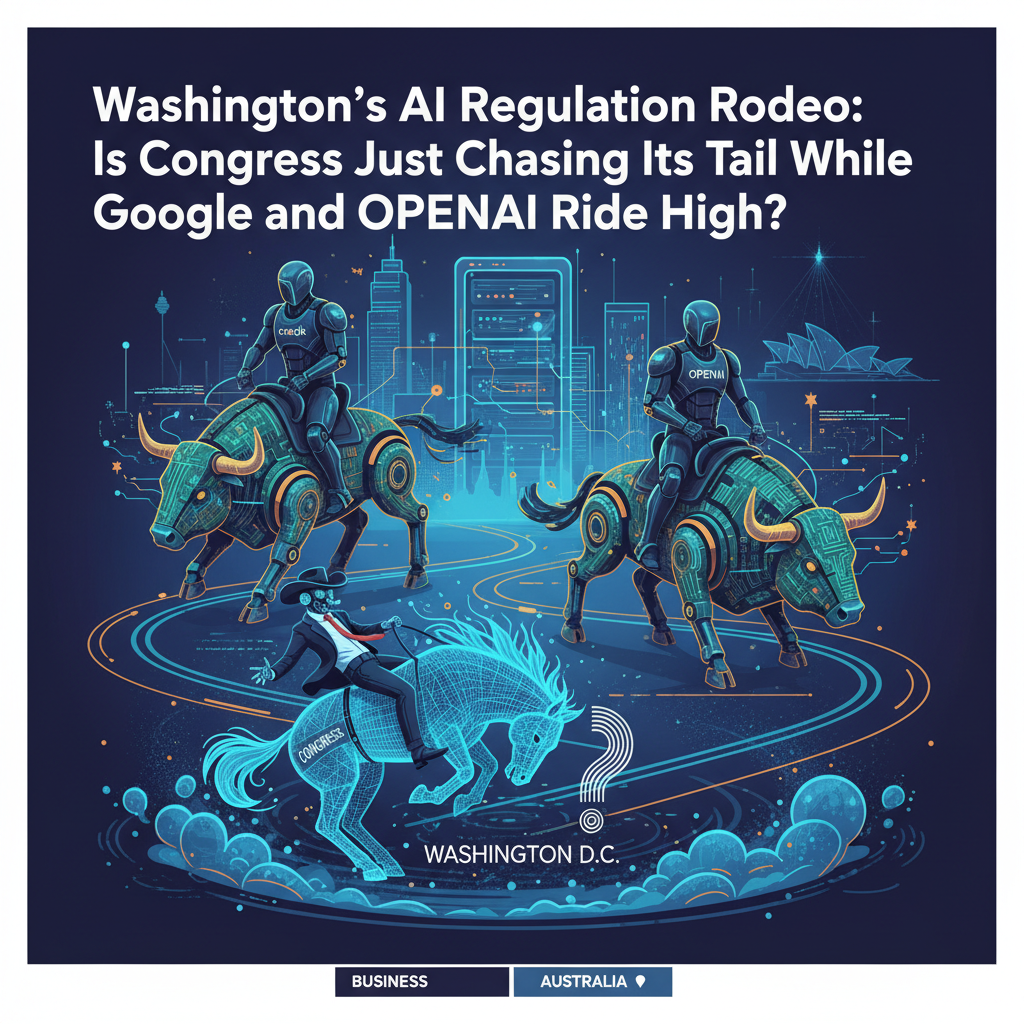

Right, so the Yanks in Washington, bless their cotton socks, are at it again. You'd think with all the kerfuffle around AI, from deepfakes of politicians singing opera to chatbots writing award-winning novels, they'd have figured out a coherent plan by now. Instead, we're watching the US Congress debate comprehensive AI legislation, and frankly, it feels a bit like watching a kangaroo try to tap dance: earnest, but ultimately a bit clumsy and probably going nowhere fast. Is this a genuine attempt to rein in the digital wild west, or just another political pantomime with the tech giants pulling the strings from the shadows?
Let's rewind a bit, shall we? This isn't the first time governments have tried to get their heads around rapidly evolving technology. Remember the early days of the internet, when lawmakers were still trying to figure out what a 'web page' was, let alone how to regulate online privacy or e-commerce? It was a bit of a free-for-all, wasn't it? The tech companies, then nascent, grew into behemoths largely unfettered. Fast forward to now, and we're seeing a similar pattern, but with AI, the stakes feel astronomically higher. This isn't just about data; it's about intelligence, autonomy, and potentially, the very fabric of our societies. The European Union, in its typically methodical fashion, has been pushing its AI Act for ages, trying to get ahead of the curve. But the US, with its often-fractured political landscape and powerful lobbying groups, always seems to be playing catch-up, or worse, playing favourites.
Currently, there are no fewer than a dozen different AI-related bills floating around Capitol Hill. From proposals for a dedicated federal AI agency to mandates for transparency in AI models and liability frameworks for autonomous systems, it's a smorgasbord of legislative ambition. The problem, as always, is turning that ambition into actual law. A recent report from the Center for AI Policy noted that in the last six months alone, major tech players like OpenAI, Google, Microsoft, and Anthropic collectively spent an estimated $70 million on lobbying efforts related to AI. That's a fair chunk of change, isn't it? It's enough to make you wonder whose interests are truly being served in these debates. Are they shaping sensible safeguards, or are they subtly nudging legislation towards frameworks that benefit their proprietary models and market dominance?
“The current legislative landscape in the US is a patchwork, not a quilt,” says Dr. Evelyn Reed, a senior policy analyst at the Washington-based Tech Governance Institute. “You have senators genuinely concerned about deepfakes and job displacement, and then you have industry lobbyists arguing that over-regulation will stifle innovation. The truth, as always, is somewhere in the middle, but the industry's influence is undeniable. They are at every table, in every conversation.” Dr. Reed pointed to the recent bipartisan Senate AI Insight Forum, where CEOs like Sam Altman of OpenAI and Sundar Pichai of Google were front and center, offering their 'expert' opinions. It's a bit like asking the foxes to design the hen house security system, isn't it?
Here in Australia, we're watching this unfold with a mixture of bemusement and genuine concern. Our own government is trying to navigate the choppy waters of AI governance, often looking to international precedents. “The US approach, or lack thereof, has a ripple effect globally,” notes Professor Liam O'Connell, head of AI Ethics at the University of Melbourne. “If the world’s largest economy can't agree on a unified approach, it makes it harder for smaller nations like ours to implement effective, harmonized regulations. We risk a fragmented global regulatory environment, which benefits no one except perhaps the largest, most adaptable tech firms.” He's not wrong, mate. A fragmented approach means these companies can just pick and choose the jurisdictions with the laxest rules, effectively creating regulatory arbitrage opportunities.
Then there's the question of what 'comprehensive' even means in this context. Is it about safety, fairness, privacy, competition, or all of the above? And how do you legislate for technology that's evolving faster than a Queensland summer storm? “The pace of AI development, particularly with large language models like GPT-5 and Claude 3, makes traditional legislative cycles feel glacial,” explains Sarah Chen, a former product manager at Meta now consulting on AI strategy for Australian startups. “By the time a bill passes, the technology it's trying to regulate might have already moved on two or three generations. It's a constant game of catch-up, and the industry knows it.” She believes that a more agile, principles-based regulatory framework, perhaps with independent expert bodies empowered to issue guidance and adapt quickly, might be more effective than rigid, prescriptive laws.
My take? Mate, this AI thing is getting interesting, but the legislative dance in Washington feels less like a serious effort to protect the public and more like a carefully choreographed performance. The lobbying power of companies like NVIDIA, with their chips powering the entire AI boom, and the foundational model developers like OpenAI and Anthropic, is immense. They're not just selling products; they're selling a vision of the future, and they're ensuring that vision aligns with their bottom line. The risk is that any legislation that emerges will be so watered down, so riddled with loopholes, or so focused on yesterday's problems that it becomes largely ineffective. We've seen this movie before, haven't we? Big tech gets big, governments try to regulate, and big tech finds a way around it, usually by throwing a truckload of cash at politicians and lawyers.
Australia's tech scene is like a good flat white, better than you'd expect, and we're not waiting for Washington to get its act together entirely. Our own discussions around AI ethics and responsible deployment are ongoing, often with a more pragmatic, less ideologically charged approach. But the global nature of AI means we can't operate in a vacuum. The decisions, or indecisions, made in the US Congress will inevitably shape the global AI landscape, impacting everything from data sovereignty to the competitive balance of power. For more insights into the broader tech landscape, you might want to check out Reuters' technology section.
So, is this comprehensive AI legislation a fad or the new normal? It's probably a bit of both. The idea of comprehensive legislation is definitely the new normal; governments can no longer ignore AI. But the actual outcome of these current debates, particularly in the US, might well end up being a legislative fad: a lot of noise, a few symbolic gestures, and ultimately, not enough teeth to truly address the profound challenges and opportunities that AI presents. The real work, the hard decisions, will likely be kicked down the road, leaving us all to wonder if we're building a future that's truly beneficial for everyone, or just for the few who can afford the best lobbyists. For a deeper dive into AI's societal impact, Wired's AI coverage often provides excellent perspectives.