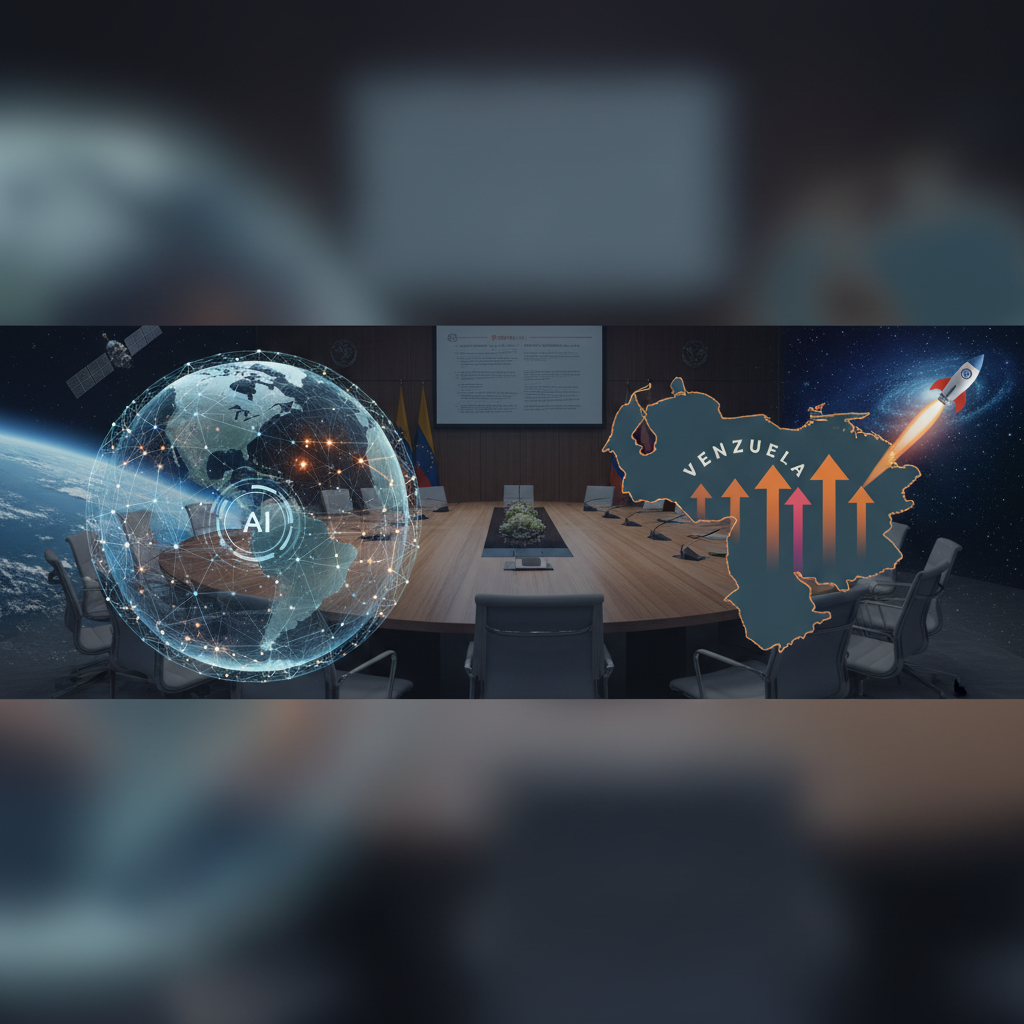
The global powers, bless their bureaucratic hearts, are at it again. This time, it is about AI in space. You know, Mars missions, satellite AI, the search for extraterrestrial intelligence. The United Nations Committee on the Peaceful Uses of Outer Space, or Copuos for those who love acronyms, has been buzzing. And now, Google, along with a few other tech behemoths, has thrown its weight behind a new initiative for what they call 'responsible AI governance in space.' They are pushing for international norms, ethical guidelines, and transparency protocols for AI systems deployed beyond Earth's atmosphere. It is all very noble, very forward-thinking, and frankly, a little naive from where I sit in Caracas.
Let us break this down. The policy move is a joint declaration, a sort of Silicon Valley manifesto for the cosmos. Google, Microsoft, and a consortium of aerospace companies like Lockheed Martin and Airbus are advocating for a framework that ensures AI in space is developed and used safely, ethically, and for the benefit of all humanity. They talk about preventing AI from being weaponized in orbit, ensuring data privacy for satellite imagery, and establishing clear lines of accountability if an AI system goes rogue on a Mars rover. The idea is to get ahead of the inevitable, to prevent a Wild West scenario in the final frontier. They want to set the rules before the game gets too messy.
Who is behind it and why? Well, it is the usual suspects. Big Tech, with their vast resources and even vaster ambitions, wants to shape the narrative and the regulations. They are already investing billions in satellite constellations, AI-driven telescopes, and autonomous probes. Google's DeepMind, for instance, has been exploring AI applications for space resource management and mission planning for years. Microsoft Azure has its own space initiatives, providing cloud infrastructure for satellite data processing. For them, it is about de-risking their future investments and securing their place as key players in the burgeoning space economy. They want to be seen as responsible stewards, not just profit-seekers. As Sundar Pichai, CEO of Google and Alphabet, reportedly stated last year, "The future of humanity is intertwined with our ability to responsibly explore and utilize space, and AI will be at the core of that endeavor. We must ensure it is governed by shared principles." It is a nice sentiment, but it also conveniently positions them at the center of the conversation.
What does it mean in practice? For nations like Venezuela, it means very little on the surface. We are not launching our own Mars missions, not yet anyway. But it does affect us. Our access to satellite data, crucial for everything from environmental monitoring to disaster relief, could eventually be influenced by these protocols. If an AI system decides what data gets prioritized or how it is interpreted, who controls that AI? Who sets its ethical parameters? These are not trivial questions. It is about who gets to define 'beneficial for all humanity' when the 'all' includes nations with vastly different needs and priorities than those in Silicon Valley.
Industry reaction has been largely positive, at least publicly. Of course it has. The big players are the ones writing the rules. Smaller space startups, however, are a bit more cautious. They worry about regulatory burdens stifling innovation. Imagine a small Venezuelan startup, perhaps one born out of sheer necessity and ingenuity, trying to navigate a labyrinth of international AI space regulations just to launch a tiny, AI-powered sensor into low Earth orbit. The barriers to entry could become insurmountable. "While frameworks are important, we must be careful not to create a regulatory environment that favors incumbents and stifles the very innovation we need to advance space exploration," commented Dr. Mae Jemison, former NASA astronaut and principal of 100 Year Starship, in a recent interview with Wired. Her point is well taken. Innovation often thrives in the margins, not in the meticulously planned centers of power.
Civil society perspective is, as always, a mixed bag. Some groups applaud the proactive approach to ethical AI, especially given the potential for dual-use technologies. Others, particularly those concerned with global equity and digital colonialism, are wary. They see this as another instance of powerful nations and corporations dictating terms to the rest of the world. They ask, where is the representation from the Global South in these discussions? Where are the voices from countries that might benefit most from space technology but have the least say in its governance? It is a valid critique. The table where these rules are being drafted is not exactly diverse. It is a table set by the powerful, for the powerful, with a few token seats for others.
Now, will it work? This is where my Venezuelan skepticism kicks in. These grand declarations, these global frameworks, they often sound great on paper, but reality has a way of complicating things. The idea that a few tech giants and international bodies can unilaterally define the future of AI in space, and that everyone will simply fall in line, is a fantasy. The real innovation, the real disruption, is often happening elsewhere, in places far removed from the polished conference rooms of Geneva or the campuses of Mountain View. Here in Venezuela, for example, the crisis created something unexpected. It forced our brightest minds to innovate with scarce resources, to build solutions from the ground up, to think differently. Many of them are now part of a global tech diaspora, taking their unique problem-solving skills to companies and projects around the world.
Venezuela's tech diaspora is reshaping AI globally, not by following established rules, but by creating new ones. They are working on everything from AI-driven data analytics for satellite imagery in Europe to developing robust, low-cost AI hardware for remote sensing in Asia. These are the people who understand resilience, who know how to make something out of nothing. They are not waiting for Google or the UN to tell them what is ethical or how to innovate. They are doing it because they have to, because it is in their blood. Their contributions, often overlooked by the mainstream media, are profound. They are building the tools and systems that will truly democratize access to space data and AI capabilities, not just manage them under a new set of corporate-friendly guidelines.
So, while the world obsesses over governance frameworks for AI in space, I am watching the true space race unfold. It is not about who launches the most satellites or lands the first human on Mars. It is about who can innovate fastest, who can adapt best, and who can leverage the collective intelligence of a globally dispersed, crisis-tempered talent pool. And on that front, the game is far from over. The real future of AI in space might just be written by those who were never invited to the initial drafting sessions. The notion that a top-down regulatory approach will contain the wild, unpredictable surge of AI innovation, especially when it comes to the cosmos, feels like trying to catch a hurricane in a teacup. It is a noble effort, perhaps, but ultimately, a futile one. The universe, and human ingenuity, are far too vast for such tidy boxes. You can read more about the broader implications of AI regulation on MIT Technology Review. The conversation is just beginning, but the answers, I suspect, will not come from the usual places. Perhaps we should look to the unexpected, to the places where necessity is the mother of invention, and where the human spirit, against all odds, continues to reach for the stars.