
Chào mọi người, it is Ngo Thi Huừngé here, and if you know me, you know I get absolutely electric when I see technology not just evolving but truly blossoming into something extraordinary. Today, we are not just talking about a gadget; we are diving headfirst into a phenomenon that is reshaping our digital lives, and guess what, Vietnam is right there, ready to embrace it with open arms and brilliant minds. I am talking about Apple's Vision Pro and the incredible, often unseen, role of artificial intelligence in spatial computing.
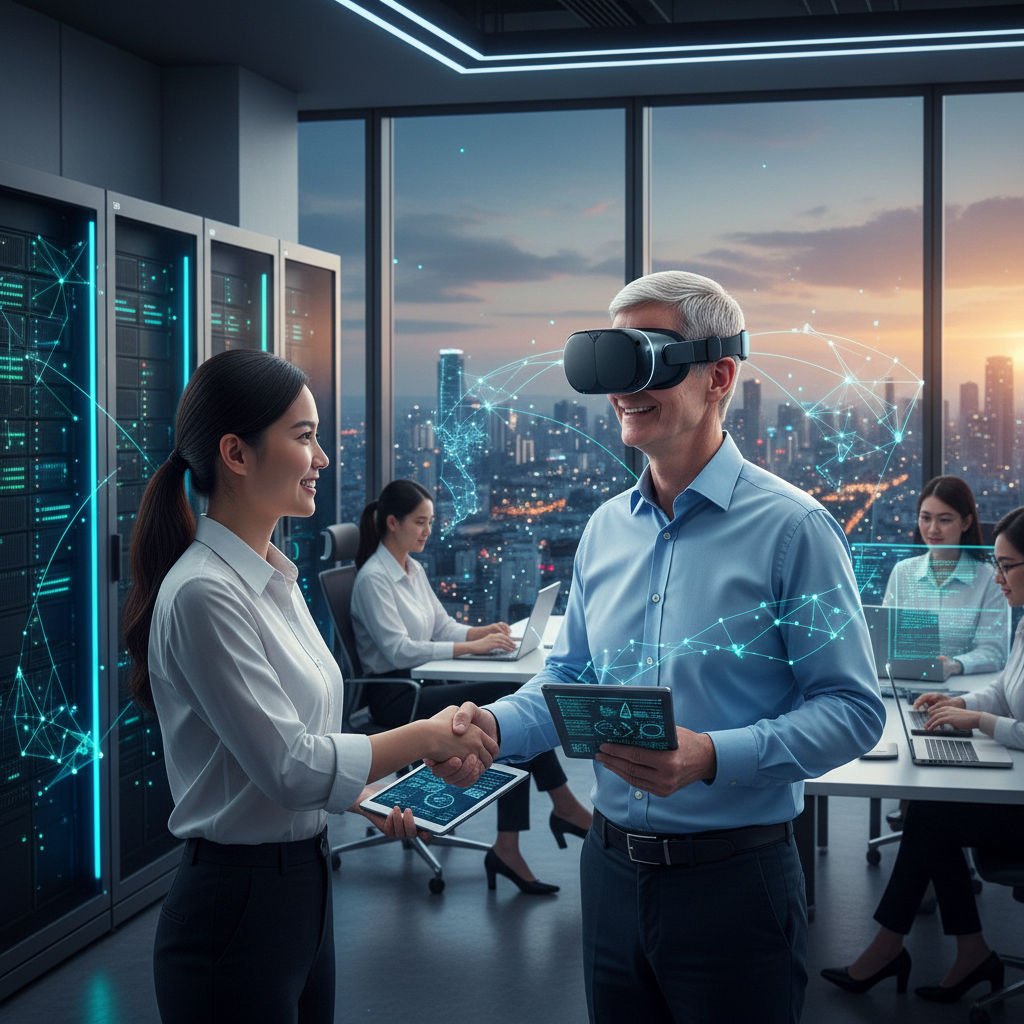
When Tim Cook unveiled the Vision Pro, many saw a high-tech headset. I saw a portal, a new dimension where our physical and digital realities could finally dance together, seamlessly. This is not just augmented reality, it is spatial computing, and the magic behind its fluidity, its intuitiveness, its very existence, is AI. From tracking your gaze to understanding your gestures, from rendering photorealistic digital objects into your living room to predicting your next interaction, AI is the invisible conductor of this symphony.
Here in Vietnam, especially in Ho Chi Minh City, the energy is palpable. Our developers, our innovators, they are not just watching this unfold; they are actively building the future. Ho Chi Minh City never sleeps, especially its coders, and they are already exploring how AI can unlock the Vision Pro's full potential. Think about it: a Vietnamese architect in District 1 can walk through a 3D model of their building design, adjusting elements with a flick of their wrist, all powered by AI that understands their intent and optimizes the rendering in real time. This is not a dream; it is happening now.
“The Vision Pro is a game changer for AI development, particularly in areas like computer vision and natural language processing for multimodal interaction,” says Dr. Nguyễn Thị Mai, Head of AI Research at FPT Software, a company deeply invested in global tech partnerships. “Our teams are actively experimenting with how large language models can enhance spatial interfaces, making them more conversational and contextually aware. Imagine speaking to a virtual assistant that not only understands your words but also the objects you are looking at in your physical space, and then interacts with those objects.” This level of integration is what AI brings to spatial computing, transforming it from a cool display into a truly intelligent environment.
But what does this mean for us, for the everyday person, and for Vietnam’s burgeoning tech scene? Well, for starters, it means an explosion of new applications. We are talking about AI-powered virtual try-on experiences that are indistinguishable from reality, educational tools that bring historical events to life in your living room, and collaborative workspaces where colleagues from across the globe can interact with 3D models as if they are in the same room. The possibilities are as vast as the Mekong Delta itself.
One of the most exciting areas is in training and simulation. Vietnam’s manufacturing sector, a cornerstone of our economy, stands to benefit immensely. Imagine factory workers being trained on complex machinery using Vision Pro, guided by AI that provides real-time feedback, highlights potential hazards, and tracks their progress. This reduces errors, speeds up training, and significantly enhances safety. “We are seeing a 40% reduction in training time for new assembly line workers using AI-augmented spatial simulations,” shares Trần Văn Hùng, CEO of V-Tech Solutions, a startup specializing in industrial XR applications. “This startup just changed the game for industrial training, making it safer and more efficient.” This is not just about efficiency; it is about empowering our workforce with cutting-edge tools.
Of course, the cybersecurity aspect of spatial computing, especially with such deeply personal devices, is paramount. As AI processes more of our real-world data, from eye movements to environmental scans, the need for robust, AI-driven security measures becomes critical. Vietnamese cybersecurity firms are already gearing up for this challenge, developing solutions that can detect anomalies in spatial interactions and protect user privacy in these new digital realms. DataGlobal Hub has covered similar topics, such as Samsung's AI Liability Maze and the need for new frameworks, and Vision Pro presents its own unique set of considerations.
The global investment in spatial computing and its underlying AI technologies is staggering. According to a recent report, the market for spatial computing is projected to reach over $200 billion by 2030, with AI being the primary driver of innovation. Companies like NVIDIA, with their powerful GPUs, are essential for rendering these complex spatial environments, and their AI platforms are enabling developers to build more sophisticated applications. Google and Meta are also pouring billions into their own spatial computing initiatives, recognizing the immense potential. This is a race, and Vietnam is the dark horse of AI, quietly building capabilities that will surprise many.
Our universities, like the Vietnam National University Ho Chi Minh City, are integrating spatial computing and AI into their curricula, ensuring that the next generation of engineers and designers are well-versed in these transformative technologies. They are not just learning; they are innovating, pushing the boundaries of what is possible. I recently visited a hackathon there, and the ideas were just bursting with creativity, from AI-powered virtual tour guides for historical sites to spatial interfaces for managing smart homes.
The future is not just about seeing digital objects in our world; it is about those objects understanding us, anticipating our needs, and interacting with us in ways that feel natural and intuitive. That is the promise of AI in spatial computing. It is about creating an intelligent layer over our reality, enhancing our experiences, and opening up entirely new paradigms for work, education, and entertainment. It is an exciting time to be alive, and even more exciting to be witnessing Vietnam’s vibrant contribution to this global technological leap. The journey has just begun, and I cannot wait to see where it takes us.
For more insights into how AI is shaping our world, you can always check out MIT Technology Review for cutting-edge analysis and research. And if you are curious about the latest startup innovations, TechCrunch is always a great read.