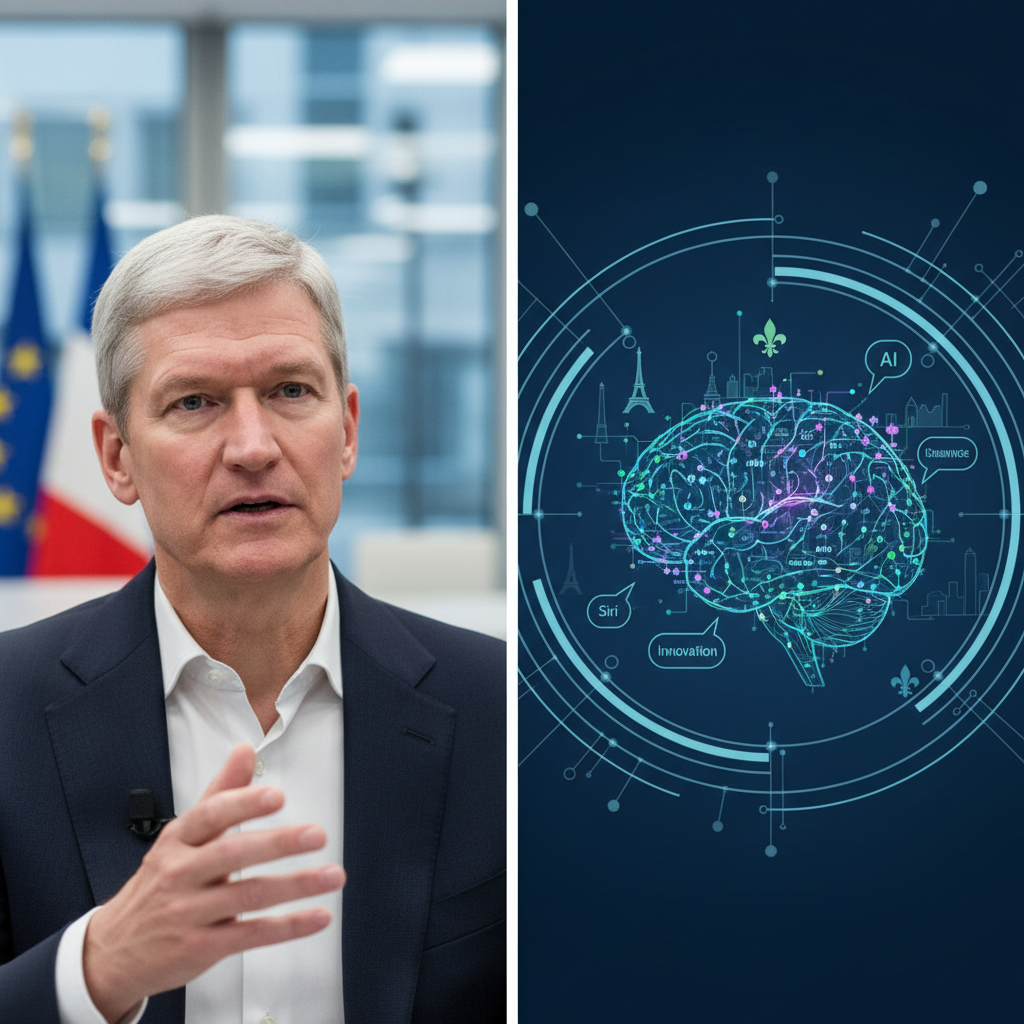

Mon Dieu, the arrogance of Big Tech. For years, we have been told that the future of artificial intelligence, particularly in our everyday devices, would be dictated by a handful of American corporations. Google Assistant and Amazon's Alexa have long dominated the smart assistant landscape, with Apple's Siri often feeling like an afterthought, a digital relic struggling to keep pace. Now, with the generative AI revolution in full swing, Apple is finally making its move, promising a complete overhaul of Siri. But is this a genuine leap forward, or just another attempt to catch up to a race it never truly understood?
The whispers from Cupertino have grown into a roar. Apple, under the leadership of Tim Cook, is reportedly pouring billions into transforming Siri from a somewhat dim-witted voice command system into a truly intelligent, context-aware assistant powered by large language models. The goal, we are told, is to make Siri proactive, personalized, and capable of complex, multi-turn conversations, much like OpenAI's ChatGPT or Google's Gemini. This is not just about answering simple queries anymore; it is about Siri anticipating your needs, managing your schedule with uncanny foresight, and even drafting emails with a flair that would make a Parisian poet proud, or so they hope.
The timing, of course, is no coincidence. The past two years have seen an explosion in generative AI capabilities, with every major tech player scrambling to integrate these powerful models into their products. Google has Gemini, Microsoft has Copilot, and Meta has Llama. Apple, famously secretive and often preferring to perfect before revealing, has been conspicuously quiet on its generative AI strategy, leading many to speculate it was falling behind. Now, with reports suggesting a significant portion of its research and development budget, estimated at over $30 billion annually, is being directed towards AI, the company is clearly trying to make up for lost time. Analysts at Wedbush Securities, for example, have repeatedly highlighted the critical need for Apple to innovate aggressively in AI to maintain its premium market position.
But here is where my skepticism, a deeply French trait, truly kicks in. Apple's strength has always been its integrated ecosystem and its unwavering focus on user privacy. How will this new, data-hungry generative AI model coexist with Apple's stringent privacy principles? Large language models thrive on vast amounts of data, often collected and processed in ways that make Europeans, quite rightly, nervous. The European way is not the American way, and that is the point. Our regulatory landscape, epitomized by the General Data Protection Regulation, GDPR, and the nascent AI Act, reflects a fundamental distrust of unchecked data collection and algorithmic opacity. Will Apple's new Siri be truly privacy-preserving, or will it be a Trojan horse for more intrusive data practices, dressed up in a sleek, minimalist design?
Consider the cultural nuances. A truly intelligent assistant needs to understand more than just language; it needs to grasp context, humor, and cultural references. Will Siri's new brain be trained predominantly on American English data, reflecting American norms and values? If so, its utility and appeal in France, or indeed across the diverse tapestry of Europe, will be severely limited. We do not just want a better dictionary; we want an assistant that understands our way of life, our history, our sometimes-contradictory desires. An assistant that can recommend a local boulangerie with the perfect croissant, not just the highest-rated chain coffee shop. An assistant that comprehends the subtle art of French sarcasm, rather than taking everything literally.
France says non to Silicon Valley's vision when it attempts to homogenize global culture. We have seen this with streaming services, with social media, and now, it seems, with AI assistants. Our cultural institutions, like the Académie Française, are guardians of our language and identity. The idea of an AI, however sophisticated, dictating or even subtly influencing our linguistic norms is, frankly, anathema. We need AI that respects and reflects our rich linguistic heritage, not one that tries to flatten it into a globalized, English-centric lingua franca.
Indeed, the EU AI Act, which is set to become fully applicable soon, is a testament to Europe's proactive stance on regulating AI. It classifies AI systems based on their risk level, imposing strict requirements on high-risk applications. Where will a massively powerful, deeply integrated AI assistant like the new Siri fall within this framework? Will Apple be transparent about the data used for training, the biases inherent in its models, and the safeguards in place to protect user autonomy? These are not trivial questions; they are fundamental to how AI integrates into our societies without eroding our values.