
¡Hola, mis amigos! Mariànnà Sanchèz here, buzzing with excitement, as always, from the heart of Ecuador. You know, sometimes I feel like I have a crystal ball, peering into the future, and what I am seeing today, especially from Apple, is nothing short of revolutionary. We are talking about artificial intelligence, but not just any AI. We are talking about an AI that whispers secrets only to you, an AI that lives on your device, guarding your most personal data like a condor guards its nest in the Andes. This is Apple's privacy-first approach to AI, and believe me, it is shaking up the entire industry, with profound implications even for our beautiful Ecuador.
For too long, the narrative around AI has been about massive cloud computing, about sending all our precious data, our thoughts, our photos, our very essence, to distant servers for processing. Companies like OpenAI, Google, and Meta have built incredible models, yes, but often at the cost of centralizing vast amounts of personal information. And while they assure us of security, the idea of our digital lives floating in some ethereal data center always gives me a little shiver, like a cold breeze from the paramo.
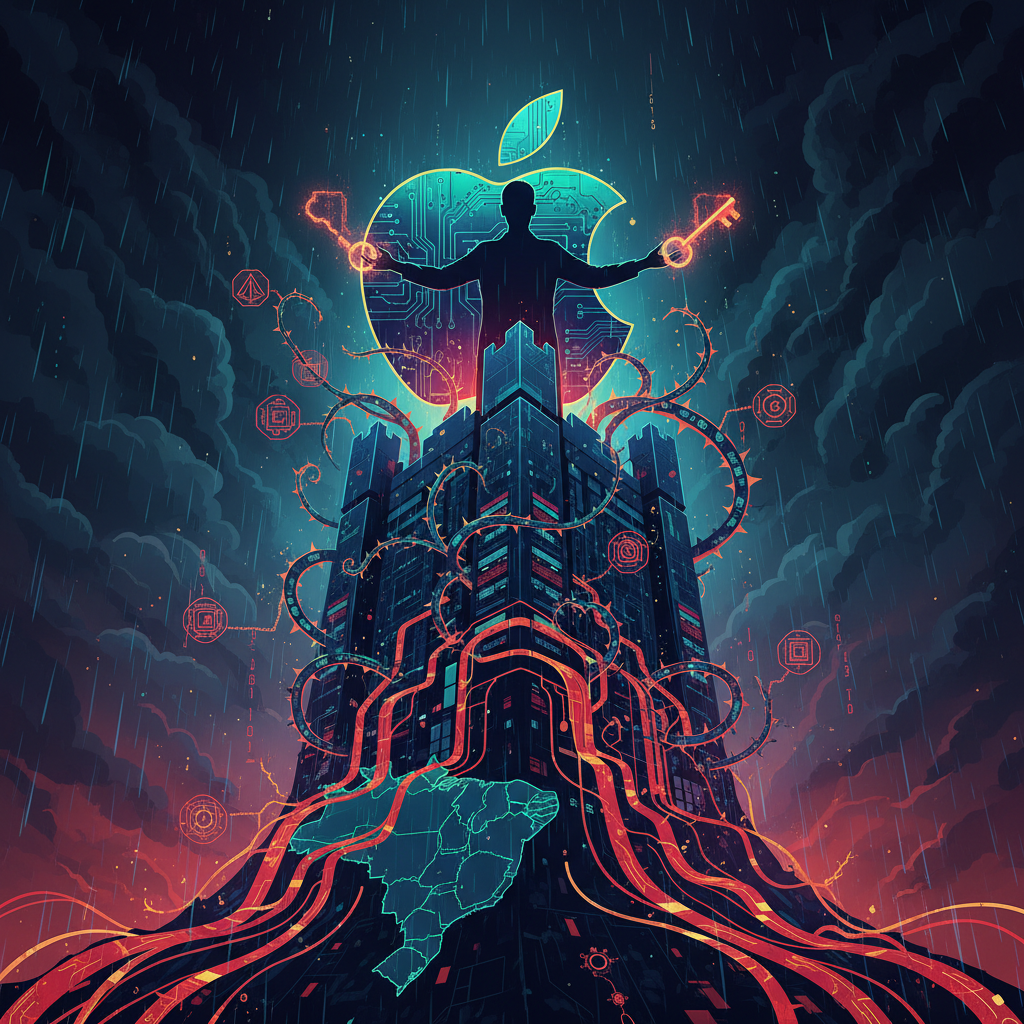
But then, Apple, with its signature blend of innovation and secrecy, steps onto the stage. Their latest announcements, particularly around 'Apple Intelligence', are not just about making Siri smarter or improving photo editing. Oh no, it is about fundamentally rethinking where and how AI operates. They are pushing for on-device processing, meaning the heavy lifting of AI happens right there, on your iPhone, your iPad, your Mac. Your data stays with you, protected by the formidable encryption that Apple is famous for. If a task is too complex for your device, they introduce 'Private Cloud Compute', a system designed to extend on-device privacy to the cloud, ensuring your data is never stored or made accessible to Apple itself. It is like having a digital guardian angel, always by your side, never peering over your shoulder.
This is not just a technical tweak, it is a philosophical declaration. "We believe that true intelligence should be personal and private," declared Tim Cook, Apple's CEO, during their recent keynote. "It should understand you, without collecting your data." This sentiment resonates deeply, especially in a country like Ecuador, where our biodiversity meets AI and it is magical, but also where data sovereignty and privacy are becoming increasingly critical. We are a nation rich in natural resources, and we are quickly becoming rich in data too, especially as we embrace technology for conservation and sustainable development. Imagine AI models trained to identify endemic species from camera trap footage, or to predict deforestation patterns, all while ensuring the privacy of the indigenous communities living in those areas. This is the dream.
I recently spoke with Dr. Elena Vásquez, a leading AI ethicist at the Universidad San Francisco de Quito. She told me, "Apple's move is a significant step towards rebalancing the power dynamics in the AI landscape. It forces other players to reconsider their data collection strategies. For developing nations, this could mean greater control over their citizens' data, fostering local innovation without the constant fear of data exploitation." Her words echo a growing sentiment that privacy should not be a luxury, but a fundamental right in the digital age.
Of course, the challenge is immense. On-device AI requires incredibly efficient hardware and software optimization. Apple's custom silicon, like the A17 Pro chip, is a key enabler here. It is the engine that allows these complex AI models to run locally, with impressive speed and power efficiency. This commitment to vertical integration, controlling both the hardware and software, gives Apple a unique advantage. Other companies, relying on a more fragmented ecosystem, face a steeper climb to achieve similar levels of privacy-preserving, on-device AI.
Consider the implications for our efforts in conservation. In the Galápagos, for example, researchers use AI to monitor wildlife populations and track invasive species. Imagine if these AI systems could process sensitive location data or species observations directly on rugged field devices, reducing the need to transmit raw, potentially identifiable data back to a central server. This could dramatically enhance both the efficiency and the ethical robustness of such projects. "The Galápagos of technology" is not just a catchy phrase, it is a vision for how cutting-edge tech can serve our planet's most precious ecosystems, all while respecting privacy.
However, not everyone is convinced this is a silver bullet. Some critics argue that while on-device AI protects individual privacy, it might make it harder to build truly comprehensive, globally beneficial AI models that require vast, aggregated datasets. Dr. Marco Delgado, a data scientist working with the Ecuadorian Ministry of Environment, shared his perspective. "While I applaud the privacy aspect, we must also acknowledge the power of collective data for grand challenges, like climate modeling or pandemic prediction. The balance is delicate. We need mechanisms for secure, anonymized data aggregation when the societal benefit is clear and democratically agreed upon." He makes a valid point; the future of AI will likely involve a hybrid approach, combining the best of both worlds.
What about the competition? Google, with its Gemini models, and Microsoft, with Copilot, are also investing heavily in making their AI more personal and integrated. However, their business models are often more reliant on cloud services and targeted advertising, which inherently involves more data collection. Apple's privacy-first stance serves as a powerful differentiator, a beacon for users who prioritize control over their personal information. It is forcing a conversation, a necessary one, about what kind of AI future we truly want to build.
This shift is not just about personal devices either. It extends to enterprise solutions, to smart cities, and even to how governments interact with technology. If AI can be deployed with stronger privacy guarantees, it opens doors for more sensitive applications, from secure healthcare diagnostics to confidential legal analysis, all without compromising the fundamental rights of individuals. According to TechCrunch, this privacy-centric approach is gaining significant traction across various sectors, pushing innovation in secure computing.
Here in Ecuador, we are always looking for ways to leverage technology for good, to protect our incredible natural heritage, and to empower our communities. Apple's privacy-first AI offers a compelling framework for doing just that. It is a reminder that technology does not have to be a trade-off between innovation and personal liberty. We can have both, and we must demand both. The journey ahead will be complex, filled with technical hurdles and ethical debates, but the path towards a more private, more personal, and ultimately, more human-centric AI is now clearer than ever. It is a future I, Mariànnà Sanchèz, cannot wait to see unfold, right here from the heart of the world. For more insights into how AI is shaping our world, you can always check out MIT Technology Review.
This is a thrilling time, my friends. The digital revolution is not just about faster processors or bigger models; it is about smarter, more ethical design. It is about building technology that respects us, that understands us, and that ultimately, serves us. And in that, Apple is showing a powerful way forward. The question remains: will the rest of the industry follow suit, or will they cling to the old ways of data harvesting? Only time will tell, but the conversation has certainly begun. For further reading on the broader impact of AI on society, Wired often has excellent analyses.