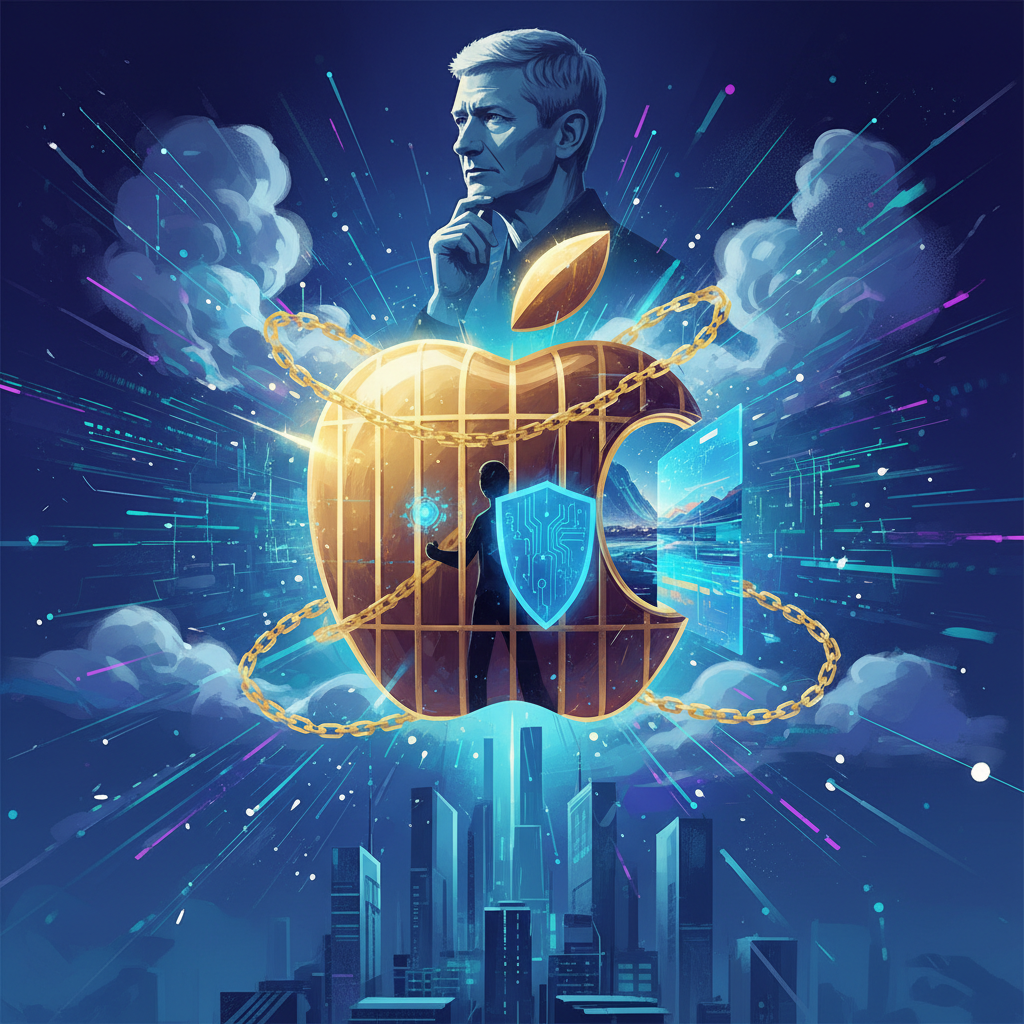
The drumbeat from Cupertino is loud and clear: Apple is building AI with your privacy at its core. Tim Cook and his lieutenants have repeatedly emphasized a commitment to on-device processing, differential privacy, and a general ethos that stands in stark contrast to the data-hungry models championed by Google, Microsoft, and OpenAI. This narrative, carefully constructed and aggressively marketed, suggests a benevolent protector standing between your personal data and the voracious algorithms of Silicon Valley. However, a deeper look, a meticulous dissection of corporate strategy and market realities, reveals a more nuanced picture, one where privacy is not merely a moral imperative but a powerful competitive weapon and a sophisticated mechanism for control.
For years, Apple has leveraged privacy as a differentiator, a shield against the criticisms leveled at its rivals. In the burgeoning era of generative AI, where models are trained on unfathomable datasets of human creation, the stakes for personal information have never been higher. Apple's response, epitomized by its recent announcements regarding 'Apple Intelligence' and its integration across iOS, iPadOS, and macOS, centers on processing as much data as possible directly on the user's device. When cloud processing is deemed necessary, the company promises 'Private Cloud Compute,' an architecture designed to ensure that data remains encrypted and untraceable, even to Apple itself. This is a bold claim, one that resonates deeply with a populace increasingly wary of digital surveillance and data breaches. It is a powerful message, particularly in the United States, where the specter of corporate data exploitation looms large over our digital lives.
My investigation reveals that while Apple's technical safeguards are indeed robust, the underlying motivations extend beyond pure altruism. This privacy-first stance is not simply a product of ethical conviction, though that may play a part. It is a strategic masterstroke, designed to solidify Apple's ecosystem, deepen user loyalty, and subtly, yet effectively, limit the reach of competitors. By keeping data on device, Apple maintains control over the user experience and, crucially, over the data flows that could otherwise enrich rival AI models or advertising networks. This approach creates a formidable barrier to entry for third-party AI developers who might wish to integrate deeply with Apple's hardware, but who cannot access the rich, on-device data streams that power Apple's own AI features.
Consider the financial implications. The global AI market is projected to reach trillions of dollars in the coming years, and data is its lifeblood. By positioning itself as the guardian of user data, Apple is not just selling privacy, it is selling trust, a commodity more valuable than gold in the digital age. This trust translates directly into sustained market share, premium pricing, and an unparalleled ability to dictate terms within its own walled garden. "Apple's strategy is brilliant from a business perspective," observes Dr. Evelyn Reed, a senior tech policy analyst at the American Enterprise Institute. "They are turning a societal concern into a competitive advantage, effectively creating a moat around their user base that few others can cross. The lobbying records tell a different story than the public narrative, showing a consistent push for regulatory frameworks that favor their closed ecosystem model, often under the guise of consumer protection."
Of course, critics will argue that Apple's approach is genuinely beneficial, that any company prioritizing user privacy should be applauded, not scrutinized. They might point to the company's long history of advocating for stronger encryption and its public clashes with law enforcement over data access. They would emphasize that on-device processing reduces latency, enhances personalization, and minimizes the risk of large-scale data breaches that plague cloud-centric models. "The technical architecture Apple is proposing for Private Cloud Compute is genuinely innovative," states Dr. Aris Thorne, a distinguished professor of computer science at Stanford University. "It represents a significant step forward in secure multi-party computation and homomorphic encryption, offering a credible path to cloud-based AI without compromising individual data. To dismiss it as purely a business play overlooks the profound engineering challenges they are tackling."
While the technical achievements are indeed noteworthy, we must remain vigilant. The question is not whether Apple's AI is more private than its competitors, but whether this 'privacy-first' posture ultimately serves the user's best interests or primarily Apple's bottom line. Washington's AI policy is shaped by these players, and the influence of tech giants like Apple in crafting legislation around data privacy and AI governance cannot be overstated. Their lobbying efforts, often subtle and indirect, frequently align with policies that reinforce their existing market dominance.
For example, while Apple champions on-device processing, it also meticulously controls the hardware and software stack that enables it. This means that users are largely dependent on Apple's devices and services to access these privacy-preserving AI features. What about users who prefer Android devices or open-source AI models? Their privacy options, particularly when interacting with Apple's ecosystem, remain limited. This creates a de facto standard where Apple's definition of privacy becomes the benchmark, and deviation from it means opting out of certain functionalities or accepting a different, potentially less private, experience.
Moreover, the very definition of 'privacy' itself can be a moving target. While Apple may not directly 'read' your data, its AI models are still designed to understand your preferences, predict your needs, and influence your behavior within its ecosystem. This form of algorithmic influence, even if anonymized or aggregated, raises its own set of ethical considerations. The power dynamic remains firmly with the platform provider. As one former Apple engineer, who requested anonymity due to ongoing non-disclosure agreements, confided, "The internal mantra was always 'user experience first,' but the unspoken corollary was 'user experience within Apple's control first.' Privacy was a feature, yes, but also a very effective lock-in mechanism."
The implications for the broader industry are profound. Apple's stance forces competitors to either match its privacy claims, a costly and technically challenging endeavor, or risk being branded as less trustworthy. This pressure could lead to an overall improvement in data privacy standards across the AI landscape, which would be a positive outcome. However, it could also stifle innovation outside of Apple's tightly controlled environment, creating a two-tiered system where premium privacy is only available to those within the Apple ecosystem.
Ultimately, Apple's privacy-first approach to AI is a double-edged sword. It offers genuine advancements in data protection, particularly for the individual user. Yet, it also reinforces a powerful corporate hegemony, leveraging privacy as a means to consolidate control and maintain market leadership. As consumers, we must look beyond the glossy marketing and ask critical questions: Is this privacy truly empowering us, or is it simply a more sophisticated form of digital paternalism? Are we trading one form of data exploitation for another, albeit a more palatable one? The answers to these questions will shape not only the future of AI but also the very nature of our digital autonomy. For further reading on the evolving landscape of AI and privacy, Reuters offers comprehensive coverage. The debate over who truly controls our data in the AI age is far from settled, and it is one we ignore at our peril. For more insights into the technological underpinnings, Ars Technica provides detailed analyses. The battle for our digital souls is being fought not just in the cloud, but increasingly, on the devices we hold in our hands.