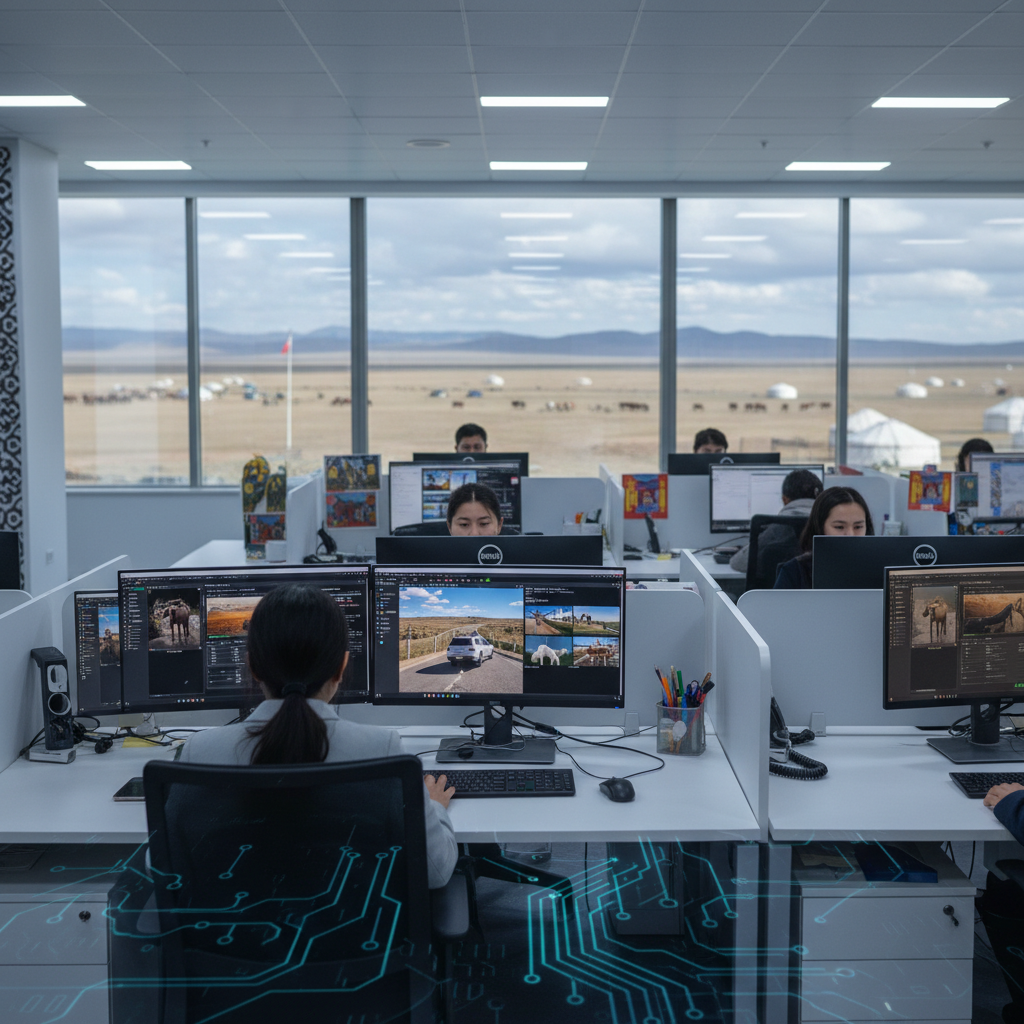

The wind whips across the steppe, carrying the scent of dust and distant livestock. It's a familiar feeling, one that has shaped generations here in Mongolia. But these days, the same wind might also carry the faint hum of a generator powering a laptop, where someone is meticulously drawing boxes around images of cars, identifying objects in satellite photos, or transcribing garbled audio. This is where the steppe meets the server farm, in a way most people in Silicon Valley could never imagine. We talk a lot about AI's intelligence, its algorithms, its future. What we often forget, or perhaps choose to ignore, are the human hands and eyes that make it all possible. These are the AI workers, the data labelers, the annotators, the people who feed the machines. Their work is the invisible foundation of the artificial intelligence revolution, and their rights are becoming a critical, global concern.
The Big Picture: Why AI Needs Human Eyes
Think of any AI system you interact with daily: Google Photos recognizing your friend's face, a self-driving car identifying a pedestrian, or an AI chatbot understanding your nuanced question. None of these systems learn by magic. They learn from vast amounts of data that has been carefully, painstakingly, labeled by humans. This process, known as data annotation or labeling, is the bedrock of supervised machine learning. Without it, most of the AI we use today simply would not function.
For companies like Google, Meta, or OpenAI, the sheer volume of data required is staggering. It's not just about quantity, though. It's about quality and diversity. An AI trained only on data from one region or demographic will inevitably be biased. This is where countries like Mongolia, with its unique cultural context and a workforce eager for opportunities, come into play. Our people are contributing to global AI, often without knowing the full scope of their impact or the value of their labor.
The Building Blocks: What Makes Data Labeling Work?
At its core, data labeling involves humans applying metadata, or labels, to raw data. Let's break down the key components:
- Raw Data: This can be anything: images, videos, audio recordings, text documents, sensor readings. For example, a self-driving car company might collect millions of hours of street footage.
- Annotation Tools: These are specialized software platforms that allow human annotators to interact with the raw data. They can range from simple image bounding box tools to complex 3D point cloud editors for autonomous vehicles.
- Human Annotators (The AI Workers): These are the individuals, often working remotely or in specialized centers, who perform the labeling tasks. They follow strict guidelines to ensure consistency and accuracy.
- Quality Assurance (QA): A critical step where labeled data is reviewed, either by senior annotators or through statistical sampling, to catch errors and maintain high standards. This often involves a feedback loop to the annotators.
- Training Data Set: The final output, a collection of raw data paired with its human-generated labels, ready to be fed into machine learning algorithms.
Step by Step: From Raw Image to Trained AI
Let's walk through a common scenario: training an AI to recognize different types of vehicles on a road. Imagine a Mongolian data labeling company, perhaps 'Steppe Annotations LLC', contracted by a major tech firm like Tesla or Waymo.
Step 1: Data Acquisition. Tesla's autonomous vehicles collect raw video footage from roads worldwide, including some from less common environments, perhaps even a dusty road outside Ulaanbaatar. This footage contains cars, trucks, motorcycles, pedestrians, and sometimes even a stray yak.
Step 2: Task Assignment. The raw video frames are broken down into individual images and uploaded to a cloud-based annotation platform. Project managers at Steppe Annotations assign these tasks to their team of annotators.
Step 3: Annotation. An annotator, let's call her Nomin, receives a batch of images. Her job is to draw precise bounding boxes around every vehicle in each image. She uses the annotation tool to select 'car', 'truck', 'motorcycle', and so on, for each object. She also might be asked to label their direction, speed, or even their color. This requires intense focus and adherence to detailed instructions, sometimes for eight hours a day.
Step 4: Quality Control. Once Nomin completes a batch, it goes to a QA specialist, Batbayar. Batbayar reviews Nomin's work, checking for missed objects, incorrect labels, or imprecise bounding boxes. If errors are found, the batch might be sent back to Nomin for correction, or to another annotator for a second pass.
Step 5: Data Aggregation and Export. After passing QA, the labeled images are aggregated into massive datasets. These datasets, now rich with human intelligence, are then exported and used by Tesla's engineers to train their AI models. The AI learns what a 'car' looks like by seeing thousands, even millions, of examples that Nomin and her colleagues have carefully outlined.
A Worked Example: Identifying a 'Ger' on the Steppe
Consider an AI system being developed by a Mongolian agricultural tech startup, 'NomadAI', aiming to monitor livestock and pasture conditions using satellite imagery. This AI needs to identify traditional Mongolian gers, which are circular felt dwellings, from above.
- Input: High-resolution satellite images of the Mongolian steppe.
- Task: Identify and outline every ger in the image.
- Annotator's Action: A data labeler, perhaps working from a small office in Khovd province, opens the image in a specialized tool. They zoom in, carefully tracing the circular outline of each ger, applying the label 'ger'. They might also be asked to label associated structures, like corrals or water points.
- Output: The image, now overlaid with precise polygons marking each ger, becomes a training example for NomadAI's computer vision model. The model learns to differentiate gers from rocks, bushes, or other natural formations, enabling it to count nomadic households and track population shifts.
This is practical innovation, born from Mongolia's challenges and finding its solutions in technology.
Why It Sometimes Fails: Limitations and Edge Cases
Even with meticulous human effort, the system isn't perfect. Several factors can lead to failures:
- Ambiguity: What if an object is partially obscured? Is that a car or a truck? Human interpretation can vary, leading to inconsistent labels. This is why clear guidelines are crucial.
- Fatigue and Monotony: Data labeling is repetitive work. Long hours can lead to fatigue, reducing accuracy. "It's not just about drawing boxes, it's about maintaining focus for hours on end, which is mentally draining," explains Ganbold Enkhbat, a project lead at 'Steppe Annotations LLC'. "We see a dip in accuracy after about six hours, even with breaks." This is a critical point for workers' rights.
- Poor Guidelines: If the instructions from the AI company are unclear or contradictory, even the best annotators will produce inconsistent data.
- Bias in Raw Data: If the raw data itself lacks diversity, no amount of perfect labeling will fix the inherent bias. An AI trained only on images of city streets will struggle on a rural Mongolian road, regardless of how well those city images were labeled.
- Low Pay and High Turnover: In many parts of the world, data labeling is a low-wage job, leading to high turnover. New, less experienced workers mean more errors, impacting the quality of the training data. This is particularly relevant in developing economies where these jobs are often outsourced.
Where This Is Heading: The Fight for AI Workers' Rights
The industry is slowly waking up to the ethical implications of this human labor. The sheer scale of the global data labeling market, estimated at over $5 billion annually and growing, means millions of people are involved. Yet, many face precarious employment, low wages, and a lack of benefits.
Organizations like the Fairwork Foundation are starting to audit these platforms, pushing for better pay, fair conditions, and transparency. MIT Technology Review has published extensively on the 'ghost work' behind AI, highlighting the human cost. Companies like Google and Microsoft, while heavily reliant on this labor, are beginning to face scrutiny over their supply chains.
"The future of AI isn't just about advanced algorithms, it's about the ethical treatment of the people who build its intelligence," states Dr. Saruul Bold, a labor rights advocate at the National University of Mongolia. "We need global standards for fair wages, safe working conditions, and the right to organize for these AI workers, whether they are in Bangalore, Nairobi, or Ulaanbaatar. Mongolia's challenges are unique and so are its solutions, but basic human rights are universal."
Some companies are exploring 'active learning' and 'few-shot learning' to reduce the reliance on massive labeled datasets, but human annotation will remain crucial for the foreseeable future, especially for complex or nuanced tasks. The conversation is shifting from merely 'how to label data' to 'how to label data ethically and sustainably'.
As AI becomes more integrated into our lives, the spotlight must also shine on the human infrastructure that supports it. Ignoring the rights of these workers is not just an ethical failing, it's a practical one. Poorly treated, underpaid workers produce lower quality data, which in turn leads to less effective, more biased AI. If we want truly intelligent and fair AI, we must first ensure fair treatment for the intelligent humans who teach it. The future of AI depends on it, and the global community, from Silicon Valley to the Mongolian steppe, must demand it. You can learn more about the broader implications of AI and its impact on society by checking out resources like Wired's AI section. For those interested in the business side of this growing industry, Bloomberg Technology provides regular updates.