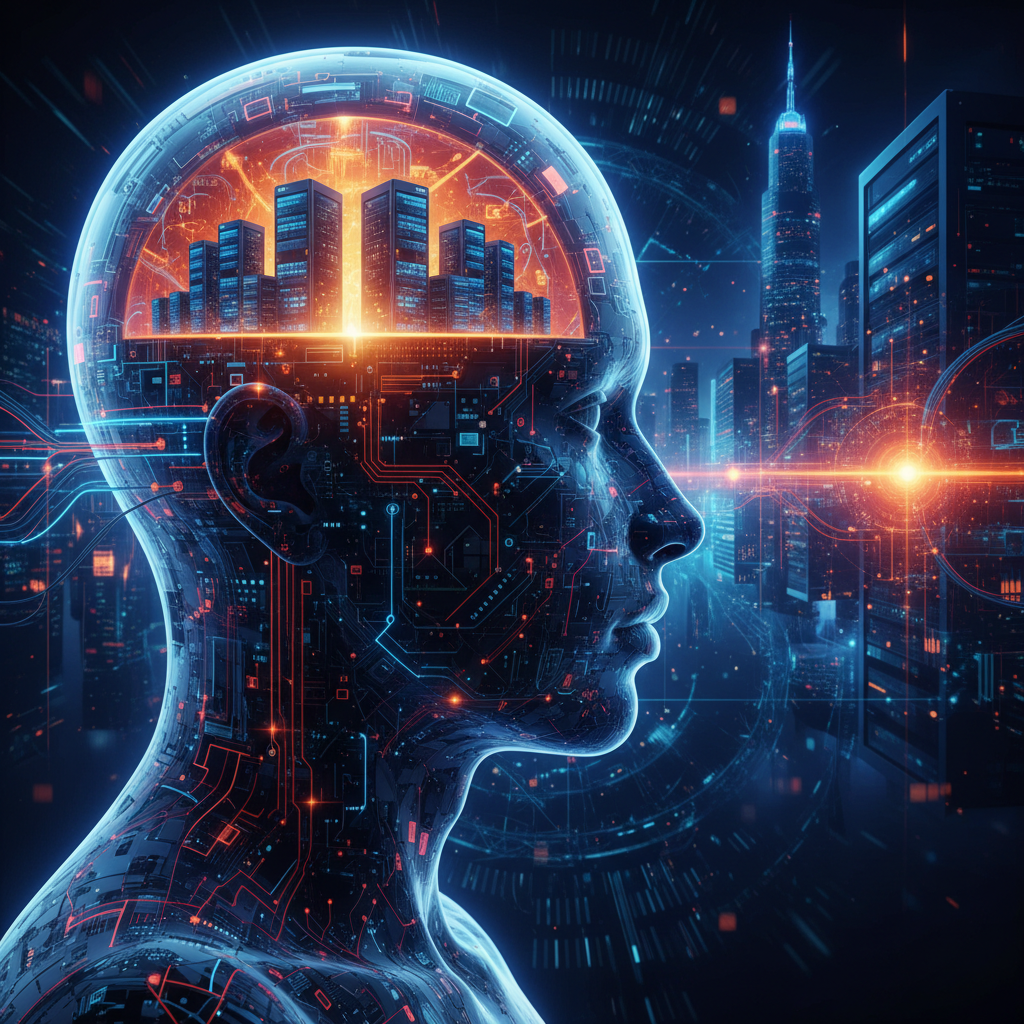

Picture this: it's a sweltering afternoon in Bengaluru, the kind where even the air-conditioning struggles. My friend, Rohan, a brilliant software architect at a leading AI startup, is glued to his phone, scrolling through an AI-generated personalized news feed. He's not just reading; he's absorbing, his eyes darting, his thumb flicking. In the background, the subtle hum of a distant data center, perhaps one of the giants powering his very feed, provides an almost subconscious soundtrack to our digital lives. This isn't just about faster internet or smarter apps anymore, my friends. This is about how the very infrastructure beneath our digital world, the colossal AI compute power and the sprawling data centers, is quietly, profoundly, rewiring our human experience right here in India.
We're talking about the physical manifestations of AI: those massive, humming fortresses of servers and cooling systems that are popping up everywhere, from Hyderabad to Chennai. These aren't just buildings; they are the beating heart of our AI future, processing unimaginable amounts of data, training the large language models, and powering every AI interaction we have. But what happens when our brains, finely tuned over millennia for a slower, more tactile world, are constantly immersed in a reality orchestrated by these hyper-efficient, always-on digital behemoths? The scale is mind-boggling, truly.
Dr. Priya Sharma, a cognitive psychologist at the National Institute of Mental Health and Neurosciences (nimhans) in Bengaluru, puts it eloquently: "Our brains are incredibly adaptable, but this constant influx of AI-curated information, delivered at breakneck speeds from distributed data centers, is creating a new cognitive landscape. We are seeing shifts in attention spans, memory recall, and even decision-making processes. The brain is optimizing for rapid pattern recognition over deep analytical thought, a direct consequence of the environment AI compute creates." She recently presented findings suggesting a 15% decrease in sustained attention in individuals who spend more than six hours daily interacting with highly personalized, AI-driven content, compared to a control group. This isn't just about screen time; it's about the nature of the content and how it's served.
Think about it: every time you ask an AI assistant for a quick fact, every time your social media feed predicts your next interest, every time a smart city sensor optimizes traffic flow, it's all powered by a vast, interconnected network of computational muscle. This instant gratification, this seamless prediction, it trains our brains to expect immediate answers, to outsource cognitive load. "We're offloading more and more basic cognitive tasks to AI, which is fantastic for efficiency, but we need to understand the long-term implications for our innate cognitive abilities," explains Professor Anish Gupta, head of AI Ethics at IIT Bombay. "Are we losing the 'muscle memory' for critical thinking, for navigating ambiguity, when AI always provides the 'optimal' path?" It's like having a super-efficient wicketkeeper who catches every ball; you might stop practicing your own catching skills.
The psychological impact isn't just individual; it's societal. The sheer computational power concentrated in these data centers allows for unprecedented levels of personalization. While this can be empowering, it also creates echo chambers, reinforcing existing biases and making it harder to encounter diverse perspectives. "When AI models, trained on vast datasets, start to dictate what we see and hear, our collective understanding of reality can become fragmented," warns Dr. Kavya Singh, a sociologist studying digital culture at Jawaharlal Nehru University. "The infrastructure enabling this personalization, the data centers, are not just neutral pipelines; they are active architects of our social cognition. This is a profound shift in how we form opinions and relate to others, and India is having its moment in this global transformation, for better or worse."
Consider the rise of hyper-realistic AI-generated content, from deepfake videos to synthetic voices. The compute power required to create and disseminate these at scale is immense, and it's readily available thanks to the explosion of data centers. This blurs the line between reality and artifice, challenging our ability to discern truth. A recent study by the Observer Research Foundation found that 68% of Indian internet users struggled to identify AI-generated news articles when presented alongside human-written ones, especially when the AI content was tailored to their perceived interests. This isn't just a fun parlor trick; it's a serious challenge to our cognitive filters and our trust in information.
So, what do we do? How do we navigate this brave new world where the very air we breathe feels infused with algorithmic influence? First, awareness is key. Understanding that our interactions with AI are not benign but are actively shaping our cognitive processes is the first step. We need to cultivate digital literacy that goes beyond just knowing how to use an app, but understanding how that app is working and what it's doing to our minds. We need to be mindful consumers of AI-generated content, questioning its source and intent. As we've previously explored with AI in scientific discovery [blocked], critical evaluation remains paramount.
Second, we need to push for ethical AI development and transparent infrastructure. Regulators, policymakers, and industry leaders in India must work together to ensure that the growth of AI compute power serves human well-being, not just corporate profit. This means investing in explainable AI, auditing algorithms for bias, and creating standards for data center operations that consider societal impact. The government's push for 'Digital India' must also include 'Cognitive India,' a framework for safeguarding our mental faculties in the AI age. According to a report by Reuters, India's data center market is projected to double by 2026, making this conversation even more urgent.
Finally, and perhaps most importantly, we must actively cultivate our human capacities. Engage in activities that demand deep thought, sustained attention, and genuine human connection. Read physical books, engage in face-to-face conversations, spend time in nature, learn a new skill that requires manual dexterity and problem-solving without digital shortcuts. These are the cognitive exercises that keep our brains agile and resilient in an AI-saturated world. It's about finding that balance, that sweet spot between leveraging AI's incredible power and preserving our unique human essence. We cannot let the silent hum of the data center drown out the symphony of human thought and emotion. This is just the beginning, and the choices we make now will define our cognitive future. We have the opportunity to shape it, to ensure that as AI grows, so too does our humanity. It's an exciting, challenging prospect, isn't it?