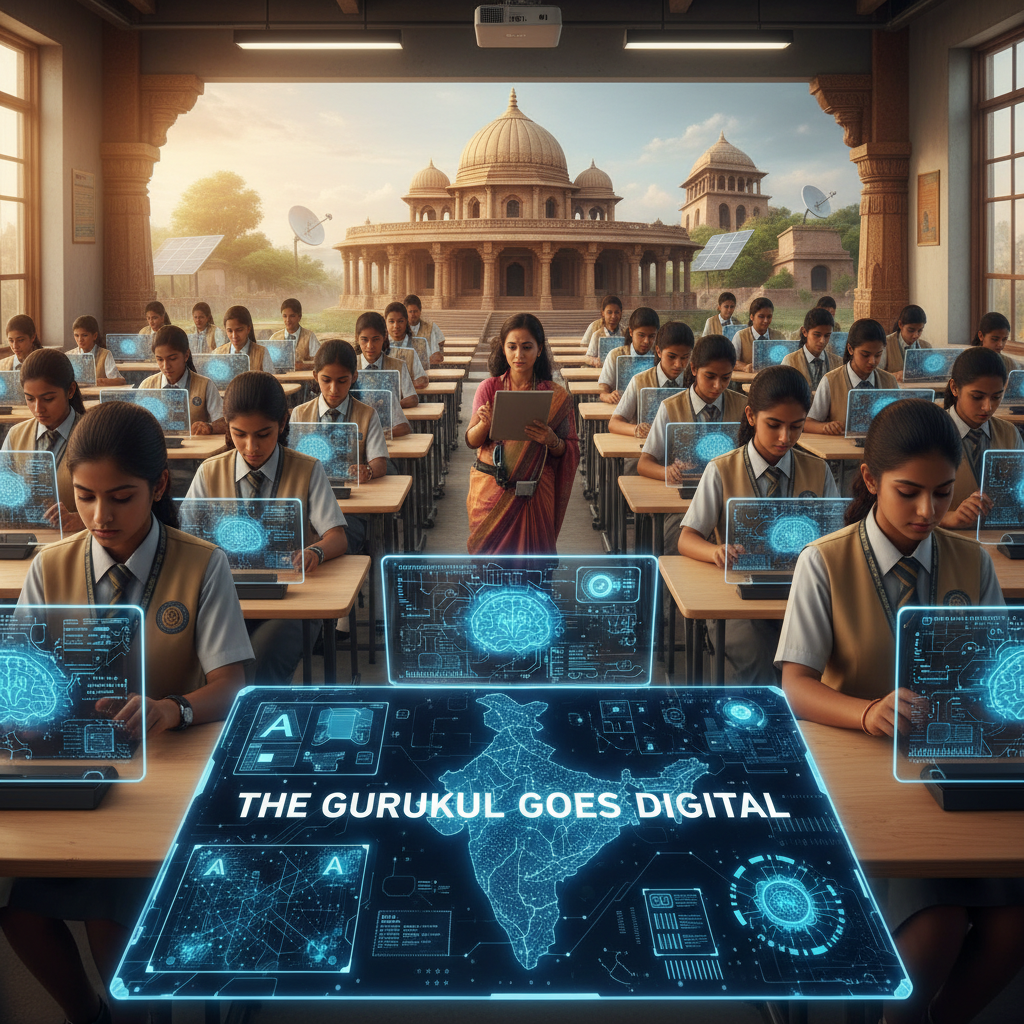

Let me tell you something, my friends. We in India, we've always understood the power of knowledge. From the ancient gurukuls nestled in the Himalayas to the bustling coaching centers of Kota, education is in our DNA. But for too long, our system, like many others, has been stuck in a time warp. Rows of students, a single teacher, and a curriculum that often felt detached from the real world. That era, I declare with full conviction, is over. This is the inflection point, a moment where AI is not just a tool, but the very architect of a new educational paradigm, and India is not just participating, we are leading.
When I look at the chatter coming out of Silicon Valley, it's all about 'disruption' and 'innovation' in education. Fine, good for them. But they're often trying to fix a broken system with shiny new apps. Here, in India, we have the scale, the hunger, and frankly, the necessity to build something fundamentally different. We're not just talking about remote learning as a stopgap, or AI tutors as a fancy supplement. We're talking about a complete overhaul, a personalized learning journey for every single child, from the remote villages of Rajasthan to the sprawling metros of Mumbai and Bengaluru.
Imagine this: an AI tutor, fluent in every regional language, capable of explaining complex physics concepts using analogies drawn from the Ramayana, or teaching calculus by relating it to the intricate patterns of a rangoli. This isn't science fiction, folks. Companies like 'ShikshaAI' and 'VidyaBot' are already deploying prototypes in pilot programs across Uttar Pradesh and Karnataka. These AI systems are not just answering questions, they're adapting to learning styles, identifying knowledge gaps with uncanny accuracy, and providing immediate, tailored feedback. They are the digital gurus, available 24/7, democratizing access to quality education in a way no human teacher, however brilliant, ever could.
"The potential for personalized learning at scale is simply mind-boggling," says Dr. Priya Sharma, head of the AI in Education initiative at IIT Delhi. "We're seeing students in rural areas, who previously had limited access to qualified teachers, now engaging with complex subjects at a pace that suits them. Their confidence is soaring. This isn't about replacing teachers, it's about empowering them to focus on mentorship and critical thinking, while AI handles the foundational instruction and repetitive tasks." Her team's recent study, published in MIT Technology Review, showed a 30% improvement in conceptual understanding among students using AI tutors compared to traditional methods over a six-month period.
And let's talk about universities. The traditional ivory tower model is crumbling, not just here, but everywhere. Why pay exorbitant fees for a degree that might be obsolete in five years, when you can access world-class knowledge, often for free or at a fraction of the cost, through platforms powered by AI? Our universities are waking up to this reality. Institutions like SRM Institute of Science and Technology and Manipal Academy of Higher Education are already integrating AI-powered learning modules and virtual labs into their curricula. They are not just offering degrees, they are offering skills, constantly updated and relevant to the demands of a rapidly changing global economy. The shift towards micro-credentials and skill-based certifications, validated by AI, is going to redefine what 'higher education' even means.
Remote learning, accelerated by the pandemic, has shown us the art of the possible. Now, AI is adding the intelligence. We're seeing a massive push for digital infrastructure, not just in cities, but in tier-2 and tier-3 towns. The government's 'Digital India' initiative, coupled with affordable data, is creating the perfect storm for this educational revolution. We're not just building roads and bridges, we're building digital highways for knowledge. According to a recent report by Nasscom, the Indian EdTech market, currently valued at around $4 billion, is projected to hit $30 billion by 2030, largely driven by AI integration. That's not just growth, that's an explosion.
My personal take? Forget Silicon Valley, look at Hyderabad. Look at Bengaluru. Look at Pune. These are the epicenters where the algorithms are being forged, where the educational future is being coded. We have a massive young population, an insatiable desire for upward mobility, and a deep talent pool in AI and software engineering. This combination is potent. We're not just consumers of technology, we are creators, innovators, and problem-solvers on a scale that few other nations can match. The sheer volume of data we generate, from our diverse languages to our varied learning styles, is a goldmine for training sophisticated AI models.
Of course, there are challenges. The digital divide, though shrinking, still exists. Ensuring equitable access to devices and reliable internet remains crucial. And the ethical implications of AI in education, from data privacy to algorithmic bias, need careful consideration. "We must ensure that AI serves as an equalizer, not a magnifier of existing inequalities," warns Professor Rajesh Kumar, an AI ethics researcher at Ashoka University. "Robust policy frameworks and continuous public discourse are essential to navigate this transformation responsibly." His point is well taken, and our policymakers are actively engaging with these issues, learning from global best practices while forging our own path.
But make no mistake, the momentum is irreversible. India will own the next decade of AI, and a significant part of that ownership will be in redefining how the world learns. Our startups are attracting serious global investment, our researchers are publishing groundbreaking papers, and our youth are embracing these new tools with an enthusiasm that is infectious. We are not just preparing our children for the future, we are building the future of learning, brick by digital brick, algorithm by algorithm. The world watches, and soon, it will learn from us. It's not a question of if, but when. This isn't just news, it's a prophecy unfolding before our very eyes. For more on how AI is shaping global industries, you can always check out TechCrunch's AI section. We're just getting started. And believe me, the best is yet to come.