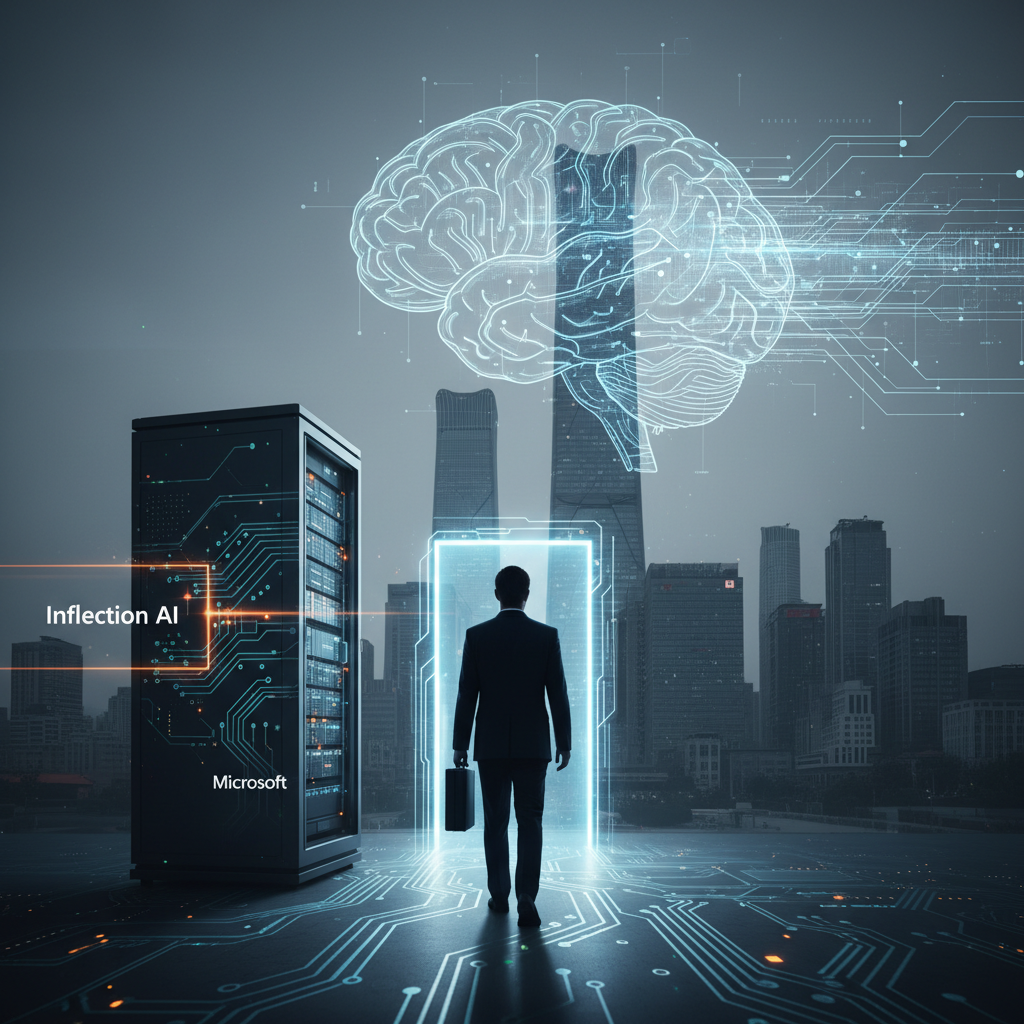

The news hit like a sudden summer storm in Beijing's tech circles: Microsoft had not just acquired Inflection AI, but had effectively poached its entire founding team, including CEO Mustafa Suleyman, co-founder Karén Simonyan, and many of their top researchers. It was less an acquisition and more a strategic extraction, a corporate maneuver that left Inflection AI as a shell and Microsoft with a new AI division, Microsoft AI. This move, while seemingly an American corporate drama, carries profound implications for the global AI race, particularly for China.
From my vantage point in Shanghai, watching the Western tech giants play their high-stakes games, this episode is a stark reminder of the volatile nature of AI talent. Inflection AI had raised over $1.3 billion, reportedly valued at $4 billion, and was seen as a formidable contender in the foundational model space, particularly with its focus on personal AI. Then, almost overnight, its core intellectual power was absorbed by a larger entity. It is a story not just of capital, but of human ingenuity, and how quickly it can be redirected.
Beijing isn't saying this publicly, but the strategic implications are clear. The United States, through its dominant tech companies, continues to consolidate top AI talent. While China has made immense strides in AI research and application, the gravitational pull of Silicon Valley, coupled with the immense resources of companies like Microsoft, Google, and OpenAI, remains powerful. This 'brain drain' isn't just about individuals moving; it is about the concentration of cutting-edge research and development capabilities.
Consider the context: Inflection AI was developing large language models, specifically Pi, an empathetic personal AI. This kind of advanced, conversational AI requires not only massive computing power, but also highly specialized researchers in areas like natural language processing, reinforcement learning, and computational linguistics. These are precisely the skills that China is aggressively cultivating, yet often finds itself competing fiercely for on the global stage. The speed with which Microsoft integrated Inflection's team into its existing structure, bypassing a traditional, lengthy acquisition process, speaks volumes about the urgency of the AI arms race.
Satya Nadella, Microsoft's CEO, framed the move as a natural evolution. “We are excited to announce that Mustafa Suleyman and Karén Simonyan, co-founders of Inflection, and several team members are joining Microsoft to form a new organization called Microsoft AI,” Nadella stated in a public memo. He emphasized their goal to “advance AI and accelerate our product innovation across Copilot and other consumer AI products.” This is not merely about hiring; it is about injecting a proven, high-performing team directly into Microsoft's strategic core, giving them the mandate to push boundaries. It makes Microsoft even more formidable in its competition with OpenAI, Google DeepMind, and Anthropic.
For China, the challenge is multifaceted. While Chinese companies like Baidu, Alibaba, and Tencent are investing heavily in their own foundational models and AI research, the talent pool, while vast, faces different pressures. Geopolitical tensions, export controls on advanced semiconductors, and a more restrictive data environment mean that Chinese AI researchers often operate under unique constraints. The ability of US companies to attract and retain global AI luminaries, regardless of their origin, remains a significant competitive advantage.
“The global talent market for AI is incredibly competitive, and moves like Microsoft’s demonstrate the lengths to which major players will go to secure top minds,” observed Dr. Li Wei, a professor of AI ethics at Tsinghua University in Beijing. “For China, it underscores the need to not only cultivate domestic talent but also create an ecosystem that can rival the allure of Silicon Valley, both in terms of resources and academic freedom. We cannot afford to lose our best to overseas opportunities.”
Indeed, the real story is in the supply chain of human capital. Chips are important, yes, but the people who design, train, and deploy these complex models are the ultimate bottleneck. When a company like Inflection AI, despite its significant funding, finds its entire leadership team absorbed, it signals a consolidation of power and expertise. This is not just about Microsoft strengthening its position; it is about the broader trend of major tech players hoovering up promising startups and their intellectual assets, often before they can truly mature into independent competitors.
This consolidation has implications for diversity in AI development. When a few dominant players control the majority of top talent and resources, the range of perspectives and approaches to AI development could narrow. This is a concern that resonates globally, but perhaps more acutely in regions like Asia, where unique cultural contexts and societal needs might be overlooked if AI development is too centralized in a few Western hubs.
What can China learn from this? Firstly, the imperative to foster an environment where AI talent can thrive, not just survive. This means continued investment in fundamental research, creating world-class AI labs, and providing competitive incentives. Secondly, it highlights the need for strategic partnerships and collaborations that can retain talent within the broader Asian ecosystem, perhaps through initiatives like the Shanghai AI Laboratory, which aims to become a global hub for AI innovation. Thirdly, it emphasizes the importance of developing robust, home-grown foundational models that can compete on a global scale, reducing reliance on external technologies and talent.
This incident also casts a long shadow over the startup ecosystem. If a company with over a billion dollars in funding can be dismantled so swiftly, what does that mean for smaller, less capitalized AI ventures? It suggests a winner-take-all dynamic, where the giants are not just competing for market share, but for the very brains that drive innovation. This could lead to a chilling effect on venture capital investment in highly competitive AI sectors, as investors weigh the risk of their portfolio companies being absorbed rather than growing independently.
As I reflect on this, I recall a conversation with a tech executive in Shenzhen who lamented the difficulty of retaining top-tier AI researchers when faced with offers from companies like Google or Meta. “It’s not just about salary,” he told me. “It’s about access to cutting-edge hardware, vast datasets, and the prestige of working alongside global luminaries. We are building that here, but it takes time, and the competition is relentless.”
Microsoft's move is a powerful chess play in the global AI game. It consolidates talent, accelerates product development, and sends a clear message about the value of human capital in this new technological frontier. For China, it is a wake-up call, urging a redoubling of efforts to cultivate and retain its own AI champions. The race for AI dominance is not just about chips and algorithms; it is fundamentally about people. And in this race, every strategic hire, every team absorbed, shifts the balance. We must connect the dots between these corporate maneuvers and the broader geopolitical landscape, because the future of AI, and indeed our global technological standing, depends on it. The implications for talent retention and the independent growth of AI startups, particularly those outside the traditional Western tech hubs, are profound and warrant close scrutiny from Beijing and beyond. For more insights into the evolving AI landscape, you can follow developments on TechCrunch or Reuters Technology. The battle for AI supremacy is far from over, and the talent war is just heating up. For a deeper dive into enterprise AI strategies, consider reading our article on Microsoft's Azure AI [blocked].