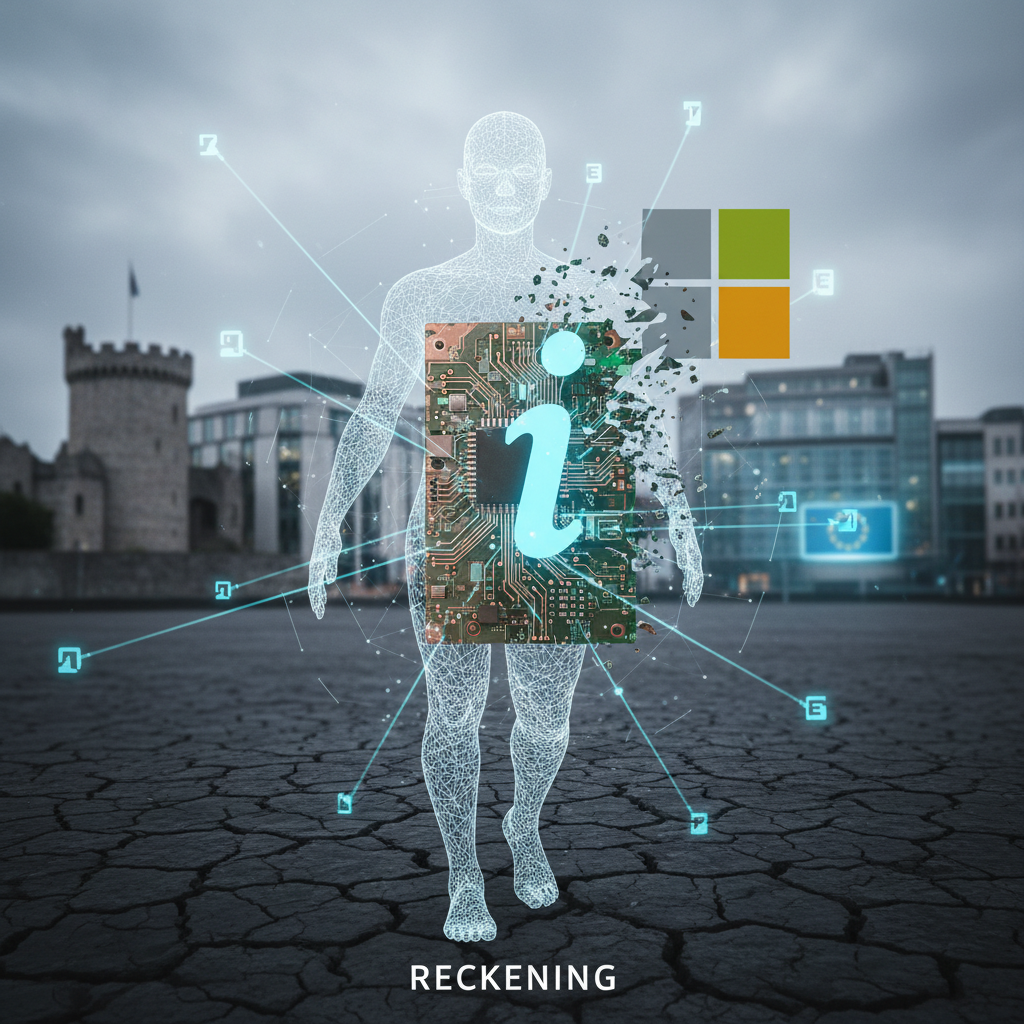

The tech world, much like the Irish Sea on a blustery day, is rarely calm. But even by its turbulent standards, the recent saga of Inflection AI and its eventual absorption by Microsoft has been a particularly telling squall. What began as a high-flying startup, valued at an astonishing $4 billion just last year, effectively ceased to exist as an independent entity, its core intellectual capital and human talent swept into the Redmond giant's orbit. This was not a typical acquisition, mind you, but a strategic talent grab, a move that speaks volumes about the cutthroat nature of the AI race and the vulnerabilities of even the most well-funded ventures.
From my vantage point in Dublin, where the digital footprints of Silicon Valley giants cast long shadows, this development raises more than just eyebrows. It prompts a deeper inquiry into the stability of the AI startup ecosystem, the concentration of power within a handful of mega-corporations, and the efficacy of European regulatory efforts to foster competition and prevent monopolies. Behind the press release lies a very different story, one of ambition, financial pressure, and the relentless pursuit of talent in a market where human ingenuity is the ultimate currency.
Inflection AI, co-founded by Mustafa Suleyman, Karén Simonyan, and Reid Hoffman, had positioned itself as a pioneer in personal AI, aiming to create digital companions that understood users on a profoundly human level. Their flagship product, Pi, was lauded for its empathetic and conversational capabilities. They had attracted significant investment, including a reported $1.3 billion round led by Microsoft, Nvidia, and other prominent figures. This was a company that seemed to have all the ingredients for success: visionary leadership, ample funding, and a compelling product vision. Yet, in a matter of months, the dream dissolved.
The official narrative, as often spun by corporate communications departments, suggests a mutual agreement. Microsoft, already a major investor, announced that Suleyman would lead a new consumer AI division, Microsoft AI, bringing with him Simonyan and a substantial portion of Inflection's 70-strong team. The remaining Inflection employees were reportedly offered roles at Microsoft as well. This was framed as a strategic alignment, a natural evolution. However, the abruptness of the move, and the effective dismantling of a highly valued independent entity, suggests a more complex reality.
Sources close to the matter, who spoke on condition of anonymity due to non-disclosure agreements, indicated that Inflection AI faced mounting pressure to find a sustainable business model that could justify its astronomical valuation. The computational costs associated with training and running large language models are immense, and the path to profitability for many AI startups remains elusive. "The burn rate was simply unsustainable for a company of their size, even with that level of funding," one former Inflection engineer confided. "The pressure to deliver a return on that $4 billion valuation was immense, and the market for personal AI, while promising, is still nascent."
This episode underscores a critical dynamic in the current AI landscape: the gravitational pull of the tech behemoths. Companies like Microsoft, Google, and Amazon possess not only vast financial resources but also the computational infrastructure, data reservoirs, and existing customer bases that smaller startups can only dream of. When a startup like Inflection AI struggles to scale or monetize its innovations, these giants are perfectly positioned to swoop in, not necessarily to acquire the company whole, but to absorb its most valuable assets: its people and their intellectual property. It is a form of strategic cannibalism, albeit one dressed in the garb of partnership and talent acquisition.
For Europe, and particularly for Ireland, which has positioned itself as a hub for tech innovation and a gateway for American tech giants into the European market, this trend is a double-edged sword. On one hand, the presence of companies like Microsoft, with their deep pockets and cutting-edge research, brings investment and high-skilled jobs. On the other hand, it risks stifling the growth of independent European AI champions. The European Union has been proactive in attempting to regulate AI through the AI Act, aiming to ensure safety, transparency, and ethical development. However, these regulatory frameworks, while vital, often struggle to address the rapid consolidation of power and talent that we are witnessing.
"The European AI Act is a crucial step towards responsible AI development, but it must also consider the economic realities of the sector," stated Dr. Aisling O'Connell, a leading expert in AI governance at University College Dublin. "If the most promising European startups are continually being absorbed by American conglomerates, we risk becoming mere consumers of AI, rather than innovators and creators. We need policies that not only regulate the technology but also foster a competitive environment for homegrown talent and innovation." Her words echo a growing concern across the continent.
The Irish tech sector has a secret it doesn't want you to know: while it boasts impressive foreign direct investment, the true depth of indigenous AI innovation, capable of competing on a global scale, remains a challenge. The lure of working for a Microsoft or a Google, with their unparalleled resources and global reach, is undeniable for top talent. This makes it incredibly difficult for smaller, independent European AI companies to retain their brightest minds, creating a brain drain that further entrenches the dominance of the established players.
The implications of the Inflection AI scenario extend beyond mere corporate maneuvering. It highlights the immense capital requirements for competing at the frontier of AI development. Training a state-of-the-art large language model can cost hundreds of millions of dollars, a sum few startups can sustain indefinitely. This financial barrier to entry inevitably funnels innovation towards those with the deepest pockets, reinforcing a winner-take-all dynamic. As reported by Reuters, the cost of AI development is a significant hurdle for many.
What does this mean for the future of AI innovation? Will the landscape be dominated by a handful of tech titans, or will there still be room for independent, groundbreaking startups? The answer, I believe, lies in a concerted effort by European policymakers to create more robust funding mechanisms, foster stronger academic-industry partnerships, and perhaps most crucially, ensure that regulatory frameworks promote genuine competition rather than inadvertently cementing existing power structures. The recent developments serve as a stark reminder that in the high-stakes game of artificial intelligence, the rules are still being written, and the players with the most chips often dictate the game's direction. We must remain vigilant, asking difficult questions, and ensuring that the future of AI is not solely determined by the balance sheets of a select few. The fate of independent innovation, and indeed, the very diversity of thought in AI, may well depend on it. For more insights into the broader AI industry, one might consult TechCrunch's AI section. The concentration of power in AI is a topic frequently discussed on platforms like MIT Technology Review.
This episode is a cautionary tale, a stark reminder that even billions in funding cannot guarantee survival in the brutal arena of advanced AI. It forces us to question the narratives of boundless innovation and to scrutinize the mechanisms through which power and talent are consolidated. The ghost of Inflection AI now resides within Microsoft's machine, a potent symbol of the challenges facing those who dare to build independently in the shadow of giants.