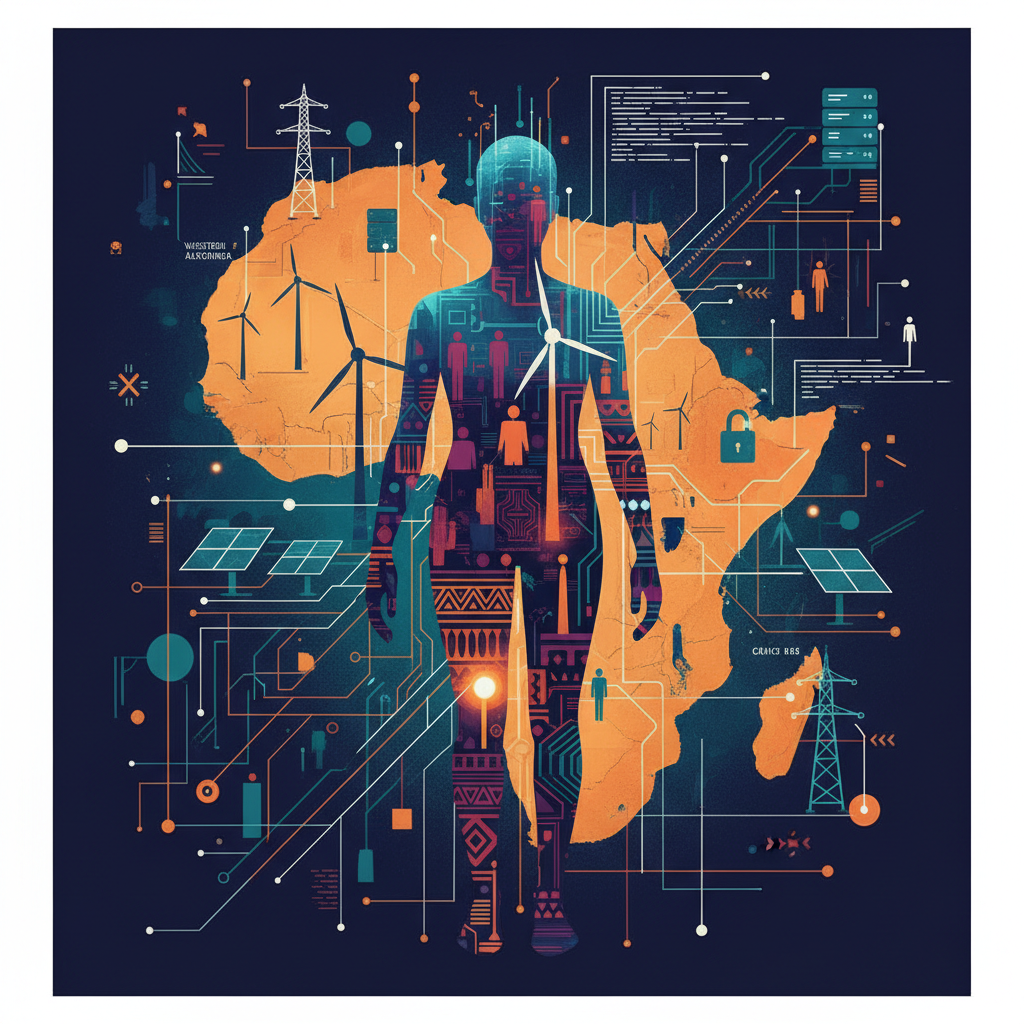

Picture this: a bustling Abidjan market, the air thick with the scent of spices and the chatter of a thousand voices. Suddenly, the lights flicker, then die. The hum of refrigerators ceases, mobile phones lose their charge, and the rhythm of life stutters. This isn't a rare occurrence; it's a lived reality for too many across our continent, a stark reminder of the fragile dance between aspiration and infrastructure. We talk about AI in energy and grid management as the panacea, the magic wand that will stabilize our power, predict outages, and optimize distribution. But from my vantage point in Côte d'Ivoire, I see a ghost in this machine, a silent, unseen force shaping our future in ways that might not always serve our people best.
My argument is simple, yet profound: the current narrative around AI in energy, largely driven by Western tech giants and their algorithms, risks creating a new form of energy dependency for African nations. We are being sold solutions designed for grids that are already robust, for energy markets that are already mature, and for societies whose priorities often differ from our own. While the promise of AI to enhance efficiency, reduce waste, and integrate renewable sources is undeniably attractive, we must ask ourselves: whose efficiency, whose waste, and whose integration are we truly optimizing?
Consider the case of the Compagnie Ivoirienne d'Electricité (CIE), our national power utility. They are under immense pressure to modernize, to meet the demands of a rapidly growing population and an expanding industrial sector. The talk of predictive maintenance, smart meters, and demand-side management, all powered by AI, sounds like progress. And in many ways, it is. We need innovation, desperately. But when the algorithms dictating our energy flow are opaque, developed in distant labs by teams with little understanding of our unique socio-economic fabric, we risk ceding control over our most vital resource. We risk having our energy future dictated by lines of code we cannot audit, models we cannot interrogate, and data sets that may not truly represent the nuances of our consumption patterns, our informal economies, or our cultural practices.
I spoke recently with Dr. Aminata Traoré, an energy economist at the Université Félix Houphouët-Boigny in Cocody. She told me something I'll never forget: "Aïssatà, they offer us a beautiful car, but they keep the keys. We can drive it, yes, but we cannot fix the engine, nor can we choose our destination freely. Our energy sovereignty is at stake." Her words echo a growing concern among local experts. We are not just talking about technical integration; we are talking about strategic autonomy. If AI becomes the brain of our grid, then the ownership and understanding of that brain become paramount.
Some will quickly counter, saying, "But Aïssatà, Africa needs this technology! We don't have the resources or the expertise to develop these sophisticated AI systems ourselves. Why reinvent the wheel when solutions already exist?" They will point to the billions being invested by companies like Google's DeepMind or NVIDIA in energy optimization worldwide, showcasing impressive statistics: a 15% reduction in cooling costs for data centers, a 10% improvement in renewable energy forecasting. These numbers are compelling, I agree. The global push for AI in energy is undeniable, with projections suggesting the market could reach tens of billions by the end of the decade.
However, this is the story they don't want you to hear: the 'off-the-shelf' solutions often come with hidden costs and inherent biases. An AI model trained on European or North American energy consumption data, reflecting patterns of large industrial consumption and widespread residential heating, will struggle to accurately predict demand in a city like Bouaké, where a significant portion of energy might be used for small artisan workshops, street food vendors, or communal charging stations. The data itself, the very fuel for these AI systems, is often collected and processed through frameworks that don't account for our informal sectors, our communal living arrangements, or the unique vulnerabilities of our infrastructure. This can lead to misallocations, inefficiencies, and even exacerbate existing inequalities, rather than alleviating them.
Furthermore, the reliance on external providers for core AI infrastructure means we are perpetually playing catch-up in terms of skills development. We need to cultivate our own cadre of AI engineers, data scientists, and energy specialists who can not only operate these systems but also understand their underlying logic, adapt them to local conditions, and, crucially, innovate upon them. Without this indigenous capacity, we risk becoming perpetual consumers of technology, rather than creators and shapers of our own destiny.
Consider the lessons from other sectors. In healthcare, for instance, there's a growing understanding that AI models for diagnostics must be trained on diverse populations to avoid bias. Similarly, in energy, our unique climate challenges, our blend of hydro, thermal, and emerging solar power, and our distinct socio-economic landscapes demand tailored, locally informed AI solutions. We cannot simply import a system and expect it to magically solve our problems without deep customization and local ownership.
I recently spoke with Monsieur Jean-Luc Koffi, a senior engineer at the Autorité de Régulation du Secteur de l'Electricité de Côte d'Ivoire (arseci). He emphasized the regulatory challenge. "How do we regulate an algorithm we don't fully understand? How do we ensure fairness and transparency when the core logic is proprietary? These are not just technical questions, Aïssatà; they are questions of governance and public trust." He makes a powerful point. Regulatory frameworks for AI are still nascent globally, and for developing nations, the challenge is even greater. We need to be proactive, not reactive, in shaping these rules.
My call to action is clear: African nations must demand more than just technological imports. We must insist on co-creation, knowledge transfer, and the development of open-source AI frameworks specifically designed for our contexts. We need investment not just in the hardware, but in the human capital. We need partnerships that empower, not just provide. Organizations like the African Development Bank and regional bodies like Ecowas must prioritize funding for local AI research and development centers focused on energy solutions, fostering an ecosystem where our young innovators can thrive. Imagine an AI model, trained on data from our own grids, developed by our own engineers, predicting the exact moment a transformer in Yopougon might fail, or optimizing solar distribution in Korhogo. That is true empowerment.
This isn't about rejecting AI; it's about reclaiming our agency within its adoption. It's about ensuring that as the lights stay on, the power remains in the hands of the people it serves. The future of our energy grid, powered by AI, should be a testament to our ingenuity, our resilience, and our self-determination, not a silent echo of someone else's vision. We must be the architects of our own digital destiny, lest the ghost in the machine becomes a permanent resident, silently pulling the strings of our future. For more on the broader implications of AI, you might find this article on AI ethics and bias insightful. The challenges we face are not unique, but our solutions must be.