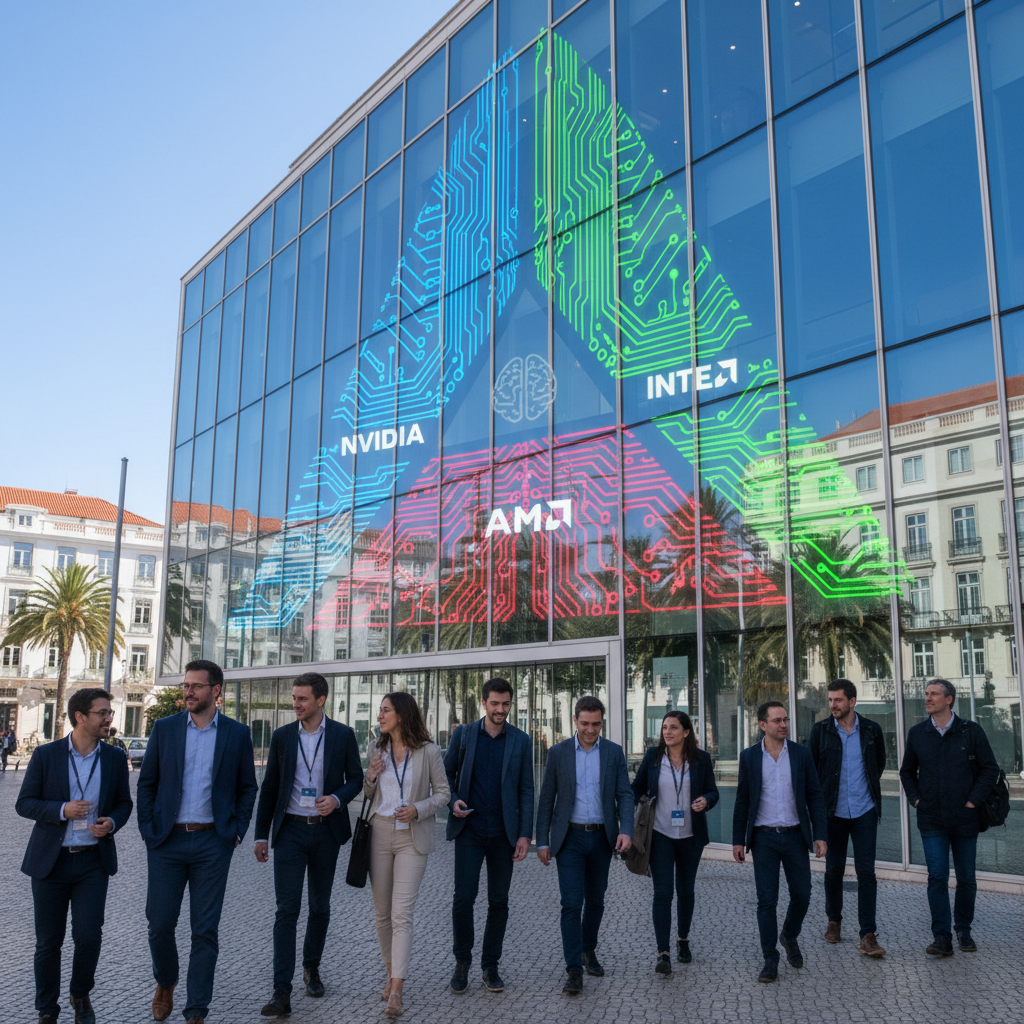

Dublin, a city once defined by its literary giants and now increasingly by its gleaming tech campuses, finds itself at a critical juncture in the global artificial intelligence race. The narrative often spun by government bodies and industry leaders speaks of Ireland as a vibrant hub, a magnet for innovation and digital talent. Behind the press release lies a very different story, one of growing technological dependency and a quiet erosion of competitive freedom, particularly concerning NVIDIA's dominant AI software stack.
I spent three months investigating this, delving into corporate filings, speaking with developers, and scrutinizing funding allocations within Ireland's AI ecosystem. What I found was a landscape overwhelmingly tethered to NVIDIA's proprietary Cuda programming model and its TensorRT inference optimizer. This isn't merely a preference; it is rapidly becoming an inescapable reality, a set of golden handcuffs for Irish startups and research institutions alike.
The ubiquity of NVIDIA's hardware, particularly its GPUs, is well-documented. What is less discussed, and far more insidious, is the near-monopoly held by its software tools. Cuda, a parallel computing platform and programming model, has become the de facto standard for high-performance computing in AI. Developers learn it, frameworks are built upon it, and academic curricula embed it. This creates a powerful network effect, making it incredibly difficult for alternative hardware or software platforms to gain traction.
Consider the plight of a burgeoning Irish AI startup. To attract talent, they must offer familiar tools. To access pre-trained models and cutting-edge research, they must operate within the NVIDIA ecosystem. To secure venture capital, they must demonstrate scalability on the hardware and software that investors understand and trust, which invariably means NVIDIA. This cycle perpetuates itself, stifling genuine competition and innovation outside of this singular paradigm.
Dr. Aoife O'Sullivan, a computer science professor at University College Dublin, articulated this concern in a recent private discussion. “Our graduates are highly skilled in Cuda, as are most globally. This makes them employable, yes, but it also narrows their horizons. We are effectively training an entire generation of engineers to operate within a walled garden. The long-term implications for our national research independence are profound,” she stated. Her sentiment echoes concerns raised by academics across Europe, many of whom feel caught between the immediate need for powerful tools and the strategic imperative for open, diverse ecosystems.
Public investment further exacerbates this issue. Government grants and EU funding initiatives, while ostensibly promoting innovation, often implicitly or explicitly favor projects utilizing established, high-performance infrastructure. Given NVIDIA's market dominance in AI hardware, these funds frequently translate into further investment in NVIDIA-centric solutions. This creates a feedback loop, cementing the very lock-in that policymakers should, arguably, be trying to mitigate. For instance, a recent report from the European Commission on AI infrastructure highlighted the overwhelming reliance on specific hardware vendors, implicitly pointing to NVIDIA without naming it directly, as a potential bottleneck for future European digital sovereignty. Reuters has covered similar concerns regarding chip dependency more broadly.
NVIDIA, for its part, maintains that its ecosystem is open and that it actively supports a wide range of developers and platforms. A spokesperson for NVIDIA, when asked about developer lock-in, stated, “cuda has been instrumental in democratizing AI development, providing researchers and developers with unparalleled performance and a rich software ecosystem. We continue to invest in open standards and cross-platform compatibility, ensuring that our technologies serve the broader AI community.” While technically true that NVIDIA participates in some open standards, the sheer weight of its proprietary stack makes true interoperability a formidable challenge for any competitor.
The Irish tech sector has a secret it doesn't want you to know: its future, particularly in AI, is being built on foundations that are increasingly proprietary and controlled by a single foreign entity. This isn't to say NVIDIA's technology is not excellent; it undeniably is. The concern is about the strategic vulnerability that arises when an entire nation's cutting-edge industry becomes so deeply intertwined with a single vendor's ecosystem. The potential for price increases, shifts in product strategy, or even geopolitical pressures to impact Ireland's AI capabilities is a risk that seems to be largely unaddressed.
What does this mean for the public, for the average citizen in Ireland? It means less competition, potentially higher costs for AI services in the future, and a reduced capacity for homegrown innovation that deviates from the NVIDIA path. It means that the next breakthrough in AI, if it requires a fundamentally different hardware or software approach, might struggle to emerge from Ireland simply because the infrastructure and talent pool are optimized for a single vendor. As The Verge has noted, the AI industry's reliance on a few key players creates systemic risks.
The European Union's AI Act, while focusing heavily on ethical guidelines and risk assessment, has yet to fully grapple with the economic and strategic implications of such deep vendor lock-in. While Brussels debates the nuances of AI governance, the foundational infrastructure upon which Europe's AI ambitions rest is quietly consolidating. Ireland, with its significant foreign direct investment in tech, is particularly exposed.
The path forward requires a concerted effort from policymakers, academic institutions, and industry leaders to diversify the technological landscape. Investment in open-source alternatives, support for hardware startups exploring different architectures, and a critical examination of procurement practices are all essential. Otherwise, Ireland risks becoming a highly skilled, but ultimately dependent, cog in a global AI machine largely controlled from afar. The long-term prosperity of our digital economy demands more than just attracting investment; it requires genuine technological sovereignty and a robust, competitive ecosystem. The current trajectory, while comfortable in the short term, is a gamble on our future independence. For more on the broader implications of tech monopolies, one might consult MIT Technology Review.