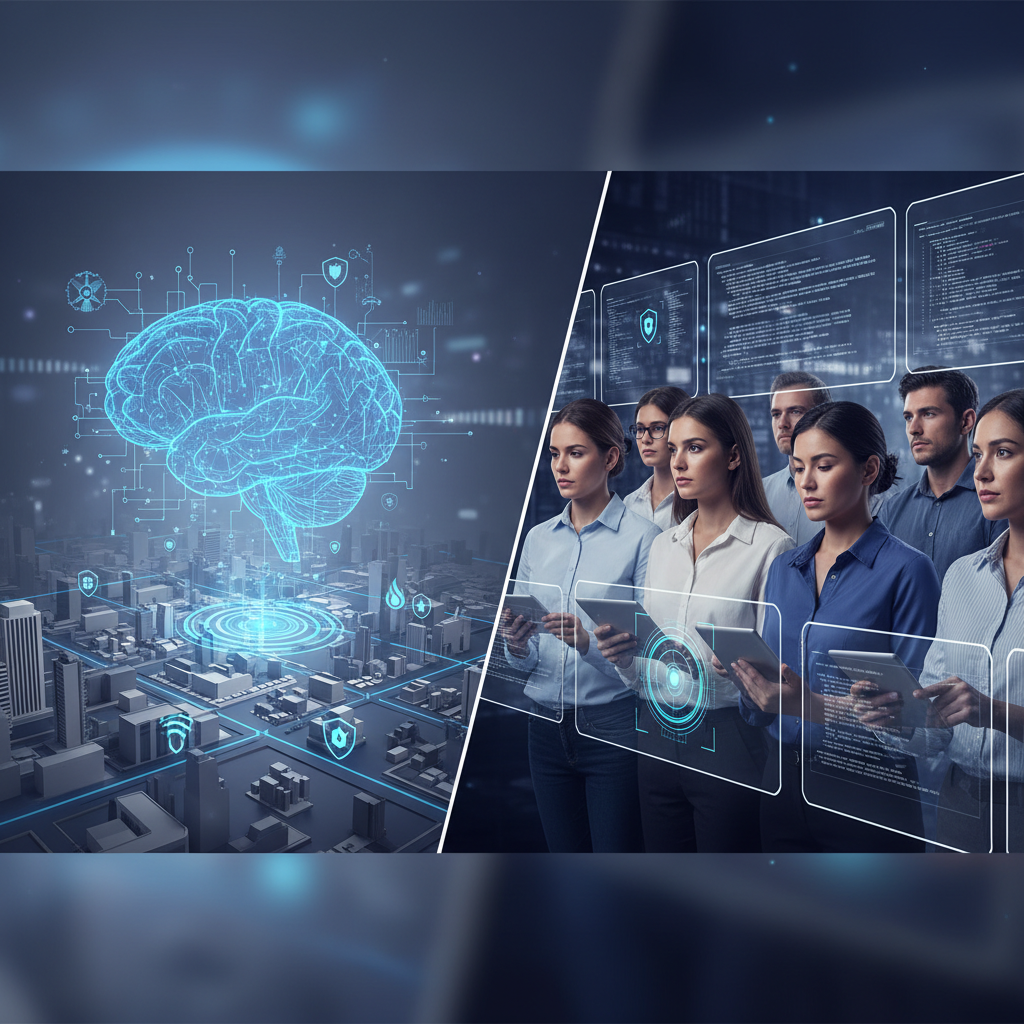

¡Hola, mis amigos! Mariànnà Sanchèz here, bubbling with excitement from the heart of Ecuador, ready to dive into a topic that truly keeps me on the edge of my seat: how artificial intelligence is transforming security in our vibrant nation. It is a dance between vigilance and liberty, a complex tango that AI is learning to lead with incredible grace. We are talking about the digital guardians of our cities and wild spaces, the unseen algorithms working tirelessly to keep us safe. But how, exactly, do these sophisticated systems function? Let us peel back the layers and discover the magic, step by step.
The Big Picture: More Than Just Cameras on a Pole
When we talk about AI in security, many people immediately picture surveillance cameras, and yes, they are a piece of the puzzle. But the reality is so much more profound, so much more integrated. Imagine a symphony of sensors, data streams, and intelligent algorithms all working in harmony to predict, prevent, and respond to threats. In Ecuador, where our biodiversity is a global treasure and our urban centers are dynamic hubs, this technology is not just about catching criminals, it is about protecting our natural heritage, ensuring public order, and even safeguarding the delicate balance of our ecosystems from illegal activities. It is a grand vision, a future where Ecuador's biodiversity meets AI and it is magical, creating a safer, more sustainable society.
Consider the city of Guayaquil, a bustling port where millions of stories unfold every day. For years, like many large cities globally, it has grappled with security challenges. Now, AI is stepping in, not as a replacement for human vigilance, but as a powerful augmentor. "We are moving beyond reactive measures," explains Dr. Ricardo Mena, head of the AI for Public Safety initiative at Espol, our prestigious polytechnic university. "Our goal is to build predictive models that can identify patterns and anomalies before incidents escalate, allowing for proactive intervention. It is a paradigm shift, truly." This is not just about watching, it is about understanding and anticipating.
The Building Blocks: What Makes These Systems Tick?
At its core, an AI security system is a sophisticated data processing machine, but with a brain that learns. Let us break it down into its essential components:
-
Sensors and Data Collection: This is where the raw information comes in. Think high-resolution cameras, thermal imaging devices, acoustic sensors that detect gunshots or unusual sounds, even environmental sensors monitoring for illegal deforestation or poaching in remote areas. In our context, this could also include data from social media analysis, public transport records, and anonymized mobile network data. It is a rich tapestry of information, much like the intricate patterns woven into a traditional Ecuadorian poncho.
-
Edge Computing Units: Often, the first layer of processing happens right at the source, on the device itself. This is called edge computing. Instead of sending all raw video footage to a central server, an intelligent camera might first identify a human form or a suspicious object. This reduces data traffic and speeds up response times. NVIDIA's Jetson platform, for example, is often used for these on-device AI capabilities, processing data in real time.
-
Data Transmission Network: All this information, whether pre-processed or raw, needs to travel securely and quickly to a central hub. This involves robust fiber optic networks, secure wireless connections, and sometimes even satellite links for remote areas like the Amazon basin or the Galápagos Islands, where connectivity can be a challenge.
-
Central Processing Unit (CPU) and Graphics Processing Unit (GPU) Clusters: This is the brain room, where the heavy lifting of AI happens. Powerful servers equipped with GPUs, like those from NVIDIA, are essential for running complex deep learning models. These clusters analyze vast amounts of data simultaneously, identifying patterns that would be impossible for humans to spot.
-
AI Models and Algorithms: This is the intelligence itself. We are talking about various types of machine learning models: computer vision algorithms for object detection, facial recognition (with strict ethical guidelines, of course), behavioral analysis, and anomaly detection. Natural Language Processing (NLP) models might analyze text from public reports or social media. These models are constantly learning and refining their understanding of what constitutes a 'normal' versus 'suspicious' activity.
-
Human-Machine Interface (HMI) and Alert System: Finally, the insights generated by the AI need to be presented to human operators in an understandable way. This involves dashboards, real-time alerts, and predictive visualizations. Operators can then verify, assess, and dispatch resources as needed.
Step by Step: How a Threat is Detected and Addressed
Let us walk through a hypothetical scenario, a common challenge in a bustling city like Guayaquil: a potential street robbery.
-
Step 1: Data Ingestion: A network of high-definition cameras, strategically placed in a commercial district, continuously streams video. Acoustic sensors are also listening for unusual sounds.
-
Step 2: Edge Pre-processing: An edge AI unit on a camera detects two individuals behaving erratically, lingering near a storefront for an extended period, and making furtive glances. It flags this as a potential 'loitering with intent' anomaly and sends a compressed alert with key frames to the central system. Simultaneously, an acoustic sensor might pick up a sudden, loud argument.
-
Step 3: Central Analysis: The central AI platform receives this alert. Its computer vision models analyze the individuals' gait, posture, and interactions, comparing them against historical data of suspicious behaviors. It cross-references with other data points, perhaps noticing these individuals have been flagged in other areas previously for similar behavior, or that a known gang member's vehicle was recently detected nearby. The NLP model might even pick up a local news report of a recent string of robberies in that specific district.
-
Step 4: Risk Assessment and Prediction: The AI system, using its trained models, calculates a probability score for an imminent criminal act. It might predict, for example, an 85% likelihood of a robbery attempt within the next 10 minutes based on the confluence of observed behaviors and contextual data. This is where the predictive power truly shines, moving beyond simple detection to foresight.
-
Step 5: Human Alert and Verification: A real-time alert flashes on an operator's screen at the Guayaquil Command Center. The alert includes the probability score, a map location, key video snippets, and a summary of the AI's reasoning. The operator quickly reviews the evidence.
-
Step 6: Response Dispatch: Upon human verification, the operator dispatches the nearest police patrol unit, providing them with real-time updates and the AI's predictive insights. This allows for a swift, targeted intervention, potentially preventing the crime before it even fully unfolds.
This entire process, from initial detection to dispatch, can happen in mere seconds, a speed impossible for human-only systems. According to a recent study by the Ecuadorian Ministry of Interior, AI-powered systems have contributed to a 15% reduction in street-level crime in pilot areas over the last year, a truly encouraging statistic.
Why It Sometimes Fails: The Human Element and Ethical Quandaries
Of course, no system is perfect, and AI security is no exception. Its limitations are often intertwined with the very data it learns from. If the training data is biased, the AI will inherit and even amplify those biases. For instance, if the system is primarily trained on data from one demographic, it might misidentify or over-flag individuals from other groups, leading to unfair targeting. This is a critical concern, especially in a multicultural nation like Ecuador.
"The 'black box' problem, where we do not fully understand how an AI arrives at its conclusions, remains a challenge," notes Dr. Sofia Paredes, an ethicist specializing in AI at the Universidad San Francisco de Quito. "Transparency and accountability are paramount. We must ensure that these systems are not only effective but also fair and respectful of individual rights. The Galápagos of technology requires careful stewardship, not just rapid deployment." There are also issues with 'adversarial attacks' where malicious actors can trick AI systems, and the simple fact that AI can only process what it sees or hears, not always the full context of human intention. Furthermore, technical glitches, network outages, or sensor malfunctions can lead to false positives or missed detections.
Where This is Heading: A Future of Integrated Intelligence
The future of AI in security is incredibly exciting, promising even more sophisticated and ethically conscious systems. We are looking at multi-modal AI that can seamlessly integrate visual, audio, and textual data for a more holistic understanding of situations. Think about AI systems that can not only detect a gunshot but also analyze the trajectory, identify the weapon type, and even predict the shooter's likely escape route, all in real time. We are also seeing advancements in explainable AI (XAI), which aims to make AI decisions more transparent, allowing human operators to understand the reasoning behind an alert. This will be crucial for building trust and ensuring accountability.
Furthermore, the integration of AI with other emerging technologies, such as drone surveillance and autonomous response units, is on the horizon. Imagine a drone autonomously deploying to an incident flagged by ground sensors, providing aerial perspective and even delivering first aid supplies before human responders arrive. This Ecuadorian startup, 'Guardianes Digitales,' is already pioneering drone-based environmental monitoring for our Amazon rainforest, using AI to detect illegal logging and mining activities, a truly inspiring application. You can read more about the broader trends in AI development on TechCrunch or Wired.
The journey of AI in security is a testament to human ingenuity, a powerful tool that, when wielded responsibly, can create a safer, more just world. It is not about replacing humans, but empowering them with unprecedented capabilities. As we continue to navigate this fascinating intersection of technology and society, the conversation around security versus freedom will undoubtedly evolve, but one thing is clear: AI is here to stay, and it is helping us build a future that is both secure and, dare I say, absolutely thrilling. For more in-depth analyses on the ethical considerations of AI, you might find valuable insights on MIT Technology Review.
And for a deeper dive into how AI is being used in other surveillance contexts, consider reading Eyes on the Street, or Eyes on You? Canada's New AI Guardian, 'Sentinel North', Under My Microscope [blocked], which explores similar themes in a different national setting. The global conversation is truly interconnected, and we are all learning together.