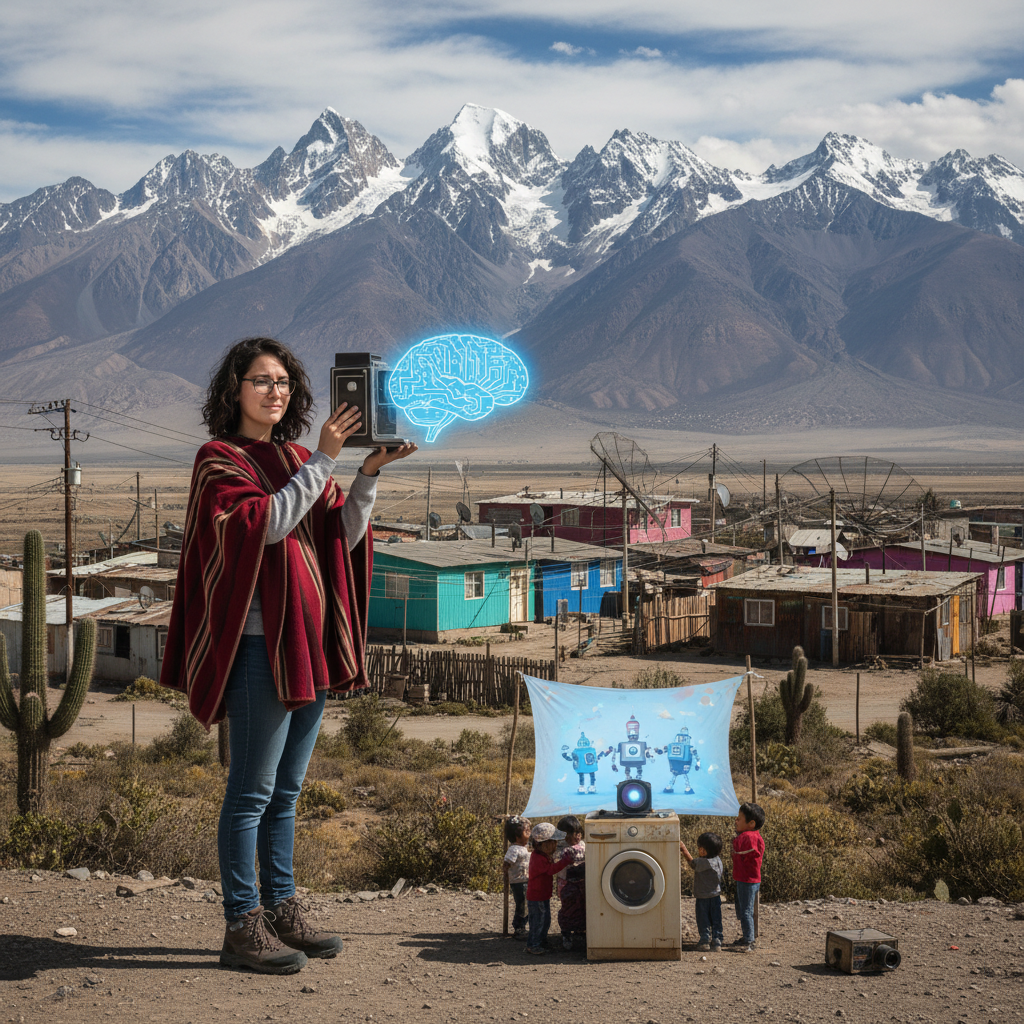

Let's be honest, the global AI conversation often feels like a party happening in a very exclusive Santiago neighborhood, while the rest of us are still trying to figure out if our internet connection will hold up long enough to send a WhatsApp message. Here in Chile, nestled between the towering Andes and the vast Pacific, the chatter about artificial general intelligence or the latest generative art feels a bit… distant. Not because we don't appreciate the marvel, but because our daily reality involves a different kind of AI challenge: making sure everyone, from the fisherman in Chiloé to the small farmer in the Central Valley, can actually access it. The Andes view of AI is different, you see. It's less about abstract philosophical debates and more about practical, ground-level impact.
We're talking about the digital divide, a phrase that sounds so academic it could put a condor to sleep. But here, it's a living, breathing beast, and AI is giving it sharper teeth. Imagine a farmer in the Maule region, struggling with climate change affecting his grape harvest. An AI-powered irrigation system could be a godsend, optimizing water use, predicting yields, and saving his livelihood. But what if he doesn't have reliable internet? What if the app is only in English? What if the device costs more than his tractor? Suddenly, this revolutionary technology becomes another barrier, another reminder of who gets to play in the future and who gets left behind, staring at a blank screen.
According to a recent report by the Chilean Ministry of Transport and Telecommunications, a staggering 35 percent of rural households still lack consistent internet access. Even in urban centers, affordability remains a significant hurdle for low-income families. "It's not just about having a smartphone, it's about having the data plan to use it, the electricity to charge it, and the literacy to understand what AI can even do for you," explains Dr. Elena Rojas, a sociologist specializing in technology adoption at the Universidad de Chile. "We're building these incredible digital tools, but we're forgetting the analog infrastructure and human capital needed to make them truly accessible. It's like having a Ferrari but no roads to drive it on."
And it's not just about internet access. The interfaces themselves are often designed for a global, English-speaking, tech-savvy audience. Try explaining the nuances of prompt engineering to someone whose primary language is Mapudungun, or who has limited formal education. It's a linguistic and cultural chasm that even the most advanced AI translation models are still struggling to bridge. "We need AI that speaks Chilean, not just Spanish," quipped Ricardo Soto, a software developer working on local language models in Valparaíso. "That means understanding our slang, our cultural references, our unique way of seeing the world. It's not just translation, it's localization at a profound level."
Yet, Chile's tech scene is like its wine, underrated and excellent. There are glimmers of hope, small vineyards producing exceptional results against the odds. Startups are emerging, often driven by a deep understanding of local problems. Consider the work being done by 'AgroInteligencia,' a Chilean company developing AI solutions for small-scale agriculture. Their platform, designed to be accessed via basic feature phones using SMS commands, offers weather predictions and crop advice in local dialects. It's a low-tech solution to a high-tech problem, and it's making a real difference. "We can't wait for Silicon Valley to solve our problems," states Sofia Morales, CEO of AgroInteligencia. "We have to build solutions that fit our reality, our climate, our people. That means simple, robust, and culturally relevant AI."
Another promising area is in education. The Chilean government, through initiatives like 'Conecta Mayor,' is exploring how AI can assist older adults in navigating digital services, from booking medical appointments to connecting with family. These programs often involve human facilitators, recognizing that technology alone isn't enough. It's a hybrid approach that blends the efficiency of AI with the empathy of human interaction, a truly Chilean compromise. "The goal isn't to replace human connection, but to augment it," says Patricio Gómez, Director of Digital Inclusion at the Ministry of Education. "AI can be a powerful tool for empowerment, but only if we design it with humanity at its core, especially for those who have been historically excluded from technological advancements." This human-centric approach is crucial, as highlighted by discussions on ethical AI development, which often emphasize fairness and non-discrimination, topics frequently covered by Wired's AI section.
But let's not get carried away with optimism just yet. The global race for AI dominance, fueled by giants like OpenAI and Google DeepMind, often overlooks the specific needs of developing nations. The sheer computational power required to train these massive models, and the cost associated with it, creates an almost insurmountable barrier for local innovation. NVIDIA's GPUs, the literal engines of the AI revolution, are not exactly cheap. This disparity means that the fundamental building blocks of AI are often controlled by a few powerful entities, raising concerns about technological sovereignty and the ability of countries like Chile to shape their own AI future. The conversation around equitable access to AI infrastructure and models is becoming increasingly urgent, as explored by MIT Technology Review.
What does this mean for Chile? It means we must be strategic. We can't compete on raw compute power, but we can compete on ingenuity and relevance. We can focus on developing specialized AI applications that address our unique challenges, from astronomy data processing in the Atacama Desert to optimizing renewable energy grids. We can invest in open source AI initiatives, fostering a collaborative environment where local talent can thrive without being beholden to proprietary systems. This approach could be a game-changer for smaller economies, allowing them to participate in the AI revolution on their own terms. For instance, the rise of open source models and platforms is a frequent topic on TechCrunch's AI category, offering alternatives to proprietary ecosystems.
Santiago has something to say, and it's not just about the latest tech trends. It's about ensuring that the AI future is inclusive, not exclusive. It's about remembering that technology, at its best, serves humanity, not the other way around. The digital divide is not merely a technical problem, it is a social justice issue, a reflection of deeper inequalities. If we allow AI to exacerbate these divisions, we risk creating a future where the benefits of this powerful technology are concentrated in the hands of a few, leaving the majority behind. And that, my friends, would be a tragedy far greater than any missed harvest. We have the opportunity to build an AI future that truly serves all Chileans, from the bustling markets of La Vega to the quiet beauty of Patagonia. Let's not waste it by focusing solely on the shiny new toys while ignoring the fundamental needs of our people. The challenge is immense, but so is our capacity for innovation and our commitment to a more equitable future.