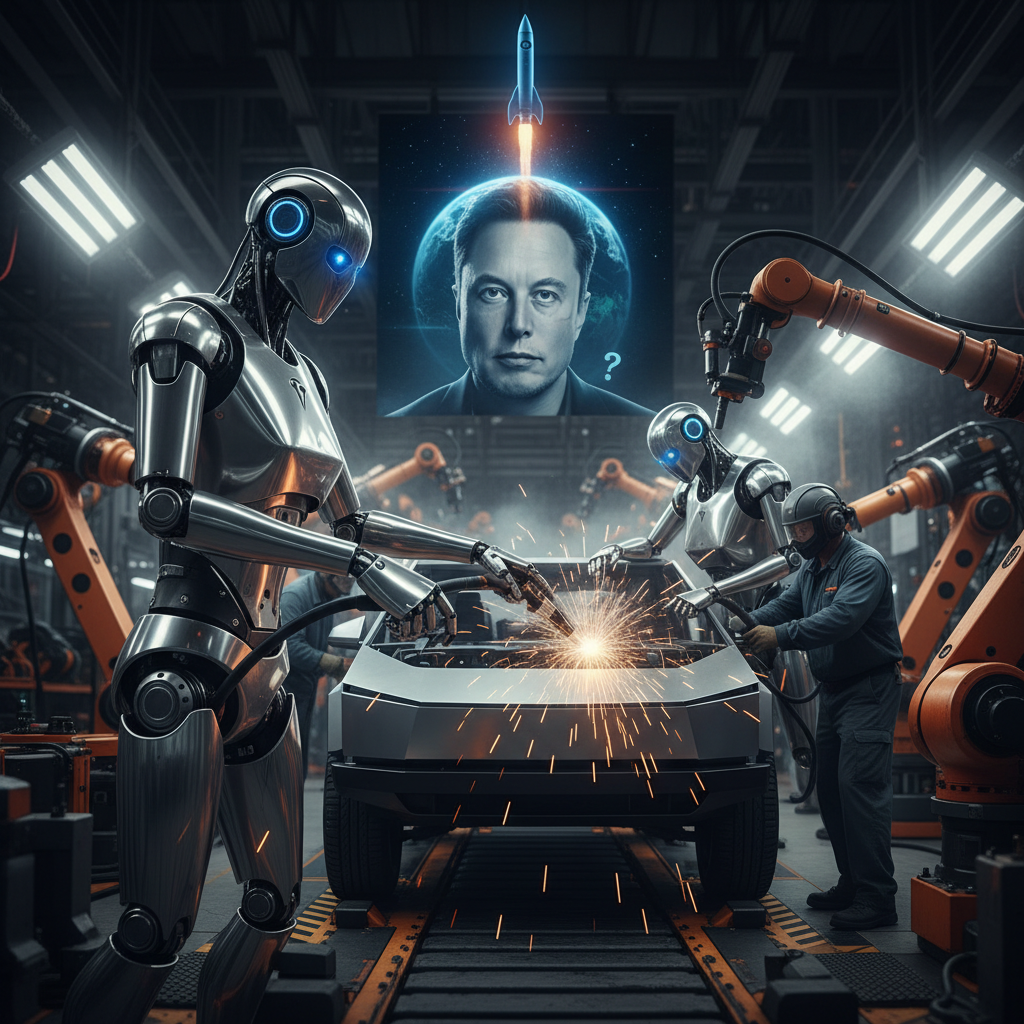

Alright, let's talk about something that just dropped like a ton of bricks in the Motor City, and trust me, it's going to echo across every single American town with a factory, a restaurant, or even a corner store. We're talking about the robots, folks. Not the clunky, caged industrial arms we've seen for decades, but actual humanoid bots, the kind Elon Musk has been hyping for years, and they are officially on the clock in Detroit.
Today, April 2026, marks a watershed moment. Tesla's Optimus units, those sleek, two-legged marvels, have begun their pilot deployment in several major automotive assembly plants across Michigan, including significant operations for Ford and General Motors. This isn't just a test run; it's a full-fledged integration into critical production lines. We're talking about tasks that used to require human hands, eyes, and sweat: fitting components, quality checks, even some intricate wiring. This is the real AI revolution, not some abstract concept debated in Silicon Valley boardrooms, but a tangible, metal-and-silicon reality hitting the factory floor.
My take? This is bigger than self-driving cars, bigger than ChatGPT, bigger than anything we've seen in AI so far because it directly impacts the very fabric of our communities. It's about jobs, yes, but it's also about dignity, purpose, and how we define 'work' in the 21st century. For decades, we've heard the whispers, the predictions, the doomsday scenarios. Well, the future is here, and it's got two legs and a surprisingly agile grip.
The initial reports from the plants are, predictably, a mixed bag. Management is ecstatic, citing immediate efficiency gains and a projected 15% reduction in production costs within the first six months. "This is about augmenting our workforce, not replacing it entirely," claimed Marcus Thorne, Head of Advanced Manufacturing at Ford, in a press conference this morning. "Optimus can handle repetitive, dangerous, or ergonomically challenging tasks, freeing our human employees to focus on more complex, creative problem-solving and oversight." He painted a picture of humans becoming supervisors, trainers, and innovators, working alongside their robotic counterparts.
But walk onto the shop floor, and you hear a different tune. "Augmenting? That's a fancy word for 'taking our jobs,' isn't it?" grumbled Maria Rodriguez, a 20-year veteran at a GM plant, speaking to local reporters. "I've seen automation before, but this feels different. These things look like us. They move like us. What happens when they don't need us at all?" Her fear is palpable, and it's a fear shared by thousands of blue-collar workers across the Rust Belt and beyond. The UAW, the powerful United Auto Workers union, has already issued a strongly worded statement, calling for immediate negotiations on job security, retraining programs, and a share of the productivity gains for human workers.
This isn't just about factories, though. The ripple effects are already being felt. Sources close to Amazon and Walmart confirm that they are accelerating their own humanoid robot deployment strategies for warehouses and retail stores, respectively. Imagine an Optimus bot stocking shelves at your local Kroger or flipping burgers at a McDonald's. It's not a distant fantasy anymore; it's the next logical step in a world increasingly driven by AI and automation. The future of AI is being built in places you'd never expect, like the bustling aisles of a superstore or the sizzling kitchens of a fast-food joint, not just in sterile labs.
"We've been preparing for this for years," stated Dr. Evelyn Reed, a labor economist at the University of Chicago, speaking on a national news program. "The question isn't if humanoid robots will enter the workforce, but how we manage that transition. We need proactive government policies, massive investments in education and vocational training, and a fundamental re-evaluation of our social safety nets. This isn't just an economic challenge; it's a societal one." She emphasized that ignoring the human element would be a catastrophic mistake, leading to widespread social unrest and economic inequality.
The implications for underserved communities, particularly in cities like Detroit, Atlanta, and Houston, are profound. These are the places that have historically borne the brunt of economic shifts, but also the places brimming with resilience and innovation. If managed poorly, this robotic influx could widen the existing wealth gap. But if approached with foresight and equity, it could also be an opportunity to redefine work, create new industries, and empower communities in ways we haven't yet imagined. We need to look beyond the immediate job displacement and start thinking about the jobs of tomorrow, jobs that involve designing, maintaining, and collaborating with these advanced machines.
Government officials are scrambling. Secretary of Labor, Dr. Lena Khan, announced the formation of a new 'Future of Work Task Force' within the Department of Labor, tasked with developing policy recommendations and investment strategies to address the robotic workforce. "We cannot allow technological progress to leave American workers behind," she declared from Washington D.C. "We must ensure that the benefits of this innovation are broadly shared, and that every American has the opportunity to thrive in this new economy." Her words offer some reassurance, but the devil, as always, will be in the details of implementation.
What happens next? I predict a rapid acceleration of humanoid robot adoption across multiple sectors, driven by competitive pressures and the allure of increased profitability. We'll see fierce debates in Congress, intense union negotiations, and perhaps even some protests on the streets. But we'll also see incredible innovation. New companies will emerge to service, program, and integrate these robots. Educational institutions will pivot to offer specialized training programs. And hopefully, we'll see communities coming together to chart a new path forward, one that leverages this technology for collective good.
This isn't just about robots doing jobs; it's about us, as a society, deciding what kind of future we want to build. It's about whether we embrace this seismic shift with fear or with a bold vision for human flourishing. Forget the Valley, look at Atlanta, Detroit, Houston, and every other American city. The real story of AI's impact is unfolding there, right now. It's messy, it's uncertain, but it's undeniably thrilling. We're standing at the precipice of a new industrial age, and how we navigate it will define the next fifty years. For more insights on how AI is reshaping industries, check out TechCrunch's AI section. You can also find broader discussions on technology's societal impact at Wired. This is not a drill; this is our future, arriving on two metallic feet. For a deeper dive into the ethical considerations of AI, particularly concerning labor, MIT Technology Review often publishes excellent pieces.