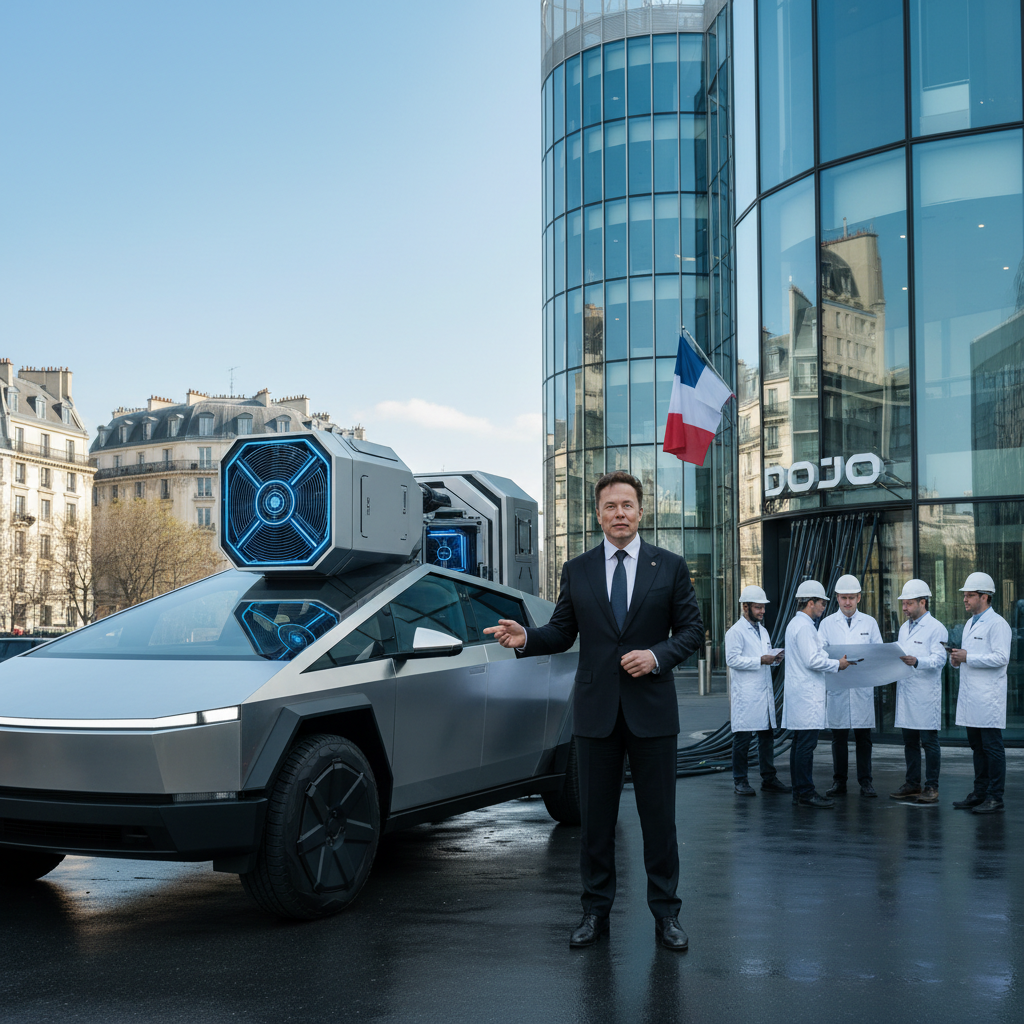
Mon Dieu, the audacity. Every year, it seems, Silicon Valley presents its latest technological marvels with the fanfare of a Hollywood premiere, and the world is expected to gasp in unison. This time, it was Tesla's AI Day, a spectacle orchestrated by Elon Musk himself, unveiling updates on their humanoid robot Optimus and, more significantly for the AI world, the continued saga of the Dojo supercomputer. The headlines screamed about unprecedented compute power, about a future where Tesla’s self driving cars achieve true autonomy, and about a general purpose robot that will change everything. But here in France, as I sip my morning coffee, I find myself asking: pourquoi? Why are we so quick to embrace these pronouncements as universal truths, rather than critically examining their relevance to our own European vision?
Let us begin with Dojo. Tesla's custom designed supercomputer, built to train its neural networks for autonomous driving, is indeed an impressive feat of engineering. Musk and his team speak of exaflops of AI compute, a colossal infrastructure designed to process vast amounts of real world driving data. The idea is to create a closed loop system, where data from millions of Tesla vehicles feeds into Dojo, which then refines the AI models, pushing the boundaries of what is possible in machine learning. It is a vertical integration strategy that would make even Louis XIV nod in approval, if he were interested in semiconductors.
However, the European way is not the American way, and that is the point. While Tesla focuses on proprietary hardware and a highly centralized approach, Europe has been diligently working on a different path. Our focus, enshrined in the EU AI Act, is not just about raw compute power, but about ethical frameworks, data sovereignty, and ensuring that AI serves humanity, not just corporate bottom lines. We are building an ecosystem that prioritizes transparency, accountability, and fundamental rights, a stark contrast to the move fast and break things ethos that often accompanies American tech ambitions.
Consider the energy consumption alone. Training these massive AI models, particularly on custom hardware like Dojo, demands an astronomical amount of electricity. While Tesla touts its renewable energy efforts for its Gigafactories, the sheer scale of Dojo’s power requirements raises serious questions about sustainability. In a continent like Europe, where energy independence and green initiatives are paramount, this kind of unbridled consumption is not just an engineering challenge, it is a philosophical one. Are we to sacrifice our environmental goals at the altar of autonomous driving, simply because a Californian company says it is the future?
Moreover, the very premise of Tesla's full self driving, or FSD, remains a contentious topic. Despite years of development and billions invested, true Level 5 autonomy, where a car can drive itself under all conditions without human intervention, remains elusive. Regulators across Europe, from the Autorité de la concurrence in France to the German Federal Motor Transport Authority, are far more cautious than their American counterparts. They demand rigorous testing, clear liability frameworks, and an undeniable safety record before such systems are widely deployed. This is not about hindering progress, it is about protecting citizens. As Ars Technica frequently reports, the path to fully autonomous vehicles is fraught with technical and ethical hurdles that neither immense compute nor bold pronouncements can simply erase.
Then there is Optimus, Tesla’s humanoid robot. While the demonstrations at AI Day showed some incremental progress, the robot's capabilities are still far from the sophisticated, general purpose assistant Musk envisions. The idea of a robot butler, or a factory worker, is certainly compelling, but again, the European perspective offers a different lens. Our robotics research, often funded by institutions like the Centre National de la Recherche Scientifique, tends to focus on collaborative robotics, on augmenting human capabilities rather than replacing them entirely. We are exploring how robots can work alongside humans in a symbiotic relationship, respecting the dignity of labor, rather than creating a dystopian future where human workers are rendered obsolete by metallic automatons.
“The real challenge for AI is not just about building bigger models or faster chips, it’s about integrating these technologies responsibly into society,” stated Dr. Cécile Latour, a leading AI ethicist at the Université Paris-Saclay, in a recent interview. “Europe’s strength lies in its ability to foster innovation while maintaining a strong ethical compass. We are not just chasing the next big thing, we are building a sustainable future.” Her words resonate deeply with the sentiment across European research labs and policy circles.
Indeed, while Silicon Valley often champions a winner take all mentality, Europe fosters collaboration. Projects like Gaia-x, a federated data infrastructure initiative, aim to create a secure and sovereign data ecosystem, allowing European companies and researchers to innovate without being beholden to foreign tech giants. This is a fundamental divergence from the Tesla model, which thrives on proprietary control and a closed ecosystem.
France says non to Silicon Valley's vision of a future dictated solely by the fastest chip or the most audacious CEO. We believe in a future where technology serves humanity, where innovation is balanced with responsibility, and where the pursuit of progress does not come at the expense of our values. Tesla's AI Day was a fascinating peek into one possible future, but it is not the only one, and certainly not the one we are building here. The question is not whether Dojo is powerful, but whether its power serves a purpose that aligns with a truly human centric vision of AI. For now, the answer from this side of the Atlantic remains a resounding, and thoughtful, non.
We must continue to scrutinize these grand pronouncements, to ask the difficult questions, and to champion our own distinct path. The future of AI is too important to be left to a single company, or even a single continent. It requires a diversity of thought, a plurality of approaches, and a steadfast commitment to ethical development. That, my friends, is the European way. And it is a way worth fighting for.