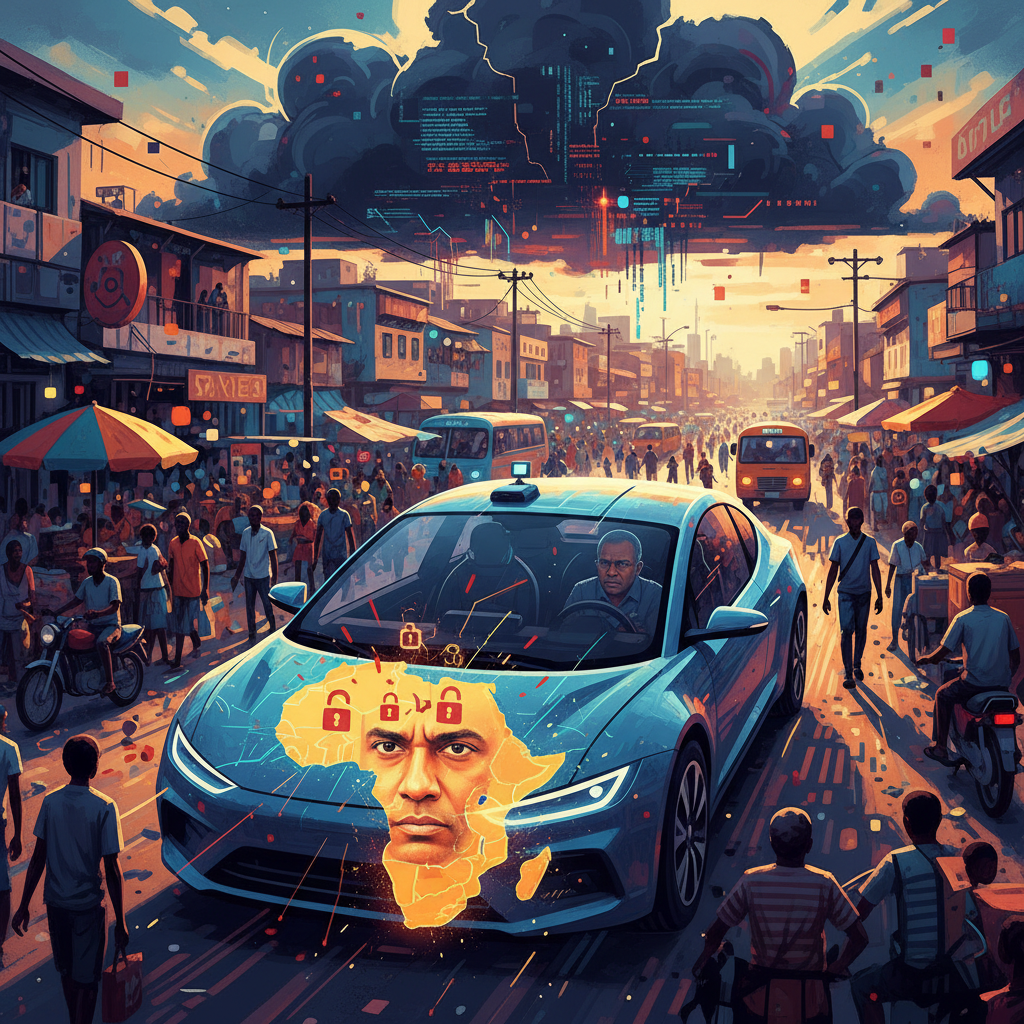

My friends, can you feel it? The air in Accra, the very pulse of our continent, is electric with innovation. Everywhere you look, there's a startup, a new app, a brilliant mind pushing boundaries. And now, the global tech giants are looking our way, bringing their most ambitious projects right to our doorstep. We are talking about Google's Waymo, the autonomous taxi service, and its impending expansion into new cities worldwide. This is bigger than anyone realizes, a true game-changer for urban transportation, but it also brings a fascinating set of challenges, especially for a dynamic, bustling city like ours.
Let's paint a picture: imagine cruising down the George Walker Bush Highway, or navigating the vibrant chaos of Makola Market, in a self-driving car. No tro-tro driver haggling, no traffic stress, just smooth, efficient travel. The promise is incredible, a vision of reduced accidents, optimized traffic flow, and greater accessibility. But as a journalist always looking at the full picture, I have to ask: what are the digital potholes in this gleaming road to the future? What are the AI safety and risk implications when Waymo, or any similar autonomous system, decides to take on the unique complexities of a city like Accra?
The Risk Scenario: Navigating the Unforeseen
The primary risk scenario I see is a confluence of technical vulnerabilities and operational challenges in diverse, rapidly developing urban environments. Waymo's systems are trained on vast datasets, primarily from meticulously mapped, well-regulated cities in the West. When these systems encounter the unpredictable, the informal, and the culturally specific elements of an African city, the potential for unexpected failures increases. We are talking about everything from pedestrians jaywalking in ways not anticipated by Western models, to livestock on urban roads, to the sheer variety of informal transport like our beloved tro-tros, each with its own unwritten rules of the road. A single, critical software glitch or an unforeseen interaction with local infrastructure could lead to severe consequences, from minor incidents to serious accidents.
Technical Explanation: The AI's Blind Spots
At its core, Waymo's technology relies on a sophisticated stack of sensors, lidar, radar, cameras, fused with advanced AI algorithms for perception, prediction, and planning. The AI's ability to 'see' and 'understand' its environment is paramount. However, these systems are only as good as the data they are trained on. If the training data lacks sufficient representation of diverse road conditions, traffic patterns, and human behaviors found in cities like Accra, the AI will inevitably have 'blind spots.'
For instance, consider the challenge of object recognition. A Waymo vehicle in Phoenix or San Francisco might be perfectly adept at identifying a cyclist or a delivery truck. But what about a street hawker balancing a towering stack of goods, or a child playing football in an unpaved alley that suddenly spills onto a main road? These are common sights in our cities, yet they might be anomalies in the datasets used to train these autonomous systems. Furthermore, the communication infrastructure, or lack thereof, can be a major hurdle. Waymo relies on robust GPS and high-speed network connectivity for real-time mapping updates and remote assistance. In areas with intermittent internet access or less precise mapping data, the system's operational integrity could be compromised. According to a recent report in TechCrunch, the challenge of adapting autonomous vehicles to varied global infrastructure is a significant barrier to widespread adoption.
Expert Debate: Beyond the Code
The conversation around autonomous vehicle deployment in Africa is vibrant, with diverse perspectives. On one side, you have the tech optimists, like Dr. Akwasi Mensah, Head of AI Research at Ashesi University in Ghana. He told me,