Let us be honest. When Silicon Valley announces its latest 'revolution,' my first instinct is rarely to cheer. More often, it is to ask: revolution for whom? And at what cost? Spotify, the behemoth of music streaming, has been touting its AI DJ and personalization engine as the next frontier in how we discover music. They speak of bespoke sonic journeys, algorithms that understand your soul, and an endless stream of perfectly curated tunes. From my vantage point here in Amman, I cannot help but wonder if this is just another sophisticated mechanism to keep us all humming the same Western tunes, albeit with a slightly different beat.
Spotify’s AI DJ, launched with much fanfare, aims to be your personal radio host, mixing music with commentary and recommendations tailored to your listening habits. It is supposed to learn your preferences, introduce you to new artists, and even bring back forgotten favorites. On the surface, it sounds like a dream for the casual listener. No more endless scrolling, no more decision fatigue. Just pure, unadulterated musical bliss, delivered by an artificial intelligence that supposedly knows you better than you know yourself. But this promise, like many from the tech giants, comes with a hidden caveat: the data it learns from is inherently biased.
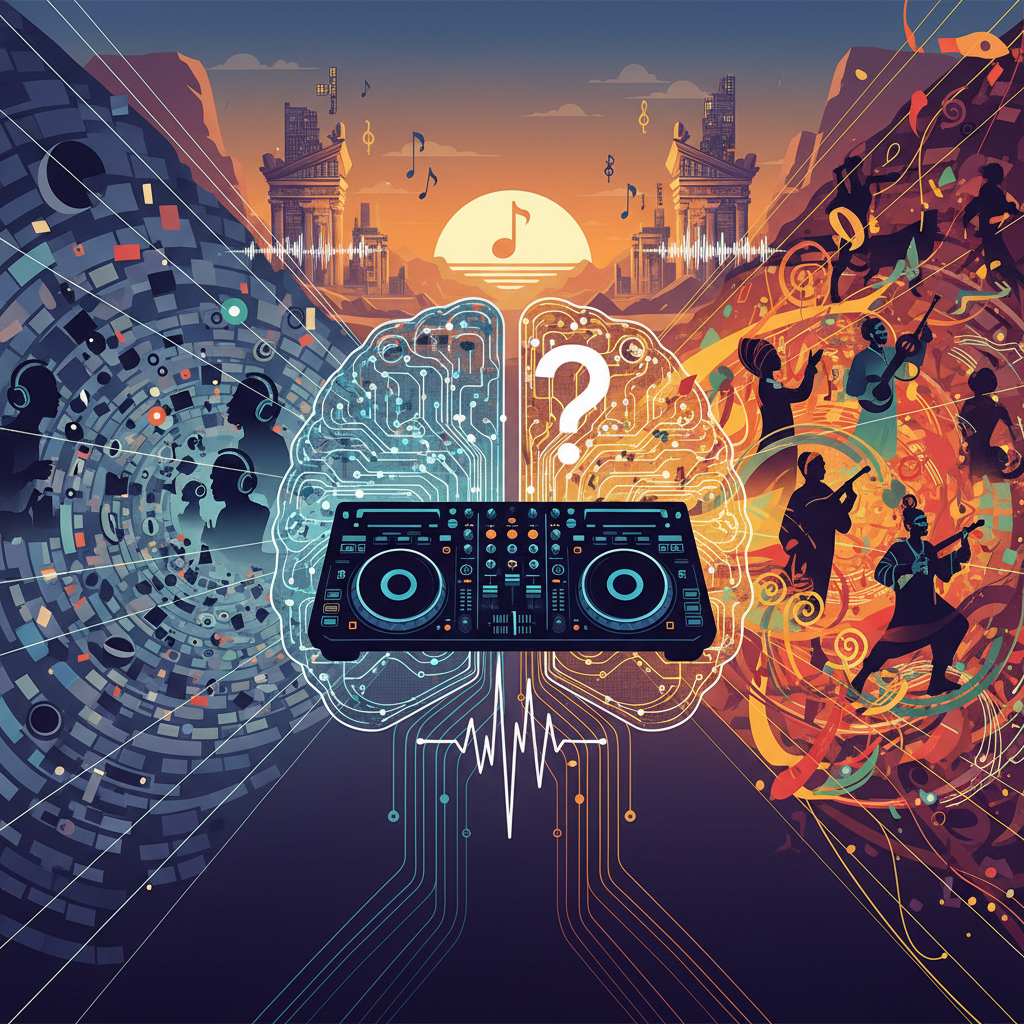
Consider the vast majority of music consumed globally on platforms like Spotify. It is overwhelmingly Western pop, hip hop, and rock. The algorithms are trained on this massive dataset, optimizing for engagement within these dominant genres. So, when an AI DJ is tasked with expanding your horizons, what 'horizons' is it truly looking at? Is it genuinely exploring the vibrant soundscapes of the Arab world, of Africa, of Asia, or is it merely shuffling through the deeper cuts of artists already popular in New York or London?
This is not a trivial concern. Music is culture, it is identity, it is history. For centuries, our music, from the intricate maqams of Arabic classical music to the energetic dabke rhythms, has been passed down, evolving, and thriving. Now, the gatekeepers of global music discovery are algorithms designed in California. MIT Technology Review has extensively covered the biases inherent in AI models, and music is no exception. If the training data lacks adequate representation of diverse musical traditions, the AI will inevitably perpetuate that imbalance.
I spoke with Dr. Lena Al-Hassan, a ethnomusicologist at the University of Jordan. She put it plainly: “The danger is not that these algorithms are bad, but that they are too good at what they are designed to do: optimize for what is already popular. This creates a feedback loop that marginalizes niche genres, especially those from non-Western cultures. Our rich musical heritage risks being relegated to an algorithmic footnote, if it is even acknowledged at all.” Her concern echoes a sentiment I hear often in cultural circles here. The West has it backwards sometimes, assuming their cultural products are universal defaults, rather than just one flavor among many.
Spotify claims its personalization engine is constantly evolving, learning from user feedback and expanding its musical palate. They point to features that allow users to explore global charts and curated playlists. However, the core AI DJ experience is designed for passive consumption, where the user surrenders control to the algorithm. How many users will actively seek out a 'Moroccan Gnawa' playlist when their AI DJ is busy serving up the latest from Taylor Swift or Drake, artists with significantly more data points for the algorithm to chew on?
This is where Jordan's approach makes more sense than Silicon Valley's. Here, music discovery is often a communal, human experience. We share music at family gatherings, through local radio stations, and in the bustling souks. It is about connection, not just consumption. My cousin might introduce me to a new Syrian artist, or my neighbor might play a captivating Iraqi melody. This organic, human-driven discovery is profoundly different from an AI that analyzes my listening history to predict my next 'like.' The human element introduces serendipity, cultural exchange, and a genuine appreciation for novelty that an algorithm, no matter how sophisticated, struggles to replicate.
An unpopular opinion from Amman: the true revolution in music discovery will not come from an AI DJ that tells you what you already like, or what it thinks you should like based on what others like. It will come from platforms that actively prioritize and amplify underrepresented voices, that build bridges between cultures, not just deeper trenches within existing ones. Imagine an AI that is specifically trained on the vast archives of regional music, that actively seeks to introduce you to a Palestinian folk singer or a Yemeni oud master, not as an exotic curiosity, but as a legitimate, beautiful part of the global musical tapestry. That would be a true innovation.
We are not asking for the exclusion of popular Western music. We are asking for inclusion, for balance, for a recognition that the world's musical wealth extends far beyond the top 40. Spotify, with its immense resources and global reach, has the potential to be a powerful force for cultural exchange. But it must consciously choose to be so. It must invest in diverse datasets, employ culturally sensitive data scientists, and actively promote non-Western artists, rather than waiting for the algorithms to 'discover' them on their own, which they may never do if the initial bias is too strong.
Consider the words of Daniel Ek, Spotify’s CEO, who has often spoken about the platform’s mission to unlock the world’s creative potential. If that mission is to be truly realized, it cannot be limited by the confines of Western data. It must embrace the entirety of human creativity. As The Verge reported, the development of these AI tools is ongoing, and there is still time for course correction. This is not just about music; it is about cultural representation and the digital future of global artistry.
My challenge to Spotify, and to all tech companies building these powerful personalization engines, is this: look beyond your Silicon Valley echo chambers. Engage with the rich, diverse musical traditions of the world. Build algorithms that are not just efficient, but equitable. Until then, my AI DJ will remain a human one, a friend sharing a new track from Beirut, or a local musician playing a soulful tune in a café in downtown Amman. That is where true discovery, and true connection, still lies.