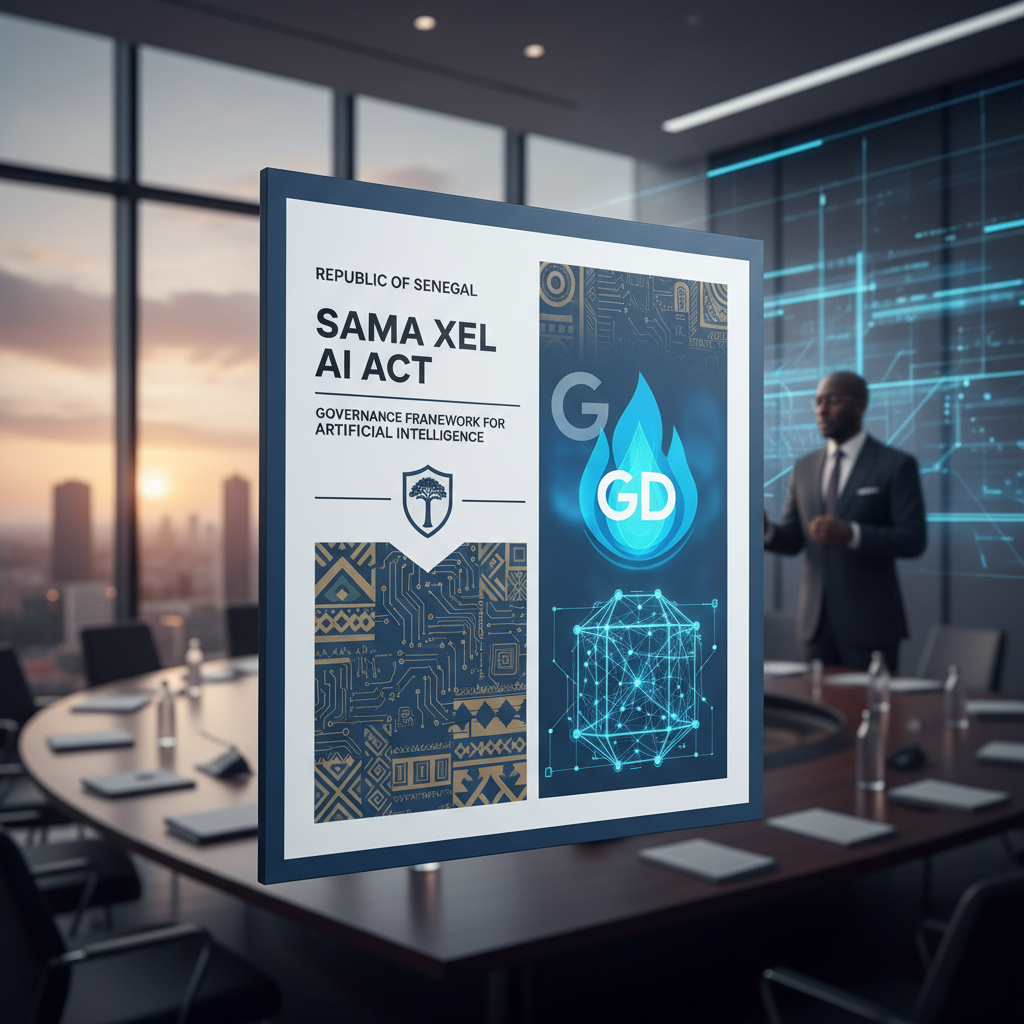
The digital winds of change, often originating from distant Silicon Valley, invariably reach the shores of Dakar. Yet, when the conversation shifts to artificial intelligence, particularly the recent breakthroughs in AI reasoning that promise architectures going beyond simple pattern matching, Senegal is not merely a passive recipient. Our nation, through its proposed 'Sama Xel' AI Act, is attempting to assert a proactive, distinctly African vision for governance. This is not just about data, it is about the very mechanisms of thought that these new machines are beginning to emulate.
The policy move, formally known as the Loi sur l'Intelligence Artificielle et la Souveraineté Numérique du Sénégal, or 'Sama Xel' Act, meaning 'My Mind' in Wolof, was unveiled in March 2026. Its primary objective is to establish a robust regulatory environment for AI systems, with a particular emphasis on those exhibiting advanced reasoning capabilities. The Act mandates transparency in algorithmic design, accountability for AI-driven decisions, and the establishment of a national AI ethics committee with significant civil society representation. Crucially, it seeks to differentiate between AI systems that merely process data and those that demonstrate emergent reasoning, applying stricter oversight to the latter. This distinction is paramount, as the new architectures from entities like Google DeepMind and Anthropic are moving beyond statistical correlations to something more akin to cognitive processes.
Behind this ambitious legislative push are several key players. My sources tell me that the initial impetus came from a coalition of Senegalese academics and legal experts, deeply concerned by the rapid, unregulated deployment of AI tools across various sectors. Dr. Aïcha Diop, a leading computational linguist at Cheikh Anta Diop University in Dakar, has been a vocal proponent. "We cannot afford to be mere consumers of technology whose inner workings we do not understand, especially when that technology begins to reason and make decisions that impact our daily lives," Dr. Diop stated during a recent parliamentary hearing. "The 'Sama Xel' Act is our attempt to reclaim agency, to ensure that AI serves our development goals, not dictates them." The government, under President Macky Sall's administration, has embraced this initiative, seeing it as an opportunity to position Senegal as a leader in ethical AI governance on the continent. This move also aligns with broader African Union aspirations for digital sovereignty, a topic I have explored in previous investigations.
What this means in practice for companies operating in Senegal is significant. Any AI system deployed within the country that utilizes architectures deemed to possess advanced reasoning capabilities will be subject to stringent pre-market assessments. These assessments will evaluate not only data privacy and bias, which are common concerns, but also the system's decision-making logic, its potential for autonomous action, and its alignment with Senegalese cultural values and legal norms. For instance, an AI designed for agricultural yield prediction, if it incorporates advanced causal reasoning to suggest new farming methods, would fall under stricter scrutiny than a simple pattern-matching system. The Act also proposes a 'sandbox' environment for testing these advanced AI systems, allowing for controlled deployment and continuous monitoring by a newly formed 'Autorité Sénégalaise de Régulation de l'Intelligence Artificielle' or Aria.
The industry reaction has been, predictably, mixed. Global tech giants, accustomed to operating with minimal regulatory friction in many African markets, are expressing concerns. A representative from Google Africa, speaking anonymously due to ongoing negotiations, voiced apprehension. "While we appreciate Senegal's commitment to responsible AI, the proposed framework introduces complexities that could hinder innovation and investment," they remarked. "Differentiating between 'pattern matching' and 'reasoning' in a legal text is a monumental task, potentially creating a moving target for compliance." Conversely, smaller, local AI startups, often struggling to compete with the vast resources of international players, see this as a potential equalizer. "This Act forces everyone to play by the same rules, and those rules prioritize our people and our context," said Mansour Faye, CEO of 'Jamm AI', a Senegalese startup developing AI solutions for public health. "It creates a level playing field where ethical design is a competitive advantage, not a burden." Indeed, the financial implications of compliance could be substantial, potentially deterring some foreign investment in the short term, but also fostering a more robust, locally-attuned AI ecosystem in the long run.
Civil society organizations, particularly those focused on human rights and digital inclusion, have largely welcomed the 'Sama Xel' Act, albeit with a cautious optimism. "This is just the tip of the iceberg, but it is a crucial first step," commented Fatou Diallo, Director of the 'Digital Rights Senegal' advocacy group. "The devil, as always, will be in the details of implementation. We need to ensure that Aria is truly independent, adequately funded, and empowered to hold powerful tech entities accountable. The inclusion of civil society voices on the ethics committee is promising, but their recommendations must carry real weight." Diallo also highlighted the importance of public education campaigns to ensure that ordinary citizens understand their rights in an AI-driven world, preventing a digital divide not just in access, but in understanding and control.
Will it work? The success of the 'Sama Xel' Act hinges on several critical factors. Firstly, the technical capacity of Aria to accurately assess and regulate complex, rapidly evolving AI architectures from companies like OpenAI and Anthropic. This requires significant investment in local expertise and continuous training. Secondly, the political will to enforce the regulations against powerful corporate interests, both domestic and international. The documents reveal that lobbying efforts from major tech firms have already begun, seeking to soften some of the Act's more stringent provisions. Thirdly, and perhaps most importantly, the ability of Senegal to collaborate with other African nations to create a unified front. A fragmented regulatory landscape across the continent would allow companies to simply move their operations to less regulated jurisdictions, undermining the spirit of 'Sama Xel'.
Senegal's bold move is a testament to a growing realization across Africa: that digital transformation must be guided by local values and priorities, not solely by the imperatives of global tech capital. As AI systems gain increasingly sophisticated reasoning abilities, the stakes become immeasurably higher. The 'Sama Xel' Act is more than just a piece of legislation; it is a declaration of digital sovereignty, a bid to ensure that the future of intelligence, artificial or otherwise, remains firmly rooted in the human experience, particularly the Senegalese experience. The world, and indeed Silicon Valley, will be watching closely to see if Dakar can truly tame the advanced reasoning capabilities now emerging from the labs of the global north. For more insights into global AI policy, you can explore reports from MIT Technology Review. For broader tech news, TechCrunch often covers these developments. The challenge is immense, but the resolve, it seems, is equally so. The path ahead is uncertain, but Senegal is charting its own course, guided by its own mind, its 'Sama Xel'.