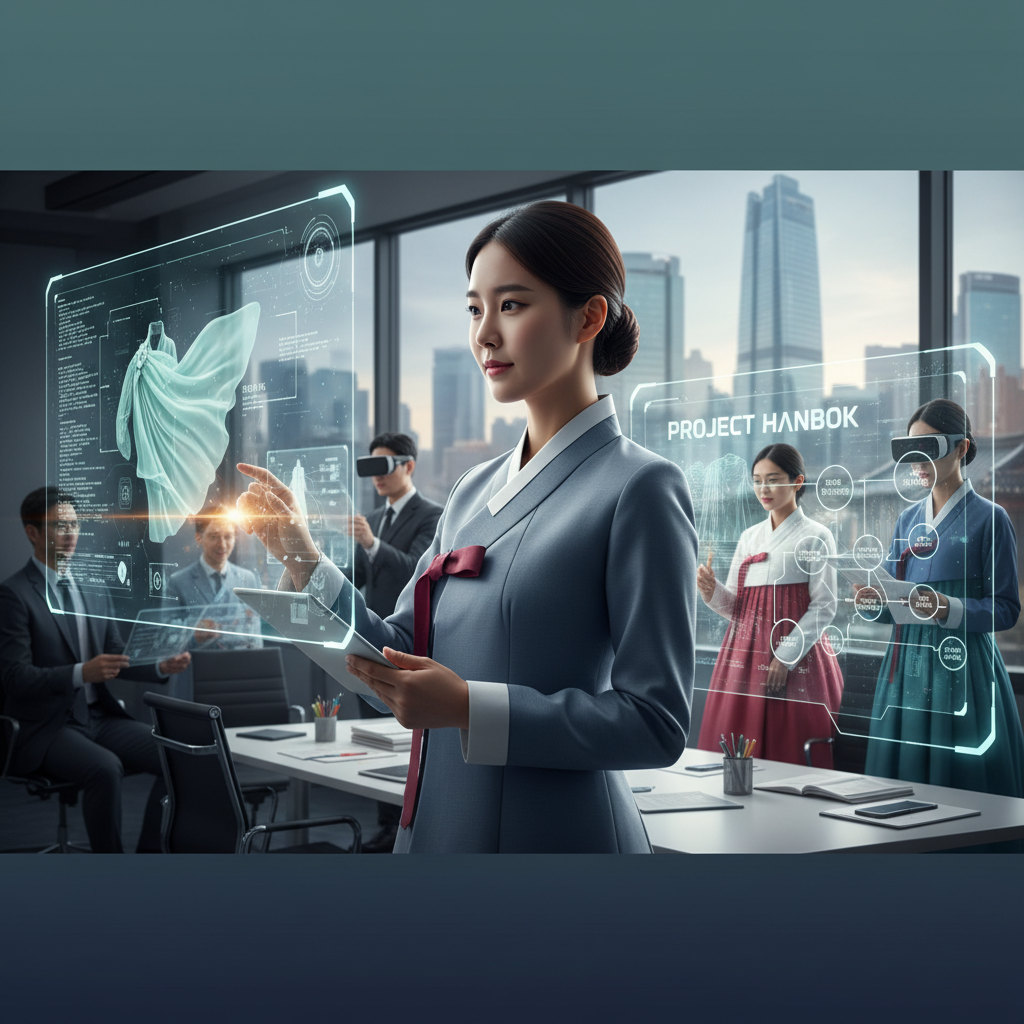

The fluorescent lights of the design studio at Hanbok-eun Sarang, a mid-sized traditional Korean apparel company in Seoul, hummed with an unfamiliar tension. Ms. Kim Min-seo, a pattern maker with two decades of experience, stared at the holographic display projecting a hanbok design. It was beautiful, undeniably, yet unsettlingly perfect. The AI, a system developed in collaboration with Samsung SDS and powered by NVIDIA's latest GPUs, had generated it in seconds, incorporating data from global fashion weeks, social media sentiment, and historical Korean textile patterns. Ms. Kim felt a chill, not from the air conditioning, but from the realization that her intuition, her very craft, was now being quantified and, perhaps, superseded by algorithms. This scene, replicated across South Korea's vibrant fashion sector, encapsulates the profound disruption and opportunity presented by artificial intelligence.
South Korea, a nation where technological adoption often outpaces global averages, is rapidly integrating AI into its fashion industry. From the bustling markets of Dongdaemun to the luxury boutiques of Gangnam, the impact is undeniable. Data from the Korea Institute of Industrial Technology, published in late 2025, indicates that 68% of major South Korean fashion houses have already implemented AI solutions for at least one aspect of their operations, a significant jump from 22% just two years prior. This rapid embrace is driven by tangible benefits: a reported 15% reduction in design cycle times, a 10% decrease in material waste due to more accurate demand forecasting, and a 20% uplift in online conversion rates through enhanced customer experiences. The return on investment, or ROI, for these early adopters is compelling, averaging 2.5x within 18 months for comprehensive AI suites.
Here's the technical breakdown of how this transformation is unfolding. Trend prediction, once a subjective art guided by human intuition and market research, is now a data science. Companies like Kolon Fashion and E-Land Group are leveraging large language models, often fine-tuned versions of OpenAI's GPT or Google's Gemini, trained on vast datasets of imagery, sales figures, and cultural events. These models can identify nascent trends with astonishing accuracy, predicting color palettes, silhouettes, and fabric preferences months in advance. This allows for proactive rather than reactive design, minimizing unsold inventory and maximizing seasonal relevance. "Our AI can sift through billions of data points in a fraction of the time it would take a human team, identifying micro-trends that would otherwise be missed," explains Dr. Lee Ji-hoon, Head of AI Innovation at Kolon Fashion. "This isn't replacing creativity; it's augmenting it with unparalleled insight."
Virtual try-on technologies represent another frontier. Imagine trying on an entire wardrobe from your living room. Companies like Musinsa, a leading Korean online fashion retailer, have integrated advanced augmented reality and 3D modeling platforms, allowing customers to visualize garments on their personalized avatars. This has been particularly impactful for Gen Z consumers, who prioritize convenience and digital interaction. A recent study by the Korea Chamber of Commerce and Industry found that virtual try-on features led to a 25% reduction in product returns for online fashion retailers, a critical metric for profitability and sustainability. The Korean approach to AI is fundamentally different in its emphasis on hyper-realistic visual fidelity, often drawing on Samsung's expertise in display technology and image processing to create seamless, immersive experiences.
Perhaps the most profound impact is on sustainable design. The fashion industry is notoriously resource-intensive, but AI offers a path toward a greener future. Algorithms can optimize fabric cutting patterns to minimize waste, recommend eco-friendly materials based on supply chain data, and even design garments with modular components for easier recycling. For instance, Hyosung TNC, a major textile manufacturer, is using AI to analyze textile waste streams and develop new recycled fibers, a process that used to be largely manual and inefficient. "Our goal is a circular economy for fashion," states Ms. Park Seo-yeon, Chief Sustainability Officer at Hyosung TNC. "AI is not just a tool for efficiency; it is an indispensable partner in achieving true environmental stewardship."
This shift, however, creates winners and losers. Large conglomerates like Samsung C&T Fashion Group and LG Fashion, with their substantial R&D budgets and access to cutting-edge hardware, are rapidly consolidating their market positions. Their ability to invest in bespoke AI platforms and talent gives them a distinct advantage. Smaller, traditional businesses, like Hanbok-eun Sarang, face the daunting challenge of adaptation. Those that embrace AI, often through partnerships with tech firms or by adopting accessible cloud-based solutions from providers like Google Cloud or Microsoft Azure, are finding new avenues for growth. Those that resist risk obsolescence, unable to compete on speed, cost, or personalized customer experience.
Worker perspectives are, naturally, varied and complex. For designers, pattern makers, and merchandisers, there is a palpable sense of anxiety mixed with opportunity. Ms. Kim Min-seo, the pattern maker, initially felt threatened. "I spent years honing my eye, my touch, and now a machine can do it faster," she confided. However, after undergoing retraining programs provided by her company, she now works alongside the AI, refining its suggestions and injecting the human element of cultural nuance that algorithms still struggle to fully grasp. "It's like having a super-efficient assistant," she now says, "It frees me to focus on the truly creative aspects, the storytelling within the fabric." Data from the Ministry of Employment and Labor shows that while 12% of traditional design roles have been automated, 18% of new roles, such as 'AI Fashion Stylist' and 'Algorithmic Textile Engineer', have emerged, requiring a blend of creative and technical skills. This indicates a transformation of work, rather than outright elimination, a pattern observed across many sectors in South Korea.
Expert analysis suggests this is merely the beginning. Dr. Choi Eun-jung, a professor of fashion technology at Seoul National University, notes, "The next wave will involve generative AI not just for design, but for entire brand identities and marketing campaigns. We are moving towards a truly autonomous fashion ecosystem." She predicts that within five years, over 90% of fashion companies in South Korea will be utilizing AI for trend forecasting, and virtual try-on will become a standard, not a novelty. MIT Technology Review has extensively covered similar trends in other global markets, underscoring the universal nature of this technological shift.
Looking ahead, the integration of 6G connectivity, championed by Korean telecommunications giants, will further enhance the real-time capabilities of AI in fashion, enabling instantaneous feedback loops from consumers to designers. Imagine smart garments embedded with sensors that provide data on wear patterns and preferences, feeding directly into the next season's designs. This level of data integration, combined with advanced material science, promises a future where fashion is not only personalized and sustainable but also deeply responsive to individual and collective needs. Samsung's latest move reveals a deeper strategy, not just in consumer electronics, but in orchestrating the entire digital lifestyle, with fashion as a key pillar.
While the initial scenes in design studios may have been tinged with apprehension, the trajectory is clear. AI is not just a tool for efficiency in the Korean fashion industry; it is a fundamental rethinking of how clothes are designed, produced, sold, and consumed. The challenge, and the opportunity, lies in ensuring this technological leap benefits all stakeholders, from the global conglomerates to the individual artisan, preserving the rich cultural heritage while embracing the innovative future. For South Korea, a nation that has consistently demonstrated its capacity for rapid technological evolution, the AI fashion revolution is another chapter in its ongoing narrative of progress. For more insights into how AI is transforming various industries, explore our Enterprise AI [blocked] coverage.