
The hand-wringing from Western educators over AI chatbots in schools has been nothing short of theatrical. They scream 'cheating crisis' while their students, armed with ChatGPT and Google Gemini, are already halfway to mastering prompt engineering. It is a predictable, almost quaint, panic. Here in Seoul, however, we have a different answer. We are not just debating AI's place in the classroom; we are actively redefining it, often with a pragmatic, almost ruthless, efficiency that would make Silicon Valley blush.
For months, the global narrative has been dominated by fears that large language models, or LLMs, would spell the end of academic integrity. Teachers in the United States and Europe reported students submitting AI-generated essays, leading to widespread bans and a frantic scramble for detection software. But honestly, who was surprised? When you give a teenager a powerful tool that can write an essay in seconds, expecting them not to use it is like expecting a K-pop idol to ignore a fan cam. It is simply not in their nature.
What these hand-wringers fail to grasp is that the conversation has already moved on. The question is no longer if students will use AI, but how they will use it, and more importantly, how educators will adapt. And this is where South Korea is, perhaps controversially, leading the charge. Our education system, often criticized for its intense focus on rote learning and high-stakes exams, is now grappling with AI in a way that could either liberate or further entrench its competitive pressures.
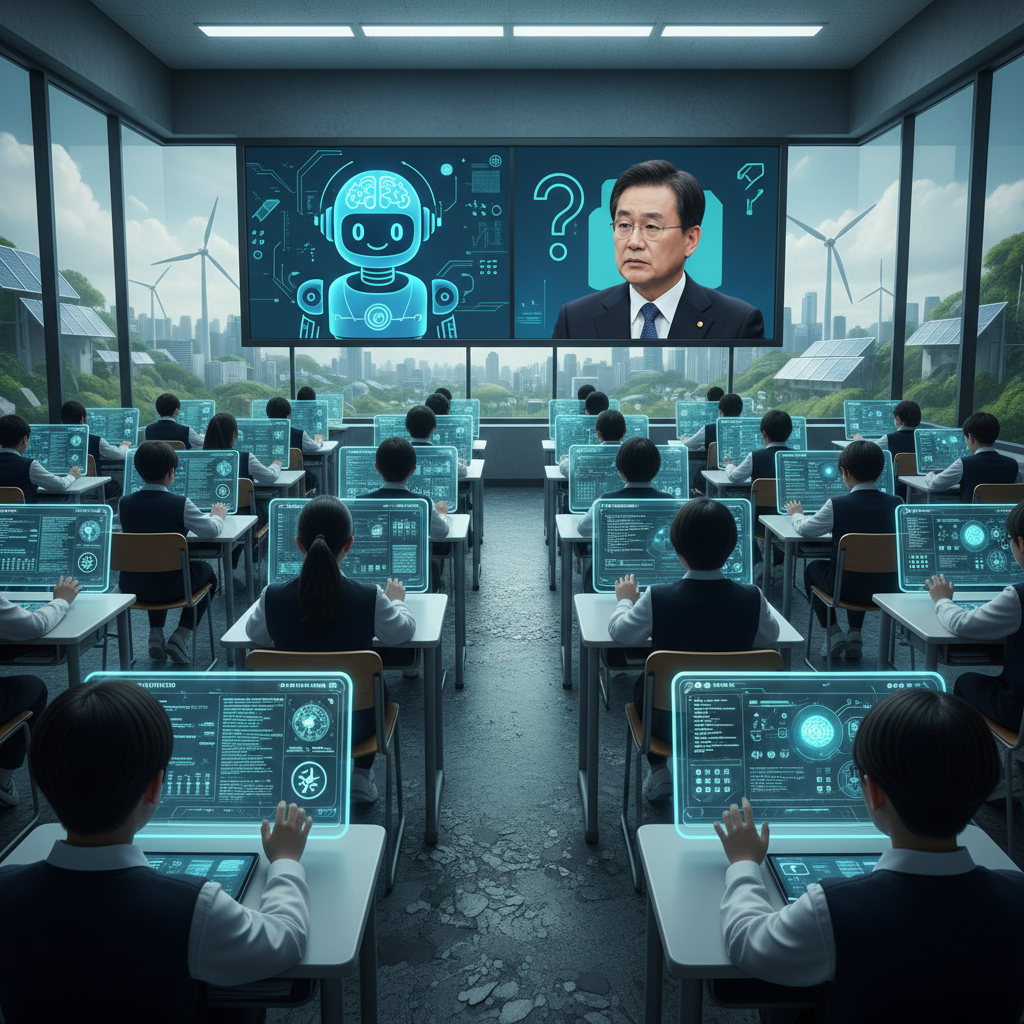
Consider the initiatives spearheaded by giants like Samsung. They are not just selling devices; they are integrating AI-powered learning platforms directly into our schools. Imagine a classroom where every student has a Samsung tablet, not just for browsing, but for interacting with an AI tutor that adapts to their learning style, provides instant feedback on complex problems, and even generates personalized study materials. This is not some distant future; it is happening now in pilot programs across the country. The potential for individualized learning is immense, promising to address the vast disparities that often plague traditional classroom settings.
Education Minister Lee Ju-ho, a figure known for his progressive stance on technology in education, recently articulated this vision. "We cannot afford to view AI as merely a tool for cheating," he stated in a recent press conference. "It is a fundamental shift in how knowledge is accessed, processed, and created. Our role is to guide our students to harness this power responsibly and creatively, not to suppress it." His words echo a sentiment that is gaining traction among forward-thinking educators here: embracing AI is not optional; it is essential for preparing students for a world where AI proficiency will be as crucial as literacy.
Yet, the challenges are formidable. The very structure of our education system, with its relentless focus on standardized testing, seems at odds with AI's potential for creative exploration. If an AI can write a perfect essay, what does that mean for the skill of essay writing? If an AI can solve complex math problems, what value does it leave for human computation? These are not trivial questions, and the answers are far from clear. The fear is that AI will not just facilitate cheating, but fundamentally erode the very skills we deem essential for critical thought and problem-solving.
Dr. Kim Min-jung, a leading researcher in educational technology at Kaist, offers a nuanced perspective. "The traditional model of assessment is broken in the age of AI," she explained in a recent interview with a local tech journal. "We need to move beyond memorization and towards evaluating higher-order thinking skills: critical analysis, synthesis, ethical reasoning, and the ability to effectively collaborate with AI as a partner." This shift, she argues, requires a complete overhaul of curricula and pedagogical approaches, a task that is far easier said than done in a system as entrenched as South Korea's.
Indeed, the K-wave is coming for AI too, and it is reshaping not just our entertainment and tech industries, but also our classrooms. Companies like Naver, with its HyperCLOVA X, are developing localized LLMs tailored to the Korean language and cultural context, offering a distinct alternative to global models like OpenAI's GPT series or Google's Gemini. These localized AIs are being explored for their potential to provide more culturally relevant educational content and support, further embedding AI into the fabric of our learning environments.
But let us not be naive. The integration of AI into education is not without its dark side. The digital divide, already a significant concern, could widen dramatically. Students with access to the latest AI tools and high-speed internet will have an undeniable advantage over those without. Furthermore, the ethical implications of AI in education are still largely unexplored. Who owns the data generated by student interactions with AI tutors? How do we ensure fairness and prevent algorithmic bias in personalized learning pathways? These are questions that demand immediate and thoughtful answers.
My take? Everyone's wrong about this if they think AI is just a cheating tool. It is a fundamental shift, a tectonic plate moving beneath the foundations of education. The real crisis is not that students will cheat, but that we will fail to equip them with the skills to navigate an AI-saturated world. We need to teach them how to use AI, when to use it, and critically, when not to. We need to foster a new kind of literacy, one that understands the capabilities and limitations of these powerful algorithms.
South Korea, with its blend of technological prowess and deeply ingrained educational values, is uniquely positioned to either lead this revolution or fall prey to its pitfalls. The path forward is not to ban AI, but to integrate it intelligently, ethically, and purposefully. We must push our educators, our policymakers, and our tech companies to collaborate on creating a future where AI enhances human potential, rather than diminishes it. Otherwise, we risk raising a generation that can generate perfect essays but cannot think for themselves. That, to me, is the real cheating crisis. The stakes are too high to simply bury our heads in the sand and pretend these tools do not exist. The future of learning, and indeed, the future of our society, depends on how we answer this challenge. For more insights on how AI is transforming various sectors, you can always check out Reuters' technology section. We are just at the beginning of this journey, and the ride will be bumpy, but ignoring it is not an option. For a deeper dive into AI research, MIT Technology Review often provides excellent analysis.